A homeowner replacing drafty windows often starts with a simple question: “Which ENERGY STAR model should I buy?” The answer depends on where the home is located, how much heat the glass admits, and how effectively the complete window resists heat flow. A product that performs well in Minnesota may be poorly matched to a cooling-dominated home in Texas.
The practical goal is to match the window's U-factor and Solar Heat Gain Coefficient, or SHGC, to the correct climate zone, then verify the product's certification and any incentive eligibility. That approach supports broader Home energy efficiency planning instead of treating windows as an isolated purchase.
Table of Contents
- Introduction to ENERGY STAR Windows Requirements
- ENERGY STAR Windows History and Evolution
- Understanding U-factor and SHGC Metrics
- ENERGY STAR Requirements by Climate Zone
- Certification Process and Tax Credit Path
- Real-World Examples of ENERGY STAR Compliant Windows
- Checklist for Specifying ENERGY STAR Windows
- Conclusion and Next Steps
Introduction to ENERGY STAR Windows Requirements
ENERGY STAR windows matter because glass and frames form part of the building envelope. They influence how quickly indoor heat escapes during cold weather and how much outdoor solar heat enters during hot weather. A label alone doesn't tell you whether a product is appropriate for every location.
The program uses regional requirements because heating and cooling priorities change by climate. Cold-climate windows generally need stronger resistance to heat loss, while warm-climate windows must control unwanted solar gain. One national window specification would force the same trade-offs on homes facing very different conditions.
Before ordering, identify the installation zone, read the NFRC label, compare U-factor and SHGC with the applicable ENERGY STAR criteria, and then check whether the product meets the separate Most Efficient requirements for a federal tax credit. That sequence prevents two common mistakes, choosing a window designed for another region and assuming every ENERGY STAR-labeled product qualifies for an incentive.
ENERGY STAR Windows History and Evolution
ENERGY STAR added windows, doors, skylights, and roof products as product categories in 1998, according to the program's official ENERGY STAR history. Residential windows, doors, and skylights were originally scheduled to qualify under the label in March of that year.
The next major step came on May 28, 2003, when the U.S. Department of Energy announced a formal specification for windows, doors, and skylights. It took effect on September 29, 2003 and established four climate zones. That decision recognized a practical fact: a window's performance target must account for regional winter heat loss and summer solar gain.
The requirements continued to change as window technology and building priorities developed. By Version 6.0, the Northern Zone prescriptive U-factor criterion had tightened to ≤ 0.27, with that requirement effective January 1, 2016, as documented in the same ENERGY STAR history record.
A useful way to read that timeline is as a shift from a broad label to a more precise performance framework:
- 1998: Windows became an ENERGY STAR product category.
- 2003: Formal specifications and four climate zones established regional criteria.
- 2016: Version 6.0 tightened the Northern prescriptive U-factor requirement.
- Version 7.0: The program introduced stricter, zone-specific thresholds.
The label has therefore evolved for more than two decades. It doesn't stop at identifying a “good” window. It identifies a product tested against requirements that reflect the demands of a particular climate.
The following video offers another visual explanation of window performance and energy considerations.
Understanding U-factor and SHGC Metrics
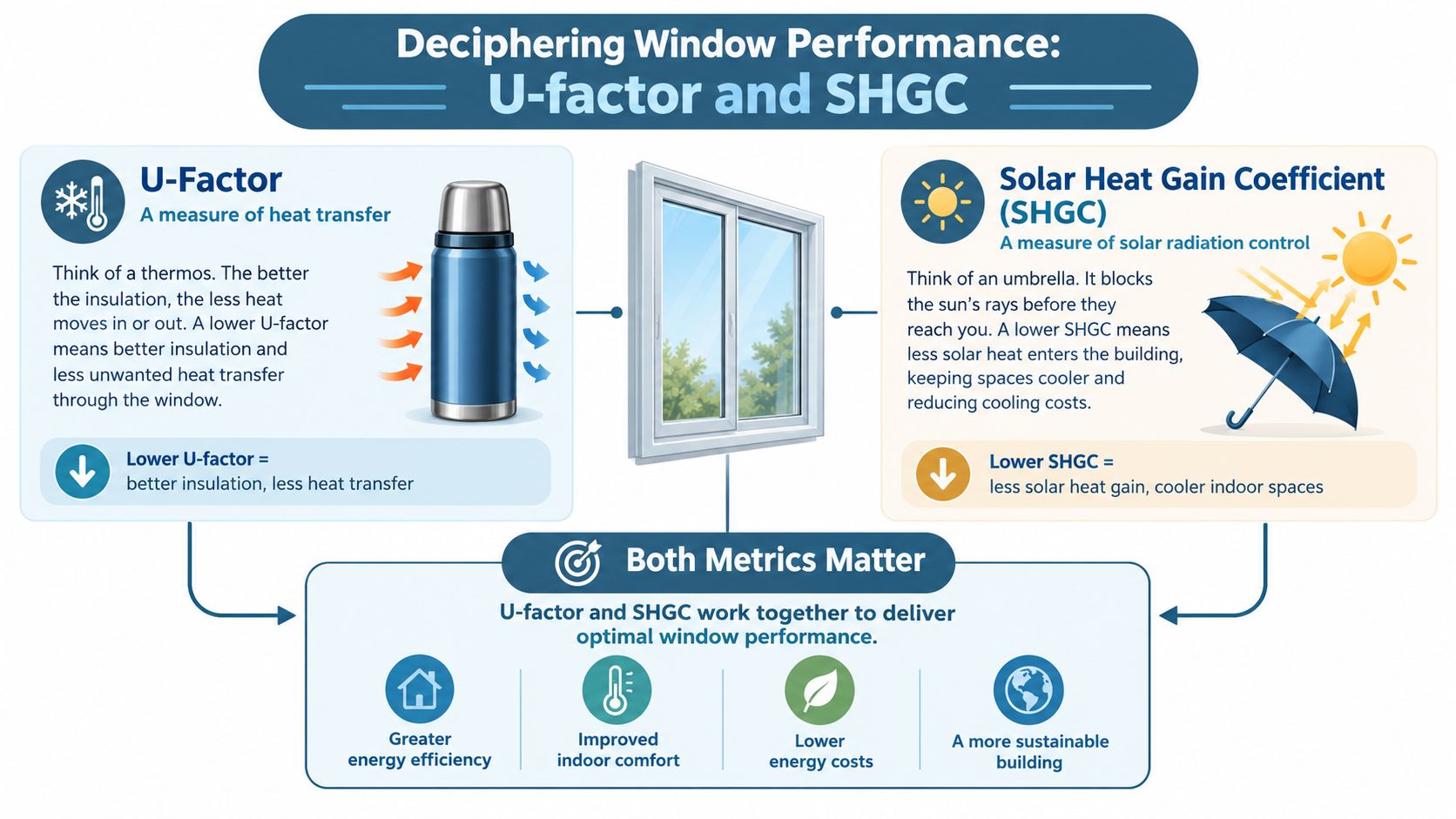
Two ratings control most of the ENERGY STAR window conversation: U-factor and Solar Heat Gain Coefficient, or SHGC. The ENERGY STAR Version 7.0 specification identifies U-factor as a measure of heat flow and SHGC as a measure of solar radiation entering the building.
U-factor measures heat transfer
Think of U-factor as the insulation rating of a thermos, except the number works in the opposite direction from the insulation value many people know. A lower U-factor means less heat passes through the window. In winter, that helps slow the movement of indoor heat toward the colder outdoors. In a hot climate, it can also reduce heat transfer from the exterior toward the interior.
The rating applies to the tested window assembly, not just a loose pane of glass. Glazing layers, low-emissivity coatings, gas-filled spaces, spacers, sashes, and frame materials all influence the result. A highly insulated glass package can lose some of its advantage if the frame conducts heat readily, which is why the NFRC whole-window rating matters.
For a deeper comparison between thermal transmission and other insulation measurements, see this guide to U-factor versus R-value.
SHGC controls solar admission
SHGC is easier to visualize as an umbrella. A low SHGC blocks more of the sun's heat before it reaches the room, which helps reduce cooling demand. A higher SHGC admits more solar heat, which can be useful in a cold climate where winter sun contributes to indoor warmth.
Glass coatings and tints are central to SHGC. A low-solar-gain coating can limit heat from direct sunlight, while a different coating package can admit more solar energy. Frame material still matters for the overall window, but SHGC is especially sensitive to the glazing design.
Practical rule: Don't choose the lowest available SHGC automatically. Choose the value that fits the building's climate, orientation, shading, and heating or cooling priorities.
A cold northern home may benefit from a low U-factor paired with a relatively higher SHGC. A sunny southern home usually needs strong solar control, even if its baseline U-factor requirement is less demanding than a northern one. That distinction explains why U-factor and SHGC must be evaluated together, rather than treated as interchangeable scores.
ENERGY STAR Requirements by Climate Zone
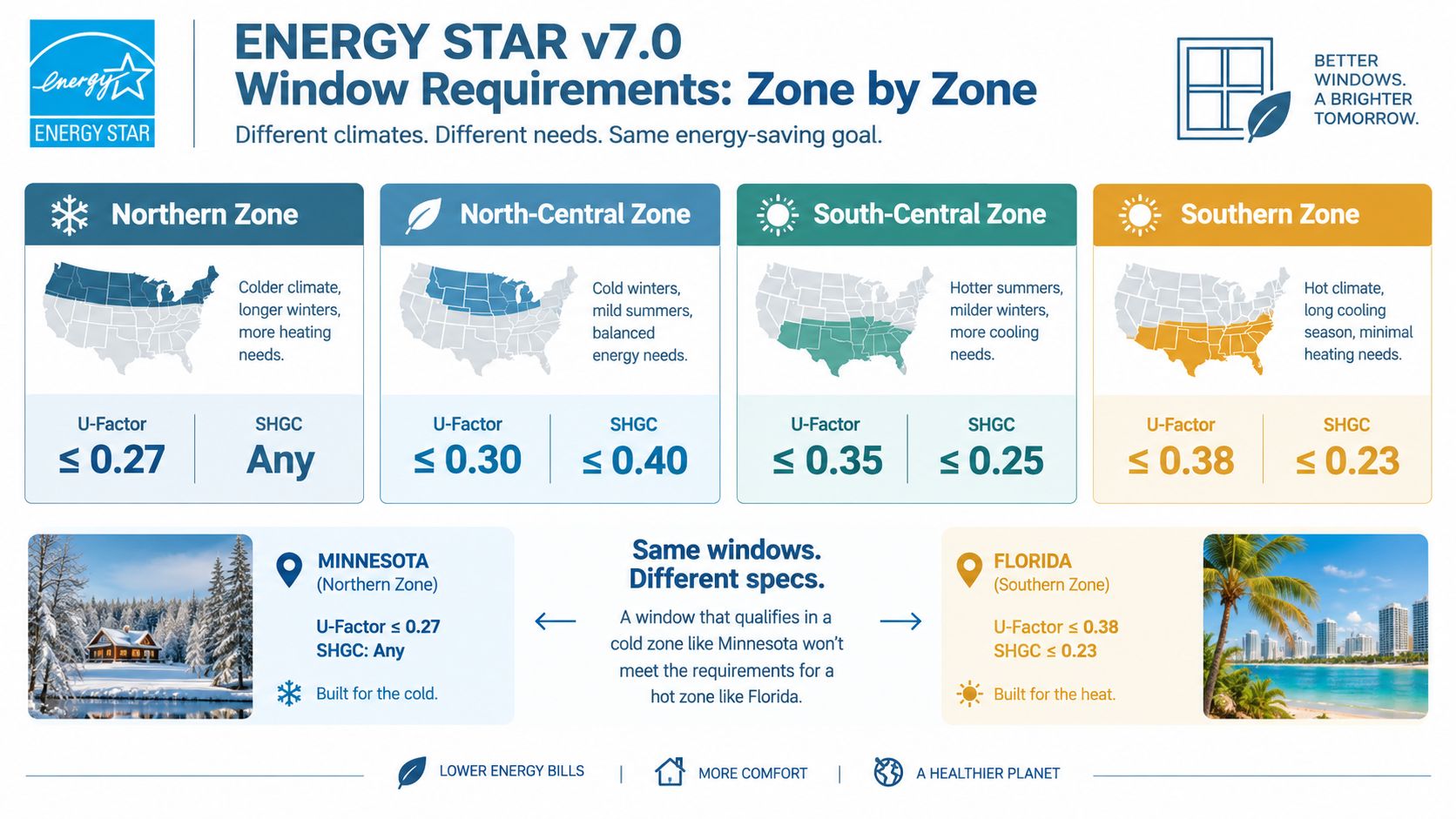
Version 7.0 became effective on October 23, 2023 and uses different performance thresholds across four climate zones. The requirements are mapped to IECC climate regions, so the correct product depends on the project's installation geography rather than the manufacturer's location or the homeowner's preferred window style. The current thresholds are documented in the ENERGY STAR guidance for residential new homes.
| Climate zone | Maximum U-factor | SHGC requirement |
|---|---|---|
| Northern | ≤ 0.22 | ≥ 0.17 |
| North-Central | ≤ 0.25 | ≤ 0.40 |
| South-Central | ≤ 0.28 | ≤ 0.23 |
| Southern | ≤ 0.32 | ≤ 0.23 |
The Northern requirement shows the strongest emphasis on insulating performance. Its U-factor limit is ≤ 0.22, and the SHGC floor of ≥ 0.17 allows the window to admit a meaningful amount of solar heat. A product designed for a cold location therefore balances two goals, slowing heat loss while preserving useful winter solar gain.
North-Central windows allow a U-factor of ≤ 0.25 and an SHGC of ≤ 0.40. The South-Central zone shifts further toward cooling control, with U-factor ≤ 0.28 and SHGC ≤ 0.23. Southern windows may meet the baseline with U-factor ≤ 0.32, but they still face the SHGC ceiling of ≤ 0.23.
Why Texas specifications differ
Much of Texas falls within South-Central or Southern climate zones. A Houston-oriented product and a window specified for a colder northern market shouldn't be treated as equivalent because both carry an efficiency label.
For Texas projects, low-solar-gain glass, coatings, and the frame-glass combination deserve careful review. The regional trade-off is clear: the window can have a comparatively moderate U-factor, but it must control solar heat tightly. Homeowners planning Texas window replacement should ask the supplier to identify the applicable zone and show the NFRC values for the exact product configuration.
The program also offers alternative performance pathways in some zones. Those paths can permit U-factor values around 0.23 to 0.26 when paired with different SHGC values, so the prescriptive table isn't the only possible route. The manufacturer or designer must confirm which compliance path applies to the specific product and project.

Certification Process and Tax Credit Path
A window's performance claim depends on documented testing, not on a sales description. The National Fenestration Rating Council, or NFRC, provides the certified ratings used to identify the window's U-factor and applicable SHGC. Buyers should compare the label for the exact model, glass package, spacer, frame, and operating style being ordered.
The baseline certification route
The process generally follows a straightforward sequence:
- NFRC rating: The manufacturer has the product configuration evaluated and receives certified performance values.
- ENERGY STAR review: The model is submitted for listing against the applicable climate-zone requirements.
- Product verification: The listed configuration remains tied to its tested performance values.
- Ongoing compliance: Manufacturers maintain the listing and address required testing or verification activity.
The standard label and the tax-credit path aren't the same. ENERGY STAR's residential windows, doors, and skylights requirements state that the core program requires an NFRC-certified U-factor and, where applicable, SHGC for the relevant climate zone.
The Most Efficient and 25C distinction
The federal 25C window tax credit requires a product to meet the ENERGY STAR Most Efficient criteria and appear in the NFRC Certified Product Directory. That means a window can carry the standard ENERGY STAR label without qualifying for the federal credit.
Most Efficient criteria are stricter than baseline Version 7.0 requirements. The 2025 Most Efficient criteria include example U-factor limits as low as ≤ 0.20, while SHGC thresholds range from ≤ 0.23 to ≤ 0.40 depending on climate zone, as shown in the ENERGY STAR product materials linked above.
A product label answers, “Does this model meet the program's climate-zone standard?” The directory check answers, “Does this exact configuration meet the incentive pathway?”
Before signing a contract, request the NFRC product listing and confirm the Most Efficient status for the exact model. Keep the certification record, invoice, product description, and installation documentation needed for the applicable tax filing. If you're comparing project economics, a practical window replacement return on investment review should separate ordinary efficiency benefits from incentive eligibility.

Real-World Examples of ENERGY STAR Compliant Windows
A specification becomes easier to understand when the climate trade-off is visible. Consider two hypothetical selection exercises, one for a Northern home and one for a South-Central Texas project. These examples illustrate how to reason from the requirements, not how to identify a particular brand or guarantee an incentive.
Northern selection
A builder in a Northern zone might compare a dual-pane vinyl window with a low U-factor and a higher solar-gain package. The target is a whole-window U-factor at or below 0.22, while the SHGC must be at least 0.17 under Version 7.0. The builder would review the NFRC label for the complete assembly, including the frame and glazing, rather than relying on the center-of-glass value.
The design logic is practical. Vinyl frames can limit conductive heat transfer, while insulated glazing and low-emissivity coatings help the assembly resist heat flow. A higher SHGC may allow useful sunlight into rooms that receive winter sun, although orientation, exterior shading, and occupant comfort still need attention.
South-Central Texas selection
A South-Central Texas project has a different priority. The Version 7.0 baseline permits U-factor up to 0.28, but SHGC must remain at or below 0.23, according to the ENERGY STAR residential window specification.
A low-solar-gain fiberglass window could fit that strategy when its complete NFRC-rated configuration meets the zone criteria. The coating and glass package become especially important because the window must reject much of the sun's heat while still providing the required insulation. A northern-style high-solar-gain package could create unnecessary cooling pressure in a sunny Texas room, even if its U-factor looks attractive.
Selection lesson: The right window isn't the one with the most impressive single rating. It's the assembly that satisfies the local U-factor and SHGC relationship.
Cost comparisons should include the complete product, installation, shading needs, documentation, and any verified incentive path. Buyers who want to boost confidence with Foundation can also treat clear window documentation as part of responsible project communication. For products and installation in Texas, Breaking Glass Co. supplies and installs window systems designed for regional conditions, while other qualified suppliers may provide comparable certified configurations.
Checklist for Specifying ENERGY STAR Windows
Use this checklist before approving a window order:
- Map the location: Identify the project's IECC climate region and corresponding ENERGY STAR zone.
- Read the NFRC label: Confirm the exact whole-window U-factor and SHGC for the ordered configuration.
- Compare thresholds: Check that the values meet the applicable Version 7.0 requirements, or the approved alternative pathway.
- Inspect the assembly: Review the frame, glazing layers, coatings, spacer, and gas-fill specification.
- Verify the label: Confirm the product's ENERGY STAR listing rather than relying only on a brochure.
- Check incentives separately: For the 25C path, verify ENERGY STAR Most Efficient status and the NFRC Certified Product Directory listing.
- Save records: Keep the product description, certification information, invoice, and installation documentation.
Ask the supplier to put the required U-factor and SHGC values directly into the project specification. That single step reduces confusion between a qualifying product, a higher-performing product, and a product that may qualify for a tax credit.
Conclusion and Next Steps
ENERGY STAR window requirements work best when treated as a matching exercise. First identify the climate zone. Then compare the complete window's U-factor and SHGC with the applicable Version 7.0 thresholds. Cold regions place more pressure on heat-loss control and may favor useful solar gain, while South-Central and Southern regions place stronger emphasis on limiting solar heat.
The ENERGY STAR label is also only the baseline checkpoint. If a federal tax credit matters, verify the stricter Most Efficient criteria and the product's listing in the NFRC Certified Product Directory. Don't assume that a familiar label automatically satisfies the incentive rules.
For a replacement or new-construction project, ask a certified installer or knowledgeable supplier to review the exact product configuration, orientation, shading conditions, and installation details. Use the checklist before ordering, and keep every document connected to the window model and its ratings.
Breaking Glass Co. can help homeowners, builders, and contractors compare ENERGY STAR window configurations for Texas and Southwest climates, coordinate measurements and installation, and arrange nationwide product shipping. Visit Breaking Glass Co. to request a quote specific to your project's climate zone and performance requirements.