
Most buyers are told to compare U-factor and R-value as if they're the same number in different clothes. That advice sounds tidy, but it breaks down fast when you're choosing a real window or door for a hot climate, where the whole assembly matters more than a converted label.
If you're shopping for windows, doors, or replacement packages, the important question isn't which formula is easier to remember. It's which rating reflects the actual unit sitting in your wall, with its frame, spacers, seals, and glass all working together.
| Criteria | U-Factor | R-Value |
|---|---|---|
| What it measures | Rate of heat transfer through the entire window or door assembly | Resistance to heat flow, usually for insulation materials or simplified comparisons |
| Direction of better performance | Lower is better | Higher is better |
| Typical use | Windows, doors, and other full assemblies | Walls, floors, roofs, and insulation materials |
| How it's often presented | Standardized assembly rating | Often a calculation or material-level estimate |
| What can get missed | Nothing major if the rating is truly for the whole unit | Frame, spacer, seals, and assembly effects can be obscured |
| Best buyer use | Comparing windows and doors fairly | Comparing insulation materials or broader building-envelope components |
Table of Contents
- Why U-Factor and R-Value Are Not Interchangeable
- Understanding U-Factor and R-Value Definitions
- Comparing U-Factor and R-Value Side by Side
- Why Whole-Assembly Testing Matters for Windows and Doors
- Real-World Scenarios for Hot Climate Window Selection
- How to Evaluate Window and Door Energy Ratings
- Making Confident Window and Door Decisions
Why U-Factor and R-Value Are Not Interchangeable
The popular shortcut is simple. Take R-value, flip it, and you've got U-factor. That works on a whiteboard, but it can mislead buyers who think the converted number tells them how a window or door will behave in the field.
The core problem is scope. U-factor is used for the entire window or door assembly, while R-value is more often tied to insulation materials or simplified component comparisons, which means a conversion can hide differences in glass type, frame material, spacer design, and edge performance. Andersen's technical explanation makes that distinction clear, and it's the reason a window spec sheet shouldn't be read like a math exercise Andersen on R-value and U-factor.
The buyer mistake most people make
A homeowner sees a high R-value on one product and assumes it's automatically better than a window with a lower converted number. That's where the comparison goes sideways, because a real window is not a slab of insulation.
A frame can conduct heat differently than the center of the glass. A spacer can change edge performance. A seal can affect how the assembly behaves once it's installed and exposed to sun, wind, and daily temperature swings.
Practical rule: If you're comparing windows or doors, treat a converted R-value as secondary at best. The more decision-relevant number is the rating that describes the whole unit, not just an isolated material.
For buyers in hot climates, this matters even more. The job isn't to win a lab comparison on paper, it's to keep heat out of the house in August without paying for a feature that doesn't show up once the product is installed.
Understanding U-Factor and R-Value Definitions
What U-Factor tells you
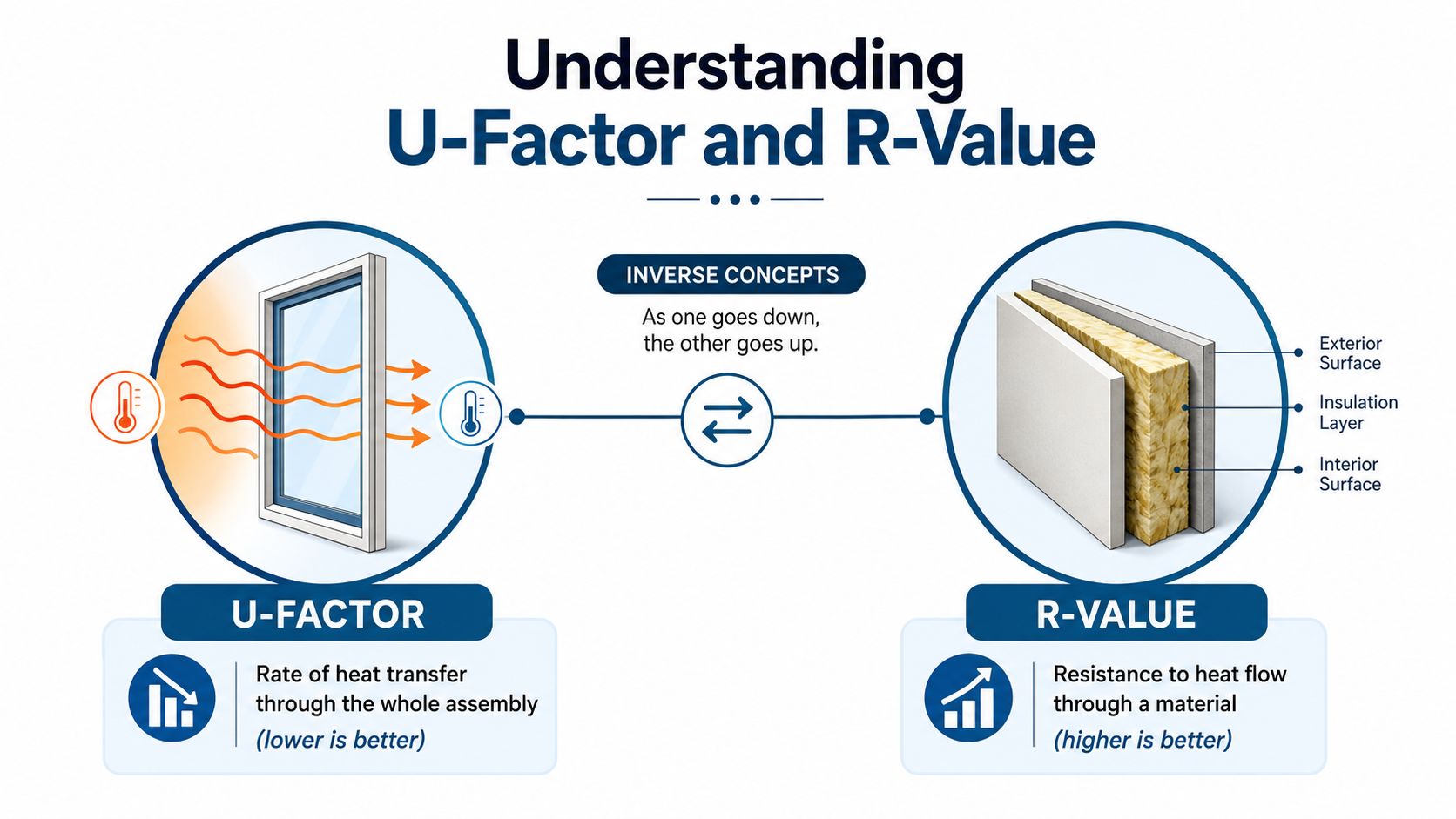
U-factor measures how quickly heat passes through a window or door assembly. In plain English, it answers a simple question. How much heat can sneak through this unit?
For windows and doors, lower is better. A lower U-factor means less heat transfer through the assembly, which is why it's the cleaner spec for comparing exterior units. Industry guidance also notes that U-factor is used for full assemblies such as windows and doors, not just individual materials technical guide on U-factor use.
What R-Value tells you
R-value measures resistance to heat flow. The higher the number, the better the insulation resists heat moving through it. That's why you hear R-value constantly in discussions about wall insulation, attic insulation, roofs, and other thicker building-envelope components.
R-value is useful, but it was never the natural language of windows. A window is a thinner, more complex product. It has multiple materials doing different jobs, so the number one wants is the one that reflects the full assembly rather than one layer in isolation.
Why the direction of the scale matters
The simplest way to remember it is this. U-factor goes down when performance improves. R-value goes up when performance improves. That inverse relationship is why homeowners get tripped up when they move too fast between the two.
Good shorthand: If you're reading a window label, start with U-factor. If you're reading insulation specs for a wall or roof, start with R-value.
That's the basic rule, but the practical difference is in what each number claims to describe. A label can be mathematically correct and still be practically misleading if the buyer assumes it covers the same parts of the product.
Comparing U-Factor and R-Value Side by Side
What each number is really for
U-factor and R-value both relate to thermal performance, but they live in different parts of the building world. U-factor is the language of complete windows, doors, and similar assemblies. R-value is the language of insulation materials and broader envelope components.
That distinction is why builders often think in U-factor when they're specifying openings, and think in R-value when they're detailing opaque assemblies like walls or roofs. When the two get lumped together, the comparison stops being useful.
Side-by-side comparison
| Criteria | U-Factor | R-Value |
|---|---|---|
| Core meaning | Heat transfer through a full assembly | Resistance to heat flow |
| Best use | Windows and doors | Insulation and broader building-envelope parts |
| Scale direction | Lower performs better | Higher performs better |
| Common buyer question | “How much heat gets through this unit?” | “How well does this material resist heat?” |
| What it can miss if misused | Less, when the rating is truly for the whole assembly | More, if the product is being judged like a complete window |
| When conversion becomes risky | When people treat a single material value like a full-unit rating | When people assume the inverted number equals installed performance |
The trap is conversion. A window with a strong glass package can still disappoint if the frame is weak, the spacer is a poor thermal bridge, or the unit was never being judged as a complete system in the first place. A math conversion can't restore the missing context.
Where the comparison helps, and where it fails
Use the numbers for the right job. U-factor helps you compare windows against windows and doors against doors. R-value helps you compare insulation against insulation, or understand material resistance in broader assembly design.
Use the wrong conversion, and you invite false precision. The spec sheet looks scientific, but the choice you make may have little to do with how the product performs in a hot wall opening after installation.
Why Whole-Assembly Testing Matters for Windows and Doors
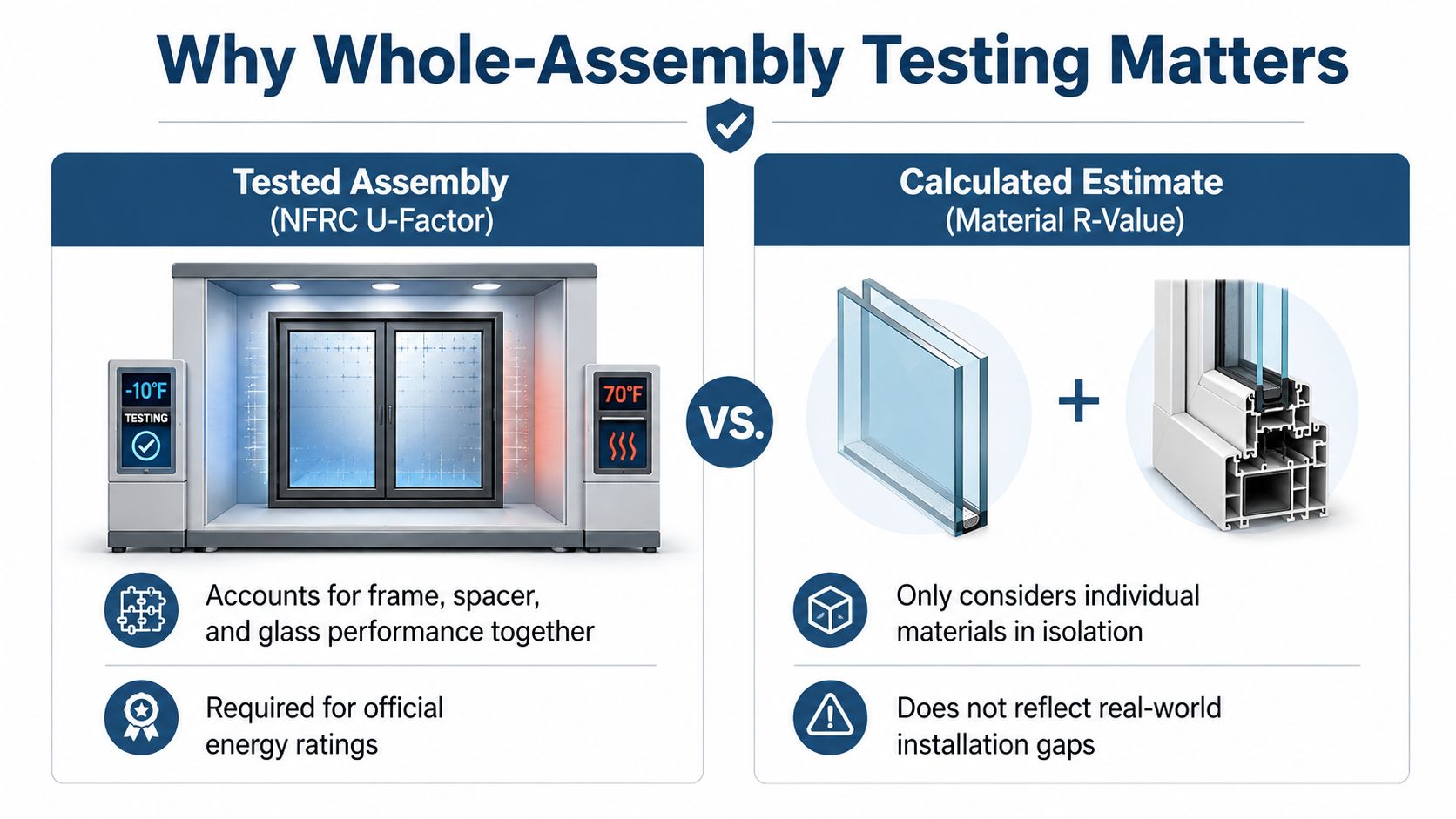
A window is not just glass. It's glass, frame, spacer, seals, and the way those parts interact once the unit is built and installed. That's why a quoted U-factor is typically the number buyers should trust first, because it reflects the performance of the entire assembly rather than a single component.
Tested assembly versus calculated estimate
The practical difference is sharp. A tested assembly rating tells you how the whole unit behaves together. A calculated material estimate tells you something narrower, usually about one material in isolation.
That matters because the edges of a window can behave differently from the center of the glass. Frames can conduct heat. Spacers can create thermal bridges. Seals can change how the unit performs once it's in the wall and exposed to weather.
A product that looks strong on paper can still underperform if the assembly details are weak. That's especially true when the buyer is distracted by a glass-only number that doesn't account for the full unit.
For replacement projects, installation quality matters too. A good window with a poor install can still disappoint, which is why the field work and the rating need to align. A proper replacement window installation only helps if the product itself is specified accurately and the opening is prepared correctly.
Why hot climates expose weak specs
Hot climates punish shortcuts. If the frame is a poor thermal performer, or if the rating you're comparing ignores the whole assembly, the interior comfort you expected may never show up.
That's why lower U-factor is usually the more useful metric for windows and doors. It gives you a closer view of what the complete product is likely to do, not what one isolated material can do under idealized conditions.
A spec that omits the frame and spacer story is only half a story.
When homeowners in Texas compare products, they should ask for the number that reflects the full opening, not a conversion that looks better because it's easier to market.
Real-World Scenarios for Hot Climate Window Selection

A homeowner in Texas often sees two sales pitches. One product leads with a glass R-value, and another leads with a lower U-factor on the full unit. The second pitch is usually the one worth paying attention to, because it's speaking the language of the whole window instead of just one layer.
Replacement windows and the label that matters
In a vinyl replacement job, the buyer should care most about how the completed window behaves in the opening. That means the frame, sash, glass, and spacer all need to be part of the conversation. A low U-factor tells you more about the actual product than a converted R-value does.
That's also why installation planning matters. The window has to fit the opening, the surrounding conditions have to be handled correctly, and the unit needs to perform as one system after it's set. Texas replacement window projects live or die on that combination of product and installation, not on a glossy number alone.
Tilt-turn and fiberglass examples
European tilt-turn windows often attract attention because buyers hear they're built for thermal performance. That can be true, but the right question is still the same. What does the whole assembly rate say, and does it match the climate and the project goal?
Fiberglass entry doors deserve the same skepticism. A door chosen on a headline R-value alone can look efficient, yet still perform worse than a properly rated unit with a better whole-assembly U-factor. The door slab, frame, and seals all matter.
What to notice during a showroom visit
- Ask for the assembly rating, not just a glass-only number.
- Check whether the frame is part of the stated performance.
- Compare like with like, because a door and a window don't tell the same thermal story.
- Watch for marketing that celebrates the conversion, but skips the actual installed unit.
If the sales conversation keeps drifting back to the easiest number to advertise, that's a warning sign. Buyers in hot climates need the metric that tracks with real comfort, not the one that looks neat on a brochure.
How to Evaluate Window and Door Energy Ratings

Start with the NFRC label
The first thing to look for is the label itself. A real product comparison starts with the NFRC U-factor, not with a marketing headline that emphasizes one material's insulation value.
Match the rating to the climate
For Texas and similar hot regions, the rating has to be useful in a warm-weather context. Lower U-factor helps with heat transfer control, and solar control matters too. Ask whether the product is being specified for your climate, not just for a generic national market.
Ask the questions that expose the whole story
- Is this a whole-assembly rating? If not, it may not tell you much about installed performance.
- Does the frame count in the published number? If it doesn't, the comparison isn't fair.
- Are you comparing windows to windows, or a component to a system? That distinction changes everything.
- What does the supplier say about spacers and seals? Those parts often decide whether the unit performs well at the edges.
Use rating labels to compare fairly
One product can look strong in a brochure and weak in a spec sheet, or the reverse. The fair comparison is the one that lines up the same kind of rating across both products. For new construction, that means matching system to system. For replacement, it means matching the published assembly rating to the actual product being installed.
This new construction window guide is useful only if you already know how to read the rating that sits behind the sales language.
Simple filter: If the conversation stays stuck on converted R-value, keep asking for the whole-unit U-factor.
That one habit cuts through most of the confusion. It keeps the focus on the product that will sit in the wall and face the weather.
Making Confident Window and Door Decisions
The safest rule is also the simplest. For windows and doors, U-factor is usually the more decision-relevant metric because it reflects the whole assembly. R-value conversions can mislead when they hide the frame, spacer, seal, and installation realities that determine actual performance.
Homeowners and builders don't need to become energy modelers to make a good choice. They just need to ask whether the number they're looking at describes the unit as installed, or only a piece of it.
When the climate is hot, that distinction gets expensive fast. A product that looks efficient on paper but ignores assembly performance can leave buyers with higher heat gain, uneven comfort, and a lot of regret.
If you want help sorting real window and door ratings from marketing noise, Breaking Glass Co. works with homeowners, builders, and contractors who need products matched to Texas and Southwest conditions. Visit Breaking Glass Co. to request a quote, compare specs the right way, and get a solution built around whole-assembly performance, not just a number on a label.