
You're probably staring at a living room window that feels like a space heater, or an upstairs room your AC can't seem to cool, and wondering whether the glass is finally the problem. In Texas, that's usually the right suspicion. Heat, UV, humidity, and storm damage beat on windows harder here than they do in milder states, so texas window replacement is less about a cosmetic upgrade and more about choosing the right fix for the right side of the house.
Table of Contents
- Why Texas Homes Wear Out Windows Faster
- Climate-Driven Choices That Actually Matter
- Comparing the Main Window and Door Types
- Codes, Historic Districts, and Rebates You Might Miss
- What a Real Texas Window Replacement Costs
- How Breaking Glass Co. Runs Your Project
- Choosing the Right Path for Your Home or Build
- Texas Window Replacement Questions Answered
Why Texas Homes Wear Out Windows Faster
The pattern is usually the same. The AC runs all afternoon, one corner of the house stays hot, and the sofa near the west wall feels like it sits in a patch of afternoon punishment. Then you notice a fogged pane, a sticky sash, or a frame that's warped just enough to quit sealing right.
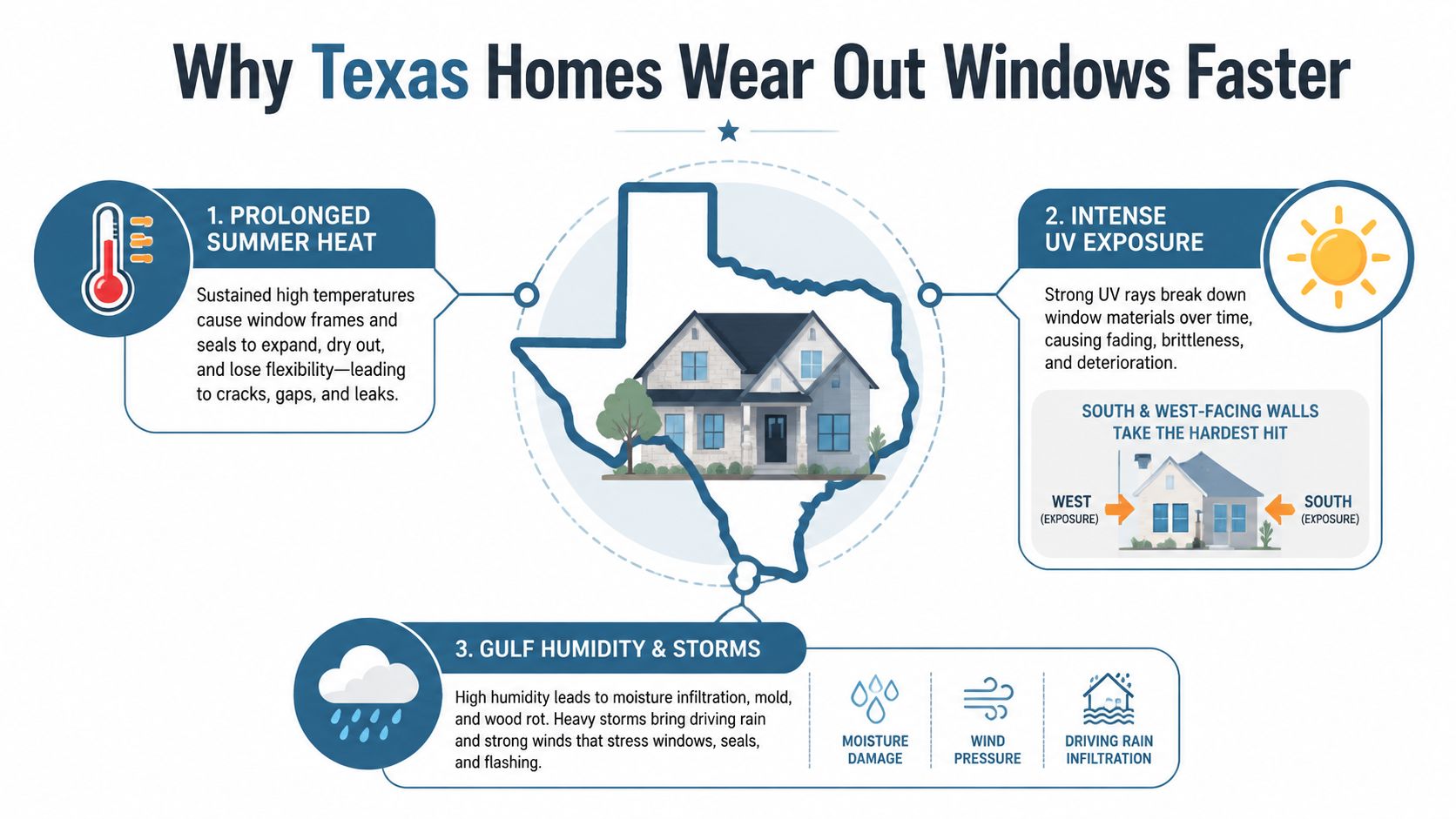
Texas windows don't fail from one problem, they fail from a pile-up. Prolonged summer heat cooks seals and hardware. Intense UV exposure hits south- and west-facing walls hardest. Along the coast, humidity and storms punish frames, caulking, and insulated glass units. That mix is why a house in Texas can age through windows faster than the same design would in a cooler climate.
Why the sun side matters more than people think
The biggest mistake I see is homeowners treating every window as equal. They're not. A north-facing bedroom may be fine with a standard replacement, while a west-facing family room is the one that needs the serious glass package. The Texas-specific issue is simple, heat gain through glass drives cooling demand, so the window spec has to follow the sun, not a brochure.
That's also why the usual national advice falls short. A generic “replace all windows with the same model” plan ignores which openings get beat up first. On a Texas house, the worst exposures deserve the best glass, while the calmer sides can often stay more basic without wasting money.
Practical rule: Start with the rooms that feel hottest in the late afternoon, not the windows that look oldest.
One more thing homeowners should watch before calling anyone, seal failure often shows up as condensation between panes, especially after years of heat and sun abuse. When you see that, you're not looking at a simple cleaning problem. You're looking at a failed insulated glass unit or a window system that's lost its edge.
Climate-Driven Choices That Actually Matter
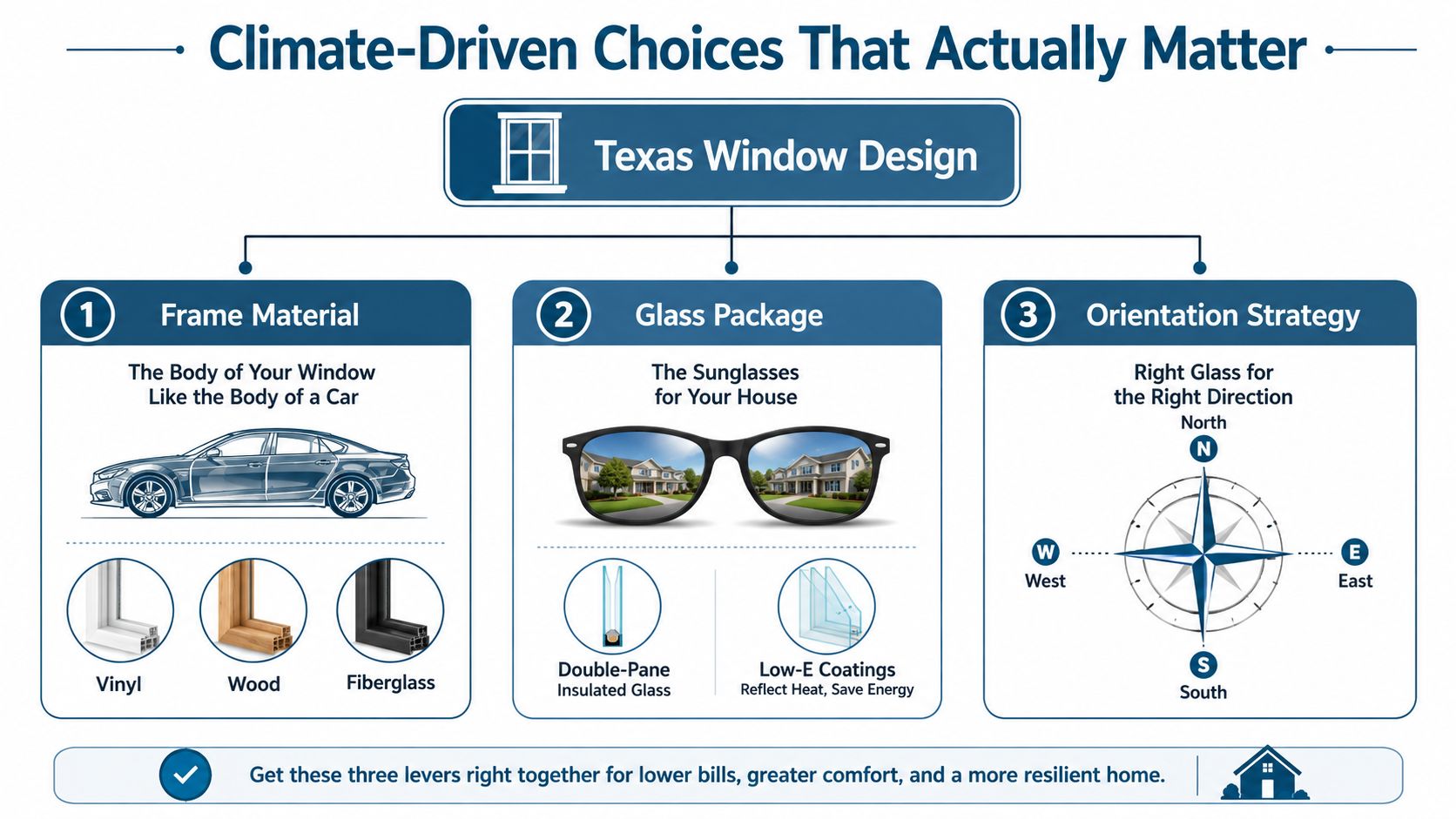
If you want the short version, stop shopping for “the best window” and start choosing the right frame material, glass package, and orientation strategy for your house. That's how Texas replacement work gets done. The fancy line item is useless if it's installed on the wrong wall or specified without regard to sun exposure.
Frame material is a durability decision, not a fashion choice
Vinyl, fiberglass, and wood do different jobs. Vinyl usually wins on value because it handles routine replacement work without dragging the budget into luxury territory. Fiberglass earns its keep when you want a stiffer, more weather-resistant shell. Wood still has a place in certain architectural settings, but in Texas heat and moisture, it asks for more upkeep than most homeowners want.
Think of the frame like a car body. It needs to stay square, resist stress, and keep the moving parts aligned. If the frame moves, the glass and seals suffer next.
Glass package is where Texas homes either win or lose
Low-E glass is basically sunglasses for the house. It helps cut unwanted heat and UV while keeping visibility decent. Argon gas inside the insulated glass unit is the foam in a thermos, it slows the transfer of heat between panes.
South- and west-facing windows deserve the better package first. North-facing windows often don't need the same upgrade level, because they're not taking the full blast. That's the part too many homeowners miss. The best value usually comes from targeting the hard-hit sides, not buying the highest-end system for every opening.
Orientation beats hype
A west wall with late-day sun and a southern wall with long exposure need a different answer than a shaded rear elevation. If you spec everything the same, you'll overspend in the quiet spots and underspend where the heat enters. That's backward.
The smartest Texas window upgrade is the one you can defend room by room, not the one that sounds best in a sales pitch.
Comparing the Main Window and Door Types
Most Texas homeowners get quoted three buckets of product, whether they realize it or not. Vinyl replacement windows, fiberglass entry doors, and European tilt-turn windows each solve a different problem. The mistake is treating them like direct substitutes.
The workhorse, the armor, and the specialist
Vinyl replacement windows are the workhorse. They fit most straight replacement jobs, they're easy to source, and they usually make the most sense when the main goal is comfort and efficiency without blowing up the budget. That's the category I'd expect most homeowners to start with.
Fiberglass entry doors belong on the front of the house, where security, warp resistance, and weather exposure matter most. A front door that stays straight through heat and storms is worth more than a decorative upgrade that twists after one brutal summer.
European tilt-turn windows are the specialist move. They bring dual-action operation, tighter locking, and strong thermal performance, but they're not the answer for every house. They make sense when the remodel allows them, and when the owner wants a more modern operating system.
Don't overspend on the wrong line
If your west-facing living room is baking at 5 p.m., I'd rather see the better glass package there than a premium product sprinkled across the whole home. That's the cleanest Texas budget rule. Spend where the sun hits hardest, then step down where the house is naturally easier to cool.
For homeowners trying to sort out sound, security, and installation details, this STC-rated window guide helps frame the noise-reduction side of the decision without drifting away from the practical project trade-offs.
What actually fits which project
- Vinyl replacement windows, best for standard residential swaps where speed and value matter.
- Fiberglass entry doors, best for front-entry upgrades that need better durability and a cleaner long-term fit.
- Tilt-turn windows, best for remodels and higher-performance projects that can support a more specialized product.
- New-construction packages, best when a builder wants coordinated sizing, ordering, and code alignment from the start.
The right product is the one that matches the house and the job. Texas doesn't reward random upgrades. It rewards targeted ones.
Codes, Historic Districts, and Rebates You Might Miss
This is the part homeowners skip, then regret later. A window that looks perfect on paper can get hung up by permit questions, historic review, or the wrong appearance in a protected district. In Texas, compliance isn't just paperwork, it can decide whether the project moves forward at all.
Historic rules can override your product preference
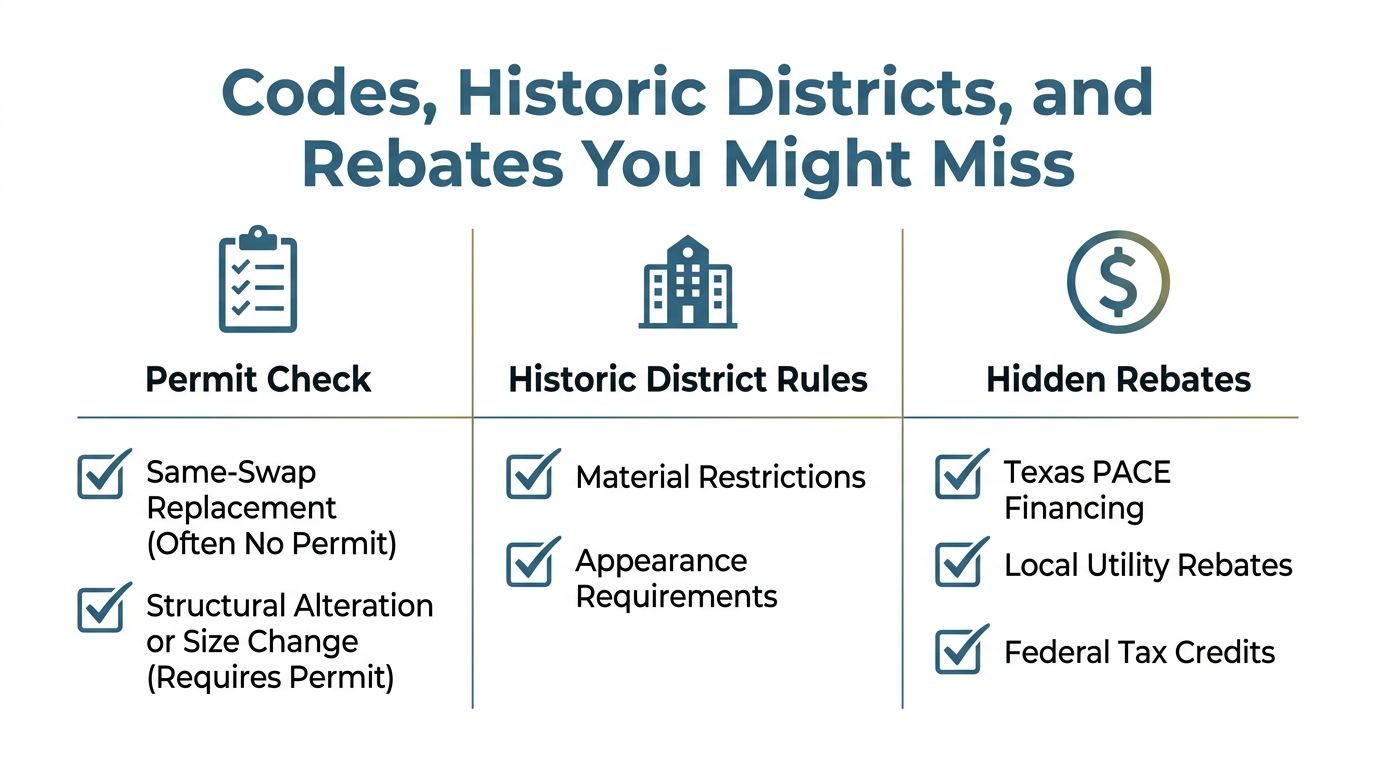
In some Texas cities and protected areas, the window has to match the original opening, profile, and visual appearance. Texas Main Street guidance for historic buildings stresses that replacement windows should fit the original size and shape, avoid standard sizes with filler panels, and use clear, non-reflective glass with a visual light transmittance of 72 or higher, as stated in the city guidance for historic buildings. That means the cheapest vinyl unit can be the wrong answer if it changes the façade too much.
For owners in places with preservation rules, the first question isn't “What has the best efficiency spec?” It's “What will get approved?”
Permits and energy expectations still matter
Like-for-like swaps are often treated differently than structural changes, but once you alter size, opening, or appearance, you're in a different lane. Energy code expectations also matter on new installations and remodels, especially when you're coordinating with a contractor or builder. The correct move is to ask before ordering, not after.
Practical rule: If the window changes the opening, assume someone needs to review it.
Don't leave money on the table
Rebates and tax credits can soften the sting of a higher-quality unit, but only if the product qualifies and the paperwork is right. Utility programs and federal credits change, so the safe move is to verify eligibility before signing. If the unit is going on a south or west wall, that verification matters even more, because that's where a better glass package earns its keep.
For homeowners also comparing impact resistance, this impact-resistant glass resource is worth a look when storm exposure is part of the decision.
What a Real Texas Window Replacement Costs
Texas window pricing gets messy fast because product tier and labor availability move the number around. The market is large and labor-sensitive, with a Texas glass and glazing contractors market estimated at $2.2 billion, 2,492 businesses, and 7,859 employees in a 2026 industry analysis, while industry growth was estimated at 2.7% annually from 2021 to 2026 and employment declined at -3.6% annually over the same period, according to IBISWorld. That's a good reminder that supply and labor can affect quotes as much as the window itself.
What homeowners actually see on quotes
For standard vinyl double-hung replacement windows with Low-E glass, installed pricing in Texas is often cited around $350 to $650 per window in the market analysis noted above. A typical 10-window project lands around $3,500 to $6,500 before discounts, again for that standard window tier. The broader Texas cost summary also notes that a whole-home replacement of 10 to 15 windows can run about $8,600 to $14,100 installed, with another common full-home range around $7,000 to $15,000. Those ranges make sense because whole-house projects often include different opening sizes, hardware, and labor conditions.
What pushes the price up
Custom shapes cost more. Large picture windows cost more. Fiberglass doors cost more than basic windows. Tilt-turn units cost more because you're paying for a more specialized system, not just a pane of glass. The line items that move the number are usually frame construction, glass package, hardware quality, and installation complexity.
The questions to ask before you compare quotes
- Is the quote for standard sizes or custom openings?
- Does it include Low-E glass and gas fill, or is that an upgrade?
- Are installation, measurement, and disposal all included?
- Does the price change if the job crosses historic or permit review?
- What part of the cost is product, and what part is labor?
Don't compare quotes until you've matched the glass package and the installation scope. Otherwise you're just comparing different jobs.
How Breaking Glass Co. Runs Your Project
A good window company should make the process easy to follow, not mysterious. Breaking Glass Co. does that with a free same-day phone and web quote, then on-site measurement for residential replacements, factory-direct ordering through PTek-supported manufacturer lines, and statewide Texas installation by its team. That sequence matters because window jobs go wrong when measurement, ordering, and install are handled like separate conversations.
What the service footprint looks like
The company also serves East Texas directly in Tyler, Lindale, Bullard, Jacksonville, Longview, Athens, Whitehouse, and Canton, which is useful if you want a local contact without losing access to broader Texas coverage. It also ships product nationwide, so out-of-state buyers and contractors can still source the right unit when a Texas-spec product is the better fit.
The setup includes bilingual support in English and Spanish, which makes scheduling and coordination easier on mixed-language jobs. That sounds minor until you're trying to align a measurement visit, a delivery window, and a site schedule.
How I'd read the process as a homeowner
Value comes from transparency. Free quote, measurement, order, install, warranty. That's the sequence you want from any replacement vendor, whether you're buying a standard vinyl swap, a fiberglass entry door, or a more specialized tilt-turn package.
If you're a homeowner trying to understand the installation side before you commit, this vinyl replacement installation guide gives a practical view of the process and where the fit, seal, and finish work matter.
Practical rule: If a company can't explain measurement and installation cleanly, don't let them near your house.
Choosing the Right Path for Your Home or Build
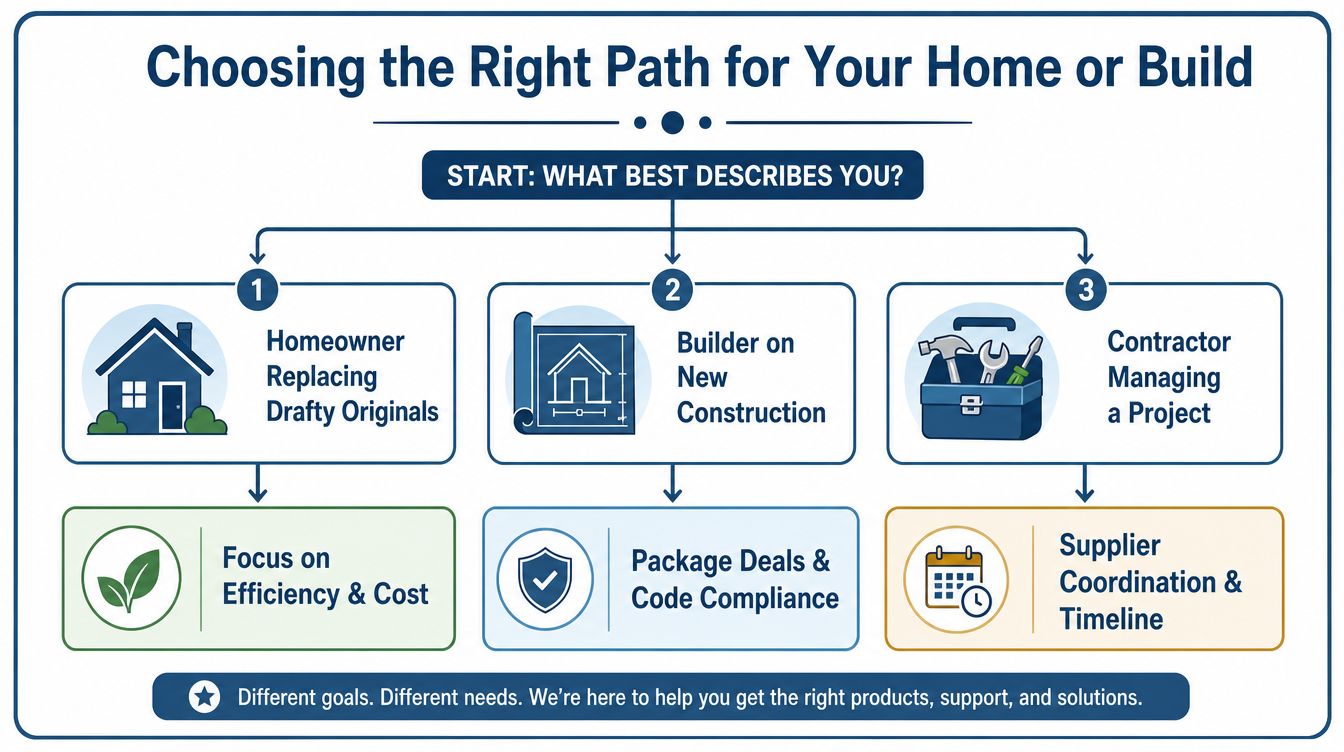
The right Texas window decision depends on who you are and what the project is really for. A homeowner replacing drafty originals needs a different answer than a builder ordering a package for a new house, and both need a different answer than a contractor trying to keep a remodel moving. Texas punishes one-size-fits-all thinking.
Match the path to the job
A homeowner replacing drafty originals should focus on efficiency and cost, starting with the worst sun-exposed walls. A builder on new construction should think in terms of package deals and code alignment. A contractor managing a project should care about supplier coordination and timeline more than brochure language.
That's also where the product mix from Breaking Glass Co. fits naturally. Vinyl replacement and new-construction windows fit the standard residential and builder lanes. Fiberglass entry doors fit projects where the entry needs to hold up. Tilt-turn windows fit higher-performance remodels and more specialized builds.
A simple checklist you can use this week
- Orientation priority, identify which rooms get the worst sun.
- Glass package tier, decide where Low-E needs to be upgraded first.
- Permit or historic review, confirm whether the project needs approval.
- Budget band, decide whether you're replacing a few windows or the whole house.
- Timeline, match the order and install window to your schedule, not the other way around.
The best next step is the one that narrows choices, not the one that adds more of them.
Texas Window Replacement Questions Answered
A whole-home replacement usually takes longer than the sales call but shorter than people fear once the order is in motion. The delay is often the product lead time and scheduling, not the install day itself. If the job is straightforward and the windows are already measured, the work moves faster than a project that needs review, custom sizing, or special ordering.
Most homeowners also ask about permits. On like-for-like swaps, many Texas cities treat the work differently than a structural change, but that's not a reason to guess. If the opening changes, the trim changes, or the façade changes, check the local rule before you buy anything.
Lifetime warranty coverage sounds simple, but you should always ask what it covers in practice. Get clear on whether the warranty applies to the product, the installation, or both, and keep the paperwork with your order documents. That's the only way the promise matters when something goes wrong later.
Nationwide shipping is realistic for DIY homeowners and contractors, but only if they already know what they're ordering. Windows are not a casual freight item. Measurements, orientation, and glass package decisions have to be right before the crate leaves the shop, especially in Texas where the sun side of the house can't be treated like the shaded side.
If you want a Texas-spec replacement plan instead of a generic quote, start with your sun exposure, your budget, and your approval requirements. Then get the product and install conversation aligned to that reality. Visit Breaking Glass Co. to request a quote, compare product lines, and get a project plan that fits Texas heat, Texas rules, and a real installation schedule.