
You know the moment. A Texas afternoon turns black, the wind starts slapping the house, and you hear hail or debris pinging the windows hard enough to make you flinch. After the storm, one pane is cracked, another is gone, and water or wind is now getting into a room that was sealed an hour earlier.
That's why impact resistant glass matters. It's not about making windows magically indestructible. It's about keeping the building envelope closed after a strike, which is the essential job in hail country, hurricane country, and anywhere Texas weather throws something hard at a home.
Table of Contents
- Why Texas Storms Make Ordinary Glass Vulnerable
- How Impact Resistant Glass Is Constructed
- What Ratings and Tests Measure
- Impact Glass Compared to Shutters and Panels
- Texas Codes, Coastal Rules, and Inland Severe Weather
- Where Impact Resistant Glass Earns Its Place in Texas
- Common Misconceptions Worth Clearing Up
- Choosing the Right Impact Resistant Glass for Your Project
Why Texas Storms Make Ordinary Glass Vulnerable
A spring storm in North Texas can sound like a handful of gravel thrown at the house. On the Gulf Coast, a gust front can send branches, roof fragments, and loose yard debris into a patio door in seconds. The glass that looks fine on a calm day can become the weakest point in the whole shell when the weather turns violent.
Ordinary glass breaks in a way that creates a second problem
Most residential glass isn't designed to take impact and stay in place. When it fails, it can leave sharp shards and an opening that lets wind and rain rush inside. That's the part homeowners often underestimate, because the damage isn't just the broken pane, it's the loss of the barrier that protects everything behind it.
Practical rule: In storm country, the goal isn't “stronger glass,” it's keeping the opening sealed after impact.
That distinction matters in Texas because the threats aren't one-dimensional. Coastal homes deal with tropical systems and windborne debris. Inland homes still face hail, straight-line winds, and tornado debris. Different storms, same problem, a window can fail fast if it wasn't built for impact.
The real risk is the hole, not just the crack
Once glass breaks, wind pressure can start working on the rest of the opening. That can turn a single failed lite into a bigger envelope problem. It's why storm-resistant design focuses on the whole assembly, not just the pane in your hand.
The federal wind-borne debris testing summary makes this threshold problem very clear. For roof shingle missiles, the momentum causing a 50% breakage probability ranged from 0.2 to 1.2 lb-s, while for 2×4 missiles it ranged from 2.3 to 2.5 lb-s across the tested glazing configurations (HUD user wind-borne debris study). In that same work, the shift from almost no breakage to complete breakage for the 2×4 missile happened over only about 1.8 to 2.7 lb-s (HUD user wind-borne debris study). That's a good reminder that failure can be abrupt once impact crosses a threshold.
How Impact Resistant Glass Is Constructed
The term impact resistant glass covers several different constructions, and Texas buyers run into all of them. That is where confusion starts, because a salesperson may say “impact glass” while the assembly underneath is laminated, tempered, insulated, or even a specialty polymer system.
Laminated glass is the core storm product
Laminated glass works like a layered shield. Two or more layers of glass are bonded with a polymer interlayer, and that interlayer holds the fragments together after impact. The pane may crack, but it is less likely to fall apart into an open hole.
A useful mental image is a safety net stretched behind the glass. The glass can take a hit, but the interlayer catches the broken pieces and keeps the surface together long enough to protect the opening. That is why laminated glass is so common in hurricane-prone applications and other exposed openings where keeping debris out matters more than avoiding a crack.
Tempered glass solves a different problem
Tempered glass is heat-strengthened so it breaks into smaller pieces than ordinary annealed glass. That makes it a safety glazing option in many applications, but it is not the same thing as laminated impact glazing. A tempered lite can still lose the opening quickly if it is struck hard enough.
Insulated laminated units add comfort to the picture
An insulated laminated unit pairs a laminated lite with a separate airspace and another lite. That setup can give you impact resistance and a better energy package in the same product. For Texas homeowners, that matters because storm protection and heat control often need to live in the same window.
Specialty systems fill in the edge cases
Polycarbonate and rigid multilayer systems show up in security-focused or unusual applications. They are not the everyday answer for most homes, but they can make sense for specialty shapes, extra-security needs, or commercial conditions where a standard residential assembly will not do the job.
The main takeaway is simple. Impact resistant is a performance category, not a single material. If you are reading a quote, you want to know what layers are being proposed, not just whether the salesperson used the right phrase.
A close-up of what laminated construction looks like helps here.

Later in the same planning conversation, it helps to see how the structure and test logic connect.
Buyer's shortcut: If a quote does not say whether the product is laminated, tempered, or insulated laminated, you still do not know what you are buying.
What Ratings and Tests Measure
Homeowners often hear “impact resistant” and picture one simple toughness test. The picture is more useful. A rating tells you how a window or door assembly handled a standard strike, then whether it stayed together under repeated wind pressure after that hit. That is the difference between a sales phrase and a specification that matters on a permit set.
Small missile and large missile are not interchangeable
Residential windborne-debris testing often separates small-missile and large-missile performance. The small-missile category covers lighter debris. The large-missile category is the harder test, and it simulates a 2×4 missile, the kind of heavy object that can show up in severe storms (HUD user wind-borne debris study).
The federal study behind this distinction shows why the split matters. The momentum tied to a 50% breakage probability was very different for roof shingle missiles and 2×4 missiles, and the 2×4 shift from no breakage to full breakage happened over a narrow band of momentum. In plain English, once the impact gets severe, the glass does not fail in a slow, even way. It can cross the failure point quickly.

The interlayer thickness tells you a lot
PNNL guidance notes that the commonly specified interlayer thickness is 0.060 inch for small-missile resistance and 0.090 inch for large-missile resistance (PNNL guidance on impact-rated glazing). That gives you a concrete detail to look for on a submittal sheet. If the interlayer is not identified, you are not comparing the same product type from one quote to the next.
Testing is about the whole build-up
The test does not stop at the strike. It also includes cycle pressure testing, which simulates repeated wind gusts after impact. That matters because a pane that survives the hit but blows out under pressure still does not protect the house.
A useful shorthand is to treat the rating like a chain. Glass, interlayer, frame, and pressure performance all have to hold together. A strong glass lite in a weak frame is like a reinforced door slab on a flimsy hinge set, the weakest link still decides the outcome. For homeowners comparing opening protection options, a simple primer on impact-rated glazing versus security doors can help clarify where glass fits and where a different assembly makes more sense.
Practical rule: A higher number on a brochure does not automatically mean the right answer for your home. The correct rating depends on exposure, location, and whether shutters or panels are part of the system.
For Texas buyers, that is the cleanest way to think about it. Performance is a build-up, not a label. The glass, the interlayer, the frame, and the pressure rating all have to work together.
Impact Glass Compared to Shutters and Panels
After a hailstorm or a hurricane scare, Texas homeowners usually start with the same question: keep the openings covered with impact-rated glazing, rely on shutters, or use removable panels. Each option can satisfy code when it is specified and installed correctly, but each one changes how the house looks, how much work storm prep takes, and how the home behaves on a normal day.
A side-by-side view helps
| Option | Day-to-Day Living | Storm Prep | Typical Best Fit |
|---|---|---|---|
| Impact glass | Looks like standard windows, stays in place year-round, no storage issue | No deployment needed before the storm | Homes where convenience, appearance, and year-round protection matter |
| Shutters | Visible hardware or panels, depending on style | Must be closed or deployed before the storm | Openings where code or exposure calls for added protection |
| Panels | Stored when not in use, least visible on the opening | Must be installed ahead of time | Budget-sensitive projects or openings that do not justify permanent glazing upgrades |
The practical difference shows up on an ordinary Tuesday, not just on a storm-warning day. Impact glazing stays ready without any extra action. Shutters and panels only do their job if someone has time, access, and the habit of putting them in place before the weather turns.
A homeowner can read that table like a jobsite note. Permanent glazing is the low-maintenance path, while temporary protection asks for planning and storage space. If a family leaves town often, has limited mobility, or does not want to keep track of hardware, that daily-use factor can matter as much as the wind rating itself.
Aesthetics, convenience, and code can point in different directions
Impact glass usually wins on appearance and ease of use because it behaves like a normal window. Shutters and panels can make more sense when the opening is large, unusually shaped, or exposed in a way that local rules treat differently. On real Texas projects, the answer is often a mix, with one set of openings getting permanent glazing and another set getting temporary protection.
Code language also points homeowners toward different assemblies depending on the job. The PNNL guidance on impact-rated glazing explains that building requirements can call for impact-resistant glazing, shutters, or panels, and local rules can be stricter than the baseline. A beautiful product that never gets deployed on time is still the wrong fit for a house that needs a manual system. For homeowners comparing opening protection options, a simple primer on impact-rated glazing versus security doors can help clarify where glass fits and where a different assembly makes more sense.
This window replacement resource is useful for seeing how replacement projects are typically coordinated when homeowners want both performance and installation support.
Texas Codes, Coastal Rules, and Inland Severe Weather
Texas buyers often hear “code compliant” and assume that means the same thing everywhere. It doesn't. The national model codes create the floor, but local jurisdictions can push beyond that floor, and coastal areas often do.
The code question starts with location
The International Residential Code and International Building Code drive the national baseline for impact-resistant glazing, shutters, or panels in windborne debris regions. In practice, the only answer that matters is the one enforced by the authority having jurisdiction where the house sits. A builder's standard window schedule doesn't override that.
That's especially true on the Gulf Coast and in other storm-exposed pockets of Texas. A house near the water may need a different opening protection strategy than a house a few counties inland, even if the exterior looks similar from the street.
The local rules can be stricter than the national minimum
Builders and homeowners sometimes get tripped up by this. One subdivision may accept impact glazing on most openings, while another requires additional protection on certain exposures or for certain unit sizes. That's why permit set review matters. It's also why you should ask for the exact code path, not just a sales pitch that says “meets code.”
The PNNL guidance is clear that code compliance can involve impact-resistant glazing, shutters, or panels, and that local rules can exceed the national code (PNNL guidance on impact-rated glazing). Guardian's guidance also notes the commonly specified 0.060 inch and 0.090 inch interlayer benchmarks, which helps explain why two products with similar appearances may not be equivalent (PNNL guidance on impact-rated glazing).
Inland Texas still has a real reason to care
Hail and tornadoes don't stop at the coastline. A homeowner in inland Texas may not be buying impact glass because of a hurricane rule, but the product can still make sense as a resilience upgrade. The driver may be severe-weather exposure, insurance expectations, or a desire to avoid another cleanup after the next hail event.
If you're not sure what your property needs, start with the permit office or builder documents, not the showroom sample.
Where Impact Resistant Glass Earns Its Place in Texas
The best way to understand the product is to place it in actual Texas settings. The right answer on the coast is often different from the right answer in the Hill Country or North Texas.
A Gulf Coast remodel is a different conversation than an inland replacement
On a Galveston or Corpus Christi beachfront project, large-missile laminated units often make sense because the code and the exposure both push in that direction. The homeowner usually wants the opening protected without relying on a separate system every time a storm forms offshore. In that setting, impact glazing is part of the building envelope strategy, not just an upgrade.
In the Hill Country, the decision can tilt differently. A new build may focus on hail resistance and energy performance, so laminated insulated glass becomes attractive because it addresses both comfort and storm resilience at once. The owner gets a tougher opening and a better-performing unit for long, hot summers.
North Texas often tells a third story. After a hailstorm, a homeowner may replace a failed builder-grade window and decide not to go back to the same product. In that case, the move to a stronger assembly is about reducing repeat damage and getting a more resilient window package the next time severe weather hits.
Commercial projects use the same logic, just at bigger scale
Storefronts, schools, and other facilities often need a mix of weather resistance, safety, and sometimes security. The same product families show up there because the core problem is the same, protect the opening and keep the building functioning after impact. The difference is only how much load, traffic, and exposure the assembly has to handle.
For homeowners comparing replacement options, window replacement planning usually starts with the opening schedule, the local exposure, and the upgrade level the project budget can support. The right unit in Texas is rarely the fanciest one on paper. It's the one that fits the risk and the code path at the address.
Common Misconceptions Worth Clearing Up
The biggest mistakes around impact products come from oversimplifying them. Buyers hear one feature, then treat it like a guarantee.
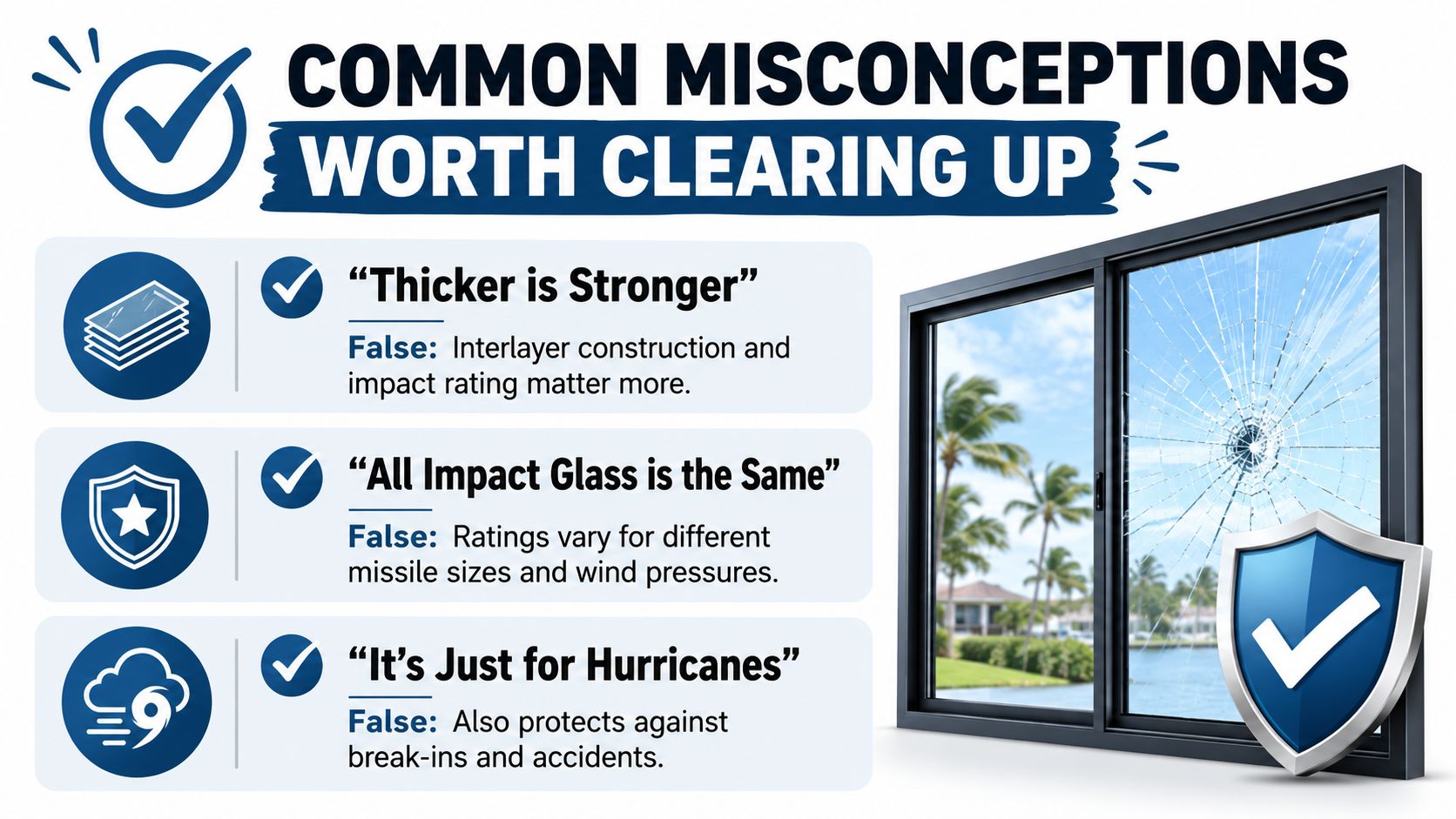
Thicker isn't automatically stronger
A thicker pane can still be the wrong product if the build-up and rating aren't right. The interlayer construction and the test result matter more than raw thickness alone. That's why two windows that look similar can perform very differently once debris starts flying.
Impact glass doesn't always replace shutters
Some exposures and code paths still favor layered protection. The PNNL guidance is explicit that code compliance can involve impact-resistant glazing, shutters, or panels, and local rules can be stricter than the national code (PNNL guidance on impact-rated glazing). So if a salesperson says impact glass makes shutters obsolete, treat that as a sales line, not a design rule.
It isn't just a coastal product
Texas hail country can benefit from these assemblies too. So can tornado-prone areas, even when the regulatory driver isn't a hurricane zone. The question isn't whether the home is on the coast. The question is what hits the glass and how often.
Before you approve a proposal, verify four things:
- The rating used for your opening, small-missile or large-missile.
- The interlayer thickness, especially whether it matches the exposure.
- The energy performance numbers, if the project also needs comfort and efficiency.
- The testing standard referenced on the submittal sheet or permit documents.
Choosing the Right Impact Resistant Glass for Your Project
A solid decision starts with three questions. Where is the home located, what severe-weather threat matters most, and what does the local code require? Once you answer those, the product choice gets a lot clearer.
Match the product to the risk, not the brochure
If you're on the coast, the code path and exposure may point you toward large-missile rated laminated units or a combination of glazing and opening protection. If hail is the dominant problem, an insulated laminated assembly may be the better long-term fit. If the opening is unusual, large, or exposed, shutters or panels may still belong in the conversation.
That's also where the submittal sheet becomes your best friend. Don't stop at “impact rated.” Ask for the actual rating, the interlayer thickness, and the standard used to verify performance. If the supplier can't explain those three items plainly, keep shopping.
The lifetime warranty information also matters in a real project, because impact glass is only part of the ownership story. Installation quality, warranty support, and who stands behind the product are part of the final decision too.
A simple buyer framework keeps the project grounded
- Confirm your zone. Check whether the property sits in a windborne debris region or another severe-weather exposure area.
- Name the main threat. Hurricane debris, hail, tornado debris, or a mix of all three.
- Choose the build-up. Match the rating, interlayer, and frame to that threat.
- Decide on added protection. Shutters or panels may still be the better move for some openings.
- Verify the paperwork. The submittal should match the permit path, not just the sales presentation.
That's the cleanest way to buy impact resistant glass in Texas. You don't need the flashiest window on the market. You need the right opening protection for the weather, the code, and the way you live.
If you're planning a window or door upgrade in Texas, Breaking Glass Co. can help you compare impact-rated options, replacement packages, and installation support with a focus on real-world severe-weather performance. Visit Breaking Glass Co. to request a quote, review product choices, and get guidance that fits your home, your code path, and your budget.