
Most advice about window replacement return on investment starts with a comforting promise: lower energy bills will eventually pay for the project. For many Texas homeowners, that's the wrong starting point. Energy savings matter, but the utility-bill portion of the payback can take far longer than sales presentations imply, especially in a home that already has reasonably efficient windows, insulation, and mechanical systems.
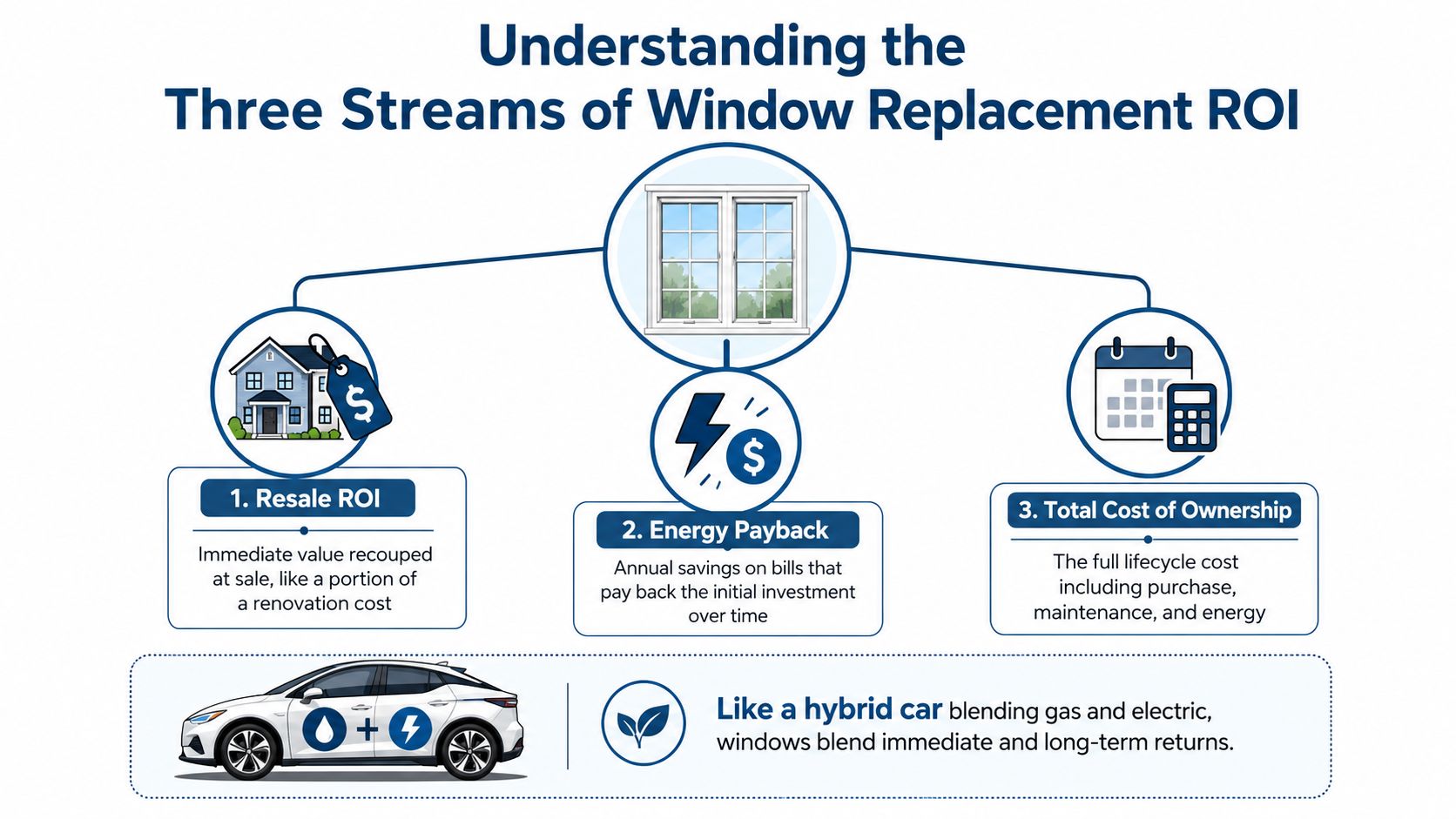
A sound analysis separates three streams. Resale recapture is the value a seller may recover when the home changes hands. Energy payback comes from lower heating and cooling costs. Comfort and ownership value includes fewer drafts, better temperature balance, reduced maintenance, noise control, and the practical benefit of living with a more reliable building envelope. Those streams don't mature on the same schedule, and they don't respond to the same window specifications.
The numbers support a candid conclusion. Published cost-vs-value data places vinyl replacement windows near 68.5% resale recapture and wood replacements near 61.2%, while energy-only payback can stretch from favorable multi-year cases to several decades depending on the home and climate (published window replacement ROI analysis). A Texas homeowner deciding whether to replace windows should therefore ask a sharper question than “Will they pay for themselves?” The useful question is, “Which form of value am I buying, and how long will I own the house?”
Table of Contents
- The Uncomfortable Truth About Window Replacement ROI
- Understanding the Three Streams of Window Replacement ROI
- What Resale Recapture Looks Like in Practice
- Energy Savings and the Slow Reality of Payback
- How Texas Climate Changes the Window Replacement Equation
- Financing Choices That Reshape the ROI Math
- Matching Window Choices to Your ROI Priority
- Your Window Replacement ROI Decision Checklist
The Uncomfortable Truth About Window Replacement ROI
New windows can reduce heating and cooling demand without quickly recovering their installation cost. DOE-linked estimates put annual savings from replacing single-pane windows with ENERGY STAR models at about $125 to $465. Energy-only payback can range from 7 to 12 years in favorable cases to 20 to 50 or more years in less favorable ones (DOE-linked window cost and ROI discussion). The spread reflects the starting point. Leaky single-pane units offer a different financial opportunity than a tight home with modern double-pane glass.
The popular claim that windows “pay for themselves” usually compresses several different returns into one promise. Marketing estimates may assume high savings and ideal installation conditions. A homeowner's result depends on glass area, solar exposure, air leakage, insulation, HVAC efficiency, thermostat settings, and local weather. In Texas, a package that performs well on a shaded north elevation may do little to address the cooling load from west-facing glass.
Three returns, three timelines
Resale recapture becomes financially measurable when the property sells. Updated windows can support the home's condition and buyer appeal, but published benchmarks generally do not show full recovery of the project price.
Energy payback accumulates through utility bills and remains the most assumption-sensitive stream. A technical analysis found that, even with energy prices assumed to rise with inflation at 3% annually, recovering a $10,734.08 replacement investment through energy savings alone could take almost 26 years (technical window replacement analysis).
The third stream is comfort and ownership value. Better windows can reduce drafts and hot or cold spots, improve operation, limit outside noise, and reduce maintenance linked to failed seals, swelling, or deteriorated frames. These benefits may justify replacement even when the utility-bill calculation remains slow.
Texas makes the distinction especially important. Cooling performance, solar exposure, and air leakage can outweigh broad claims about a window's efficiency rating. The financial case therefore rests on three separate outcomes, resale, energy savings, and comfort, each with its own timing and evidence.
Practical rule: Treat energy savings as one component of the decision, not the entire investment thesis.
Understanding the Three Streams of Window Replacement ROI
Replacement windows are a hybrid purchase. Part of the transaction resembles a kitchen renovation, where appearance and buyer perception influence resale value. Another part resembles an HVAC upgrade, where operating costs and service life matter over time. The financial result is not one payback period. It follows three separate streams, resale recapture, energy savings, and ownership value.
Start with resale recapture
Resale ROI measures how much of the installed cost may appear in the home's value at sale. A published example based on the 2025 Cost vs. Value dataset shows a project costing $20,091 contributing $13,766 in resale value, or 68.5% recapture (window replacement ROI example). The remaining cost may still purchase years of comfort and use, but it should not be presented as resale profit. As detailed in the opening section, resale value and project cost are separate figures.
Then calculate energy payback
Energy payback follows a simple relationship:
Net project cost ÷ annual energy savings = simple energy payback period
The calculation depends on the difference between the existing and replacement assemblies, local weather, window orientation, and household operation. U-factor describes heat transfer through the window. Solar heat gain coefficient, or SHGC, indicates how much solar heat enters through the glass. Homeowners comparing these ratings can use Breaking Glass Co.’s explanation of U-factor versus R-value rather than treating every efficiency label as interchangeable.
Texas adds a practical qualification. A window that reduces solar gain on exposed glass may affect cooling demand differently from one chosen mainly for winter performance. That makes energy payback sensitive to the home's exposure and existing air leakage.
Finally, measure ownership cost
Total cost of ownership includes purchase price, installation, maintenance, warranty coverage, expected service life, and energy impact. Add resale value and lifetime energy savings to comfort and durability benefits, then subtract financing costs and other project expenses. The result is more informative than dividing the invoice by an advertised monthly-savings estimate.
Homeowners studying how improvements affect marketability can browse real estate marketing guides for broader context. Keep the three streams separate before combining them.
What Resale Recapture Looks Like in Practice
Resale recapture is an estimate, not a refund at closing. It measures how much of a project's cost may appear in the property's resale value under a benchmark's assumptions. The published example for a 10-window vinyl project averaged $20,091 in cost and $13,766 in resale value, equal to 68.5% ROI. That benchmark is useful for framing expectations, but it does not predict a Texas closing adjustment.
Wood replacement windows in the same benchmark showed 61.2% recapture. The lower percentage does not make wood a poor choice. Higher project costs, architectural fit, maintenance expectations, and buyer preferences can change the return calculation. The relevant question is whether the installation matches the home and its likely buyers, not whether the invoice returns in full.
Reading the benchmark correctly
| Project Tier | Average Project Cost | Resale Value Added | Recoup Percentage |
|---|---|---|---|
| Vinyl replacement example | $20,091 | $13,766 | 68.5% |
| Wood replacement benchmark | Not provided in the verified example | Not provided in the verified example | 61.2% |
In a Texas neighborhood, an appraiser would generally compare the property with nearby sales, then consider window condition alongside the home's broader maintenance and finish level. A dated, difficult-to-operate window package may weaken buyer confidence, while clean installation and consistent appearance can support the property's overall condition. Comparable sales still control the market evidence. The replacement cost alone does not create an automatic line-item credit.
Buyers' reactions and appraised value can also diverge. Visible deterioration may affect offers before an appraisal, while a less noticeable efficiency upgrade may contribute more to comfort than to a separately recognized adjustment.
Timing changes the result
Resale value matters only when the homeowner sells. A near-term listing may favor reliable operation, curb appeal, consistent finishes, and documented installation. A long-term owner can accept slower resale recapture because comfort and reduced maintenance have value during occupancy.
The three streams should remain separate: resale recapture, utility savings, and comfort. A project can perform modestly on resale while still improving daily use, especially where failing windows create drafts, glare, or difficult operation.
For a clearer distinction between projected finished property value and project cost, see after repaired value for home buyers. That distinction prevents the common error of treating every dollar spent on windows as though it transfers directly into the sale price.
Energy Savings and the Slow Reality of Payback
Energy savings are real, but they rarely make window replacement a quick utility investment. Windows represent only one part of the building envelope. Cooling costs also reflect the roof, walls, air sealing, insulation, ductwork, equipment efficiency, thermostat settings, occupancy, and solar exposure. New windows can improve one weak point while leaving other major sources of heat gain unchanged.
For replacing single-pane windows with ENERGY STAR models, verified annual savings range from about $125 to $465 (DOE-linked energy savings estimates). That range is not a Texas guarantee. It shows why a substantial project can have a long utility-only payback, even when the windows perform as designed.
The formula is simple, the inputs aren't
A $12,000 project that saves $400 per year has a simple energy payback of roughly 30 years. At $200 in annual savings, the payback stretches much longer. This calculation excludes financing, maintenance, resale value, comfort, and changes in energy prices.
| Window Tier | Project Cost (15 Windows) | Annual Energy Savings | Years to Payback |
|---|---|---|---|
| ENERGY STAR replacement, favorable case | Not provided in verified data | $465 | Depends on installed cost |
| ENERGY STAR replacement, lower-savings case | Not provided in verified data | $125 | Depends on installed cost |
| Energy-only technical example | $10,734.08 | Not provided as a standalone annual figure | Almost 26 years |
The technical report models the risk clearly. Even with energy prices rising with inflation at 3% per year, the investment required almost 26 years to recover through energy savings alone, as the technical report models. That result is a warning against treating projected utility savings as the entire return.
Where the economics improve
Savings become more meaningful when existing windows are single-pane, visibly leaky, or exposed to intense sun. A West Texas home with large west-facing glass, for example, may reduce afternoon cooling demand when replacement glass limits solar heat gain. The result still depends on the room, shading, HVAC operation, and the rest of the envelope.
Savings may be limited when the house is already tight, the HVAC system is efficient, or the project includes windows that contribute little to the cooling load. Window selection should therefore connect the product to the exposure, not only to a marketing label.
Quotes should show U-factor and SHGC. Homeowners can review how U-factor compares with R-value and use those ratings to assess heat transfer alongside solar gain. Energy payback is usually the slowest ROI stream. It is most defensible for a long-term owner who also assigns value to comfort, durability, and reduced drafts.
How Texas Climate Changes the Window Replacement Equation
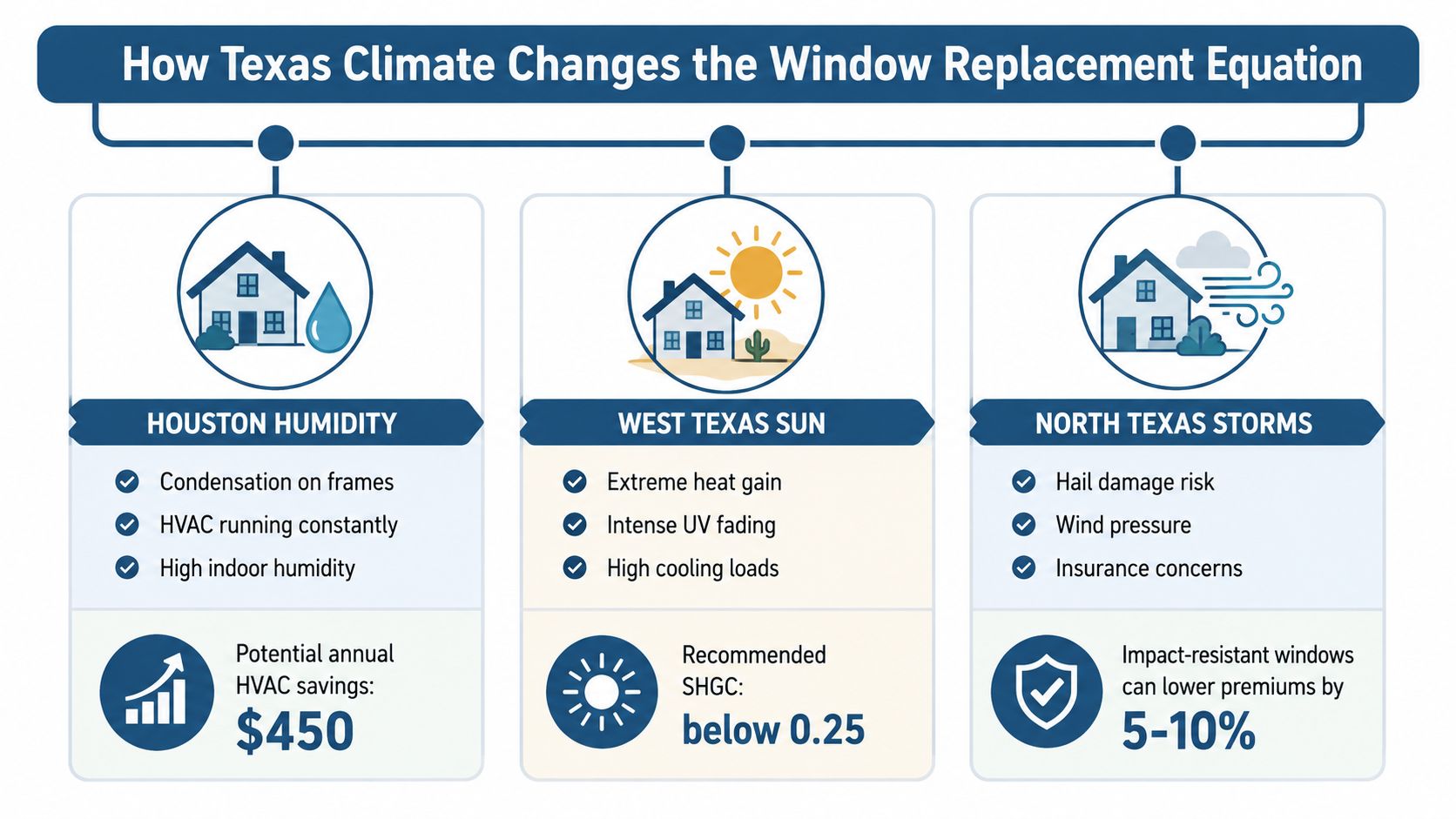
Texas does not have one window problem. A humid Houston-area house, a sun-exposed West Texas property, and a Gulf Coast home facing severe weather require different specifications. Applying one national package across these settings can waste money because the dominant source of loss, discomfort, or risk changes by location.
Houston and East Texas humidity
In humid regions, the practical priorities are interior comfort, condensation control, and limiting unwanted heat transfer. A properly selected insulated assembly, durable frame, and careful installation can support those goals. The relevant return may come mainly through comfort and lower HVAC demand, not resale recapture alone.
Vinyl can suit homes where moisture exposure and low maintenance matter, but the frame is only one component. Installation quality, drainage, perimeter sealing, and glass performance determine whether the replacement addresses the actual source of trouble.
West Texas solar exposure
West-facing glass can produce severe afternoon discomfort and higher cooling demand. SHGC therefore matters more on these elevations. Low-solar-gain glass can limit unwanted solar heat entering the room, while a package chosen for winter performance or broad marketing language may miss the dominant summer load.
Evaluate each elevation rather than assuming every opening needs identical glass. Replacing windows in the problem room or on the problem facade can align project scope with the source of discomfort and make the energy case more specific.
Gulf Coast weather exposure
Near the coast, storm performance and impact resistance can matter alongside thermal efficiency. Laminated or impact-rated assemblies may support protection, security, and buyer confidence even when direct utility savings remain modest. Insurance treatment varies, so homeowners should verify eligibility and documentation with their carrier rather than assume a discount.
The financial return can therefore include three separate streams: resale, energy, and comfort or risk reduction. A weather-focused specification may support ownership value that a utility-only spreadsheet misses. Homeowners comparing Texas window replacement services should match product and installation choices to the property's exposure.
A short visual explanation can clarify how frame, glass, and exposure interact:
Financing Choices That Reshape the ROI Math
Financing changes the project's financial result before energy savings begin. A lower monthly payment can improve affordability, but it does not prove profitability. Compare total repayment, promotional conditions, prepayment rules, expected resale timing, and the period required for energy savings to recover the cost.
Three common approaches require different checks:
- Cash payment: Avoids interest and gives the clearest ownership-cost calculation, but commits savings that might be needed elsewhere.
- Home-equity borrowing: May provide a structured rate and longer repayment period. Review the total loan cost and the risk tied to the home.
- Dealer promotion: Deferred-interest or same-as-cash terms can work if the balance is paid according to the contract. Missing that condition may add financing costs large enough to reduce the project's expected benefit.
Why the monthly payment can mislead
A $14,000 project spread across a long term may produce a manageable payment while leaving debt outstanding beyond the likely sale date. A promotion can appear to offer 0% financing while applying deferred interest if the balance is not cleared on time. Read the contract closely. Confirm whether interest accrues from the purchase date, when the promotional period ends, and what payment is required afterward.
| Financing Path | APR / Terms | Total Interest Paid | Breakeven Year | Effective 10-Year ROI |
|---|---|---|---|---|
| Cash | No financing | $0 | Based on resale and energy results | Based on project value, not provided as a verified figure |
| Same-as-cash promotion | Contract-specific | Depends on payoff compliance | Cannot be calculated without annual savings | Cannot be calculated without financing terms and savings |
| Home-equity borrowing | Contract-specific | Depends on rate and term | Cannot be calculated without annual savings | Cannot be calculated without financing terms and savings |
The table leaves unverified fields blank deliberately. A specific APR, term, interest total, or ROI requires an actual loan offer and a defensible estimate of annual savings. Substituting assumptions would create false precision.
Use an effective ROI calculation
A practical formula is:
Effective ROI = (resale value + lifetime energy savings + comfort value minus financing cost) ÷ net out-of-pocket cost
This calculation keeps three value streams visible. Resale recapture is separate from utility payback, while comfort has a real ownership benefit even when it is difficult to price. A room that stays usable during a hot afternoon, windows that open reliably, and fewer maintenance problems can justify a project that a utility-only calculation understates.
The formula also exposes why financing can change the decision. If resale value arrives only at sale and energy savings accumulate slowly, interest is charged immediately. A long loan may therefore reduce effective ROI even when the window package improves the home.
Homeowners evaluating transactions that involve alternative payment structures can also review guidance on closing deals with seller financing, though a window project and a property sale involve different legal and financial considerations. For contractor payment options, compare the written terms available through window replacement financing rather than relying on a verbal monthly-payment quote.
Matching Window Choices to Your ROI Priority
Window specifications should follow the value you want to create. Resale, energy performance, comfort, and storm durability reward different choices. A resale-focused homeowner may prioritize visible elevations and architectural consistency, while a homeowner dealing with severe solar gain may get more value from targeted glazing in one room.
| Priority | Frame Material | Glazing Package | Project Scope | Expected Recapture | Texas Note |
|---|---|---|---|---|---|
| Resale-first | Vinyl or a material consistent with the home | Double-pane low-E | Whole-home or visible primary facade | Use the published vinyl benchmark as a reference, not a guarantee | Match style and finish to neighborhood expectations |
| Resale-first | Wood where the architecture supports it | Double-pane low-E | Primary facade and prominent rooms | Use the published wood benchmark as a reference | Premium material may add appeal but also maintenance responsibility |
| Energy-first | Vinyl or fiberglass | Low-E glass selected for exposure | Problem rooms or high-solar elevations | Resale value is secondary to operating performance | Prioritize SHGC on strong west and south exposures |
| Energy-first | Vinyl or fiberglass | Higher-performance insulated glazing | Whole-home when existing units are poor performers | Depends on the home's starting condition | Existing insulation and HVAC performance affect savings |
| Comfort-first | Vinyl, fiberglass, or wood suited to the opening | Low-E, laminated, or other targeted package | Problem rooms first | Hard to isolate from buyer perception | Choose specifications around drafts, glare, noise, or moisture |
| Storm and durability-first | Durable frame suited to exposure | Laminated or impact-rated glass where appropriate | Exposed elevations or whole-home scope | May support buyer confidence beyond energy value | Verify code, insurance, and installation requirements locally |
The published figures cited earlier provide context for resale decisions, not a promise about a particular property. They also should not be used to justify every premium upgrade. Triple-pane glass may improve thermal performance, for example, but its added cost can be difficult to recover in a resale-focused project if buyers and appraisers do not assign comparable value to that feature.
Texas conditions make the energy and comfort rows more important than a generic national comparison suggests. Strong west and south exposures can create afternoon heat and glare, so SHGC and room-specific scope may matter more than installing identical windows throughout the house. In a storm-exposed location, laminated or impact-rated glass can address durability and buyer confidence even when utility savings are limited.
The practical choice is the specification that solves the largest verified problem at a defensible installed cost. If two packages address that problem equally well, choose the one with clearer warranty coverage, fewer maintenance demands, and a scope that avoids paying for performance where the home does not need it.
Your Window Replacement ROI Decision Checklist
A quote becomes useful only when it separates resale recapture, energy savings, and comfort from the financing offer. A monthly payment and a broad efficiency claim do not provide enough information for an investment decision.

Screen the quote
- Line-item pricing: Separate windows, glass upgrades, installation, trim, permits, disposal, and repairs. This reveals which features drive the installed cost.
- Performance documentation: Record the U-factor and SHGC for the exact assembly, rather than relying on a general product family.
- Installation scope: Confirm whether the work is an insert, pocket, or full-frame replacement. Identify allowances for concealed damage before signing.
- Warranty terms: Check coverage for glass seals, frames, hardware, labor, transferability, and weather-related exclusions.
Test the financial case
- Energy estimate: Ask for the assumptions behind projected bill reductions, including the existing window type, affected openings, and whether the estimate reflects Texas cooling loads.
- Resale expectation: Use the benchmark figures cited throughout this guide as context, not as a guaranteed appraisal adjustment. The published benchmark reports 68.5% for vinyl and 61.2% for wood (published resale recapture figures). Those figures support a resale comparison, not automatic justification for premium glass or frames.
- Ownership horizon: Compare the project with the time you expect to remain in the home. A shorter hold gives greater weight to condition and buyer perception, while a longer hold allows comfort and operating savings more time to contribute.
- Financing cost: Calculate total repayment, not just the advertised monthly amount. Include deferred-interest conditions and promotional deadlines.
Apply the sanity check
Divide the installed cost by realistic annual energy savings. The DOE-linked estimates noted above show that energy-only payback can be as short as 7 to 12 years in favorable cases and extend to 20 to 50 or more years in others (energy-only payback estimates). If the result exceeds your expected ownership period, classify the project accordingly. It may be primarily a comfort or consumption upgrade, not a fast financial investment.
Write down resale, energy, and comfort objectives separately. Ask the installer to connect each objective to a specification, installed cost, and measurable verification method. For Texas homes, room-specific exposure and glare concerns may justify targeted work instead of identical windows throughout the property.
Breaking Glass Co. supplies and installs residential and commercial windows and doors across Texas, including products specified for heat, sun exposure, and severe weather, with quotes, installation coordination, and warranty support. Visit Breaking Glass Co. to request a project quote and discuss which window package fits your home's climate, condition, and ROI priority.