
Most window advice starts from the wrong end. You're told old windows waste energy, so you should replace the lot. That skips the only question that decides whether the money works. Which part failed, and what happens if you fix just that part?
Table of Contents
- Start With the Part That Failed
- Repair and Replacement Side by Side
- Energy Savings That Actually Move the Bill
- What You Pay Across the Service Life
- Match the Failure to the Fix
- How East Texas Heat Changes the Call
- Choose Repair or Replacement for Your Openings
Start With the Part That Failed
Say a west-facing bedroom is fogged between the panes, the living room sash whistles at the meeting rail, and the rest of the house is fine. A salesperson looks at the age of the units and quotes ten new windows. I'd look at two failed components and quote one glass unit plus weatherstripping. That difference is the whole decision.
Age is a weak test. Glass, sash, hardware, weatherseal, and frame fail on different schedules, and a worn seal or sticky balance doesn't condemn a square, solid frame. A sound frame with a localized defect often beats a new window because you keep the flashing, trim, and wall interface that are already shedding water correctly, and you spend only on the part that's done.
The 2026 Rule
Repair earns the money first when the frame is solid and the trouble is worn weatherstripping, a broken crank or balance, dried glazing compound, or one fogged insulating unit. Replacement earns it when the frame is rotten or racked out of square, water has reached the wall, seals have failed across several units, or glass on a hot south or west wall lets in more sun than a storm, shade, or new glass can handle.
Everything below pins down what that choice costs per opening, what share of your energy bill either path can realistically move, and how many years of service you're buying with each dollar. East Texas twists all three, because cooling load and hard afternoon sun punish glass that a national average would call adequate. If a draft is your main complaint right now, work through practical ways to stop drafts from windows before you price demolition. Then use the side by side comparison that follows, one opening at a time, before you call anyone for a quote.
Repair and Replacement Side by Side
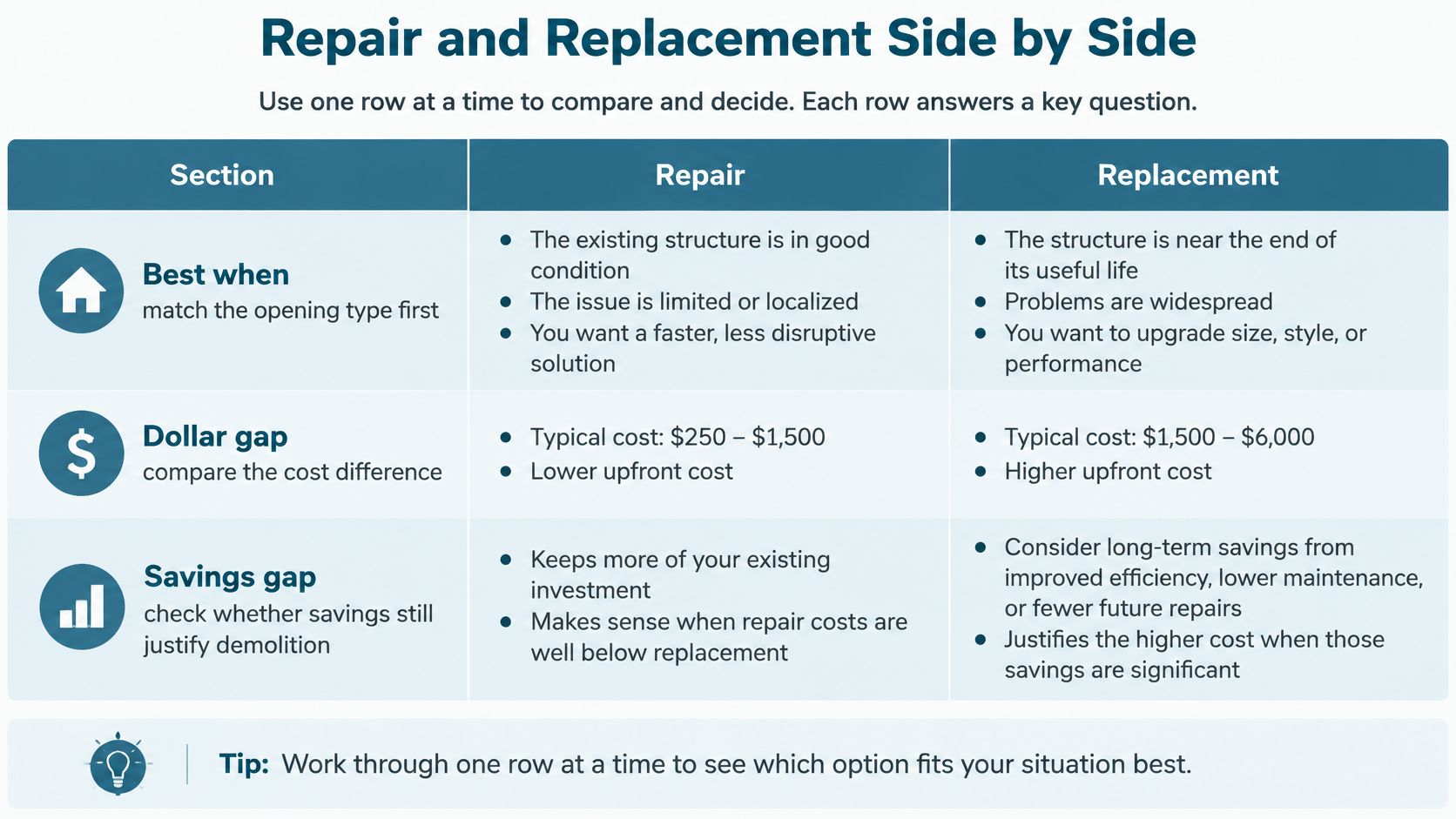
Compare one opening, not one house. Find the symptom under Best when, then ask whether the dollar gap and the savings gap clear the cost of tearing out a frame that still holds glass.
| Criterion | Repair or Retrofit | Full Replacement |
|---|---|---|
| Upfront cost | $180 to $720 per window; historic restoration $280 to $700 plus $165 to $295 for a storm | $600 to $1,800 per window; about $30,000 for a typical whole-house project |
| Energy savings | Restored historic windows plus storms about 14% to 24%; low-e storms about 20% of heating and cooling bills | High-performance replacements about 17% to 29%; ENERGY STAR over single-pane up to 13% of household bills |
| Service life | Properly restored historic windows another 50 to 100 years | A modern unit still needs hardware, seal, or sash service later, so replacement is rarely the last purchase |
| Best when | Sound frame and a localized defect | Rot, racking, water in the wall, widespread seal failure, or solar control repair cannot reach |
| Disruption | One opening, little demolition | Removal, new flashing, trim, and possible interior finish repair |
| Payback signal | Higher return when the frame is sound; low-e storm incremental cost about a three-year payback | Strongest from single-pane or very drafty glass; weak if the old unit is already a clear double-pane |
The price gap is wide at the opening level. In 2025, residential window repairs in the United States were reported at $180 to $720 per window, compared with $600 to $1,800 for full replacement, according to Dataintelo's door and window repair service market report. Preservation work lands in the same neighborhood on the repair side. At the other end, a Preservation Pennsylvania analysis of historic windows put a typical whole-house replacement at roughly $30,000 for materials, installation, and related construction.
The savings gap is far narrower than the price gap when the frame is sound. That same analysis found restoring existing historic windows and adding storm windows achieved roughly 14% to 24% in savings, against approximately 17% to 29% for high-performance replacement windows. A few points of difference against a multiple on the price.
When the frame is sound, a retrofit often costs less than half of replacement while landing near the same savings. That spread is the return argument.
Payback is where the table earns its place. A low-e storm window over single-pane clear glass carries an incremental cost that recovers itself in roughly three years. A full replacement sold on energy savings alone has to justify its entire price against those same few percentage points, which is a much longer road.
Service life widens the repair case further. Properly restored historic windows combined with storm windows can last another 50 to 100 years without significant work. A modern unit can still need hardware, a seal, or a full sash later. Repair lets you replace one failed piece at a time. Replacement puts a fresh set of wear parts on the same clock.
None of this makes repair automatic. A rotten sill, a frame pulled out of square, or water already in the drywall reverses the math, because every dollar spent saving that frame leaves with the demolition. The call turns on which component failed and on solar gain at that particular opening, which is why two windows on the same wall can justify opposite answers.
Energy Savings That Actually Move the Bill
Most ads quote one savings number. The published figures split sharply by what you're starting with, and that split decides whether replacement makes sense at all.
The chart below highlights the strongest case, swapping single-pane glass for certified units.
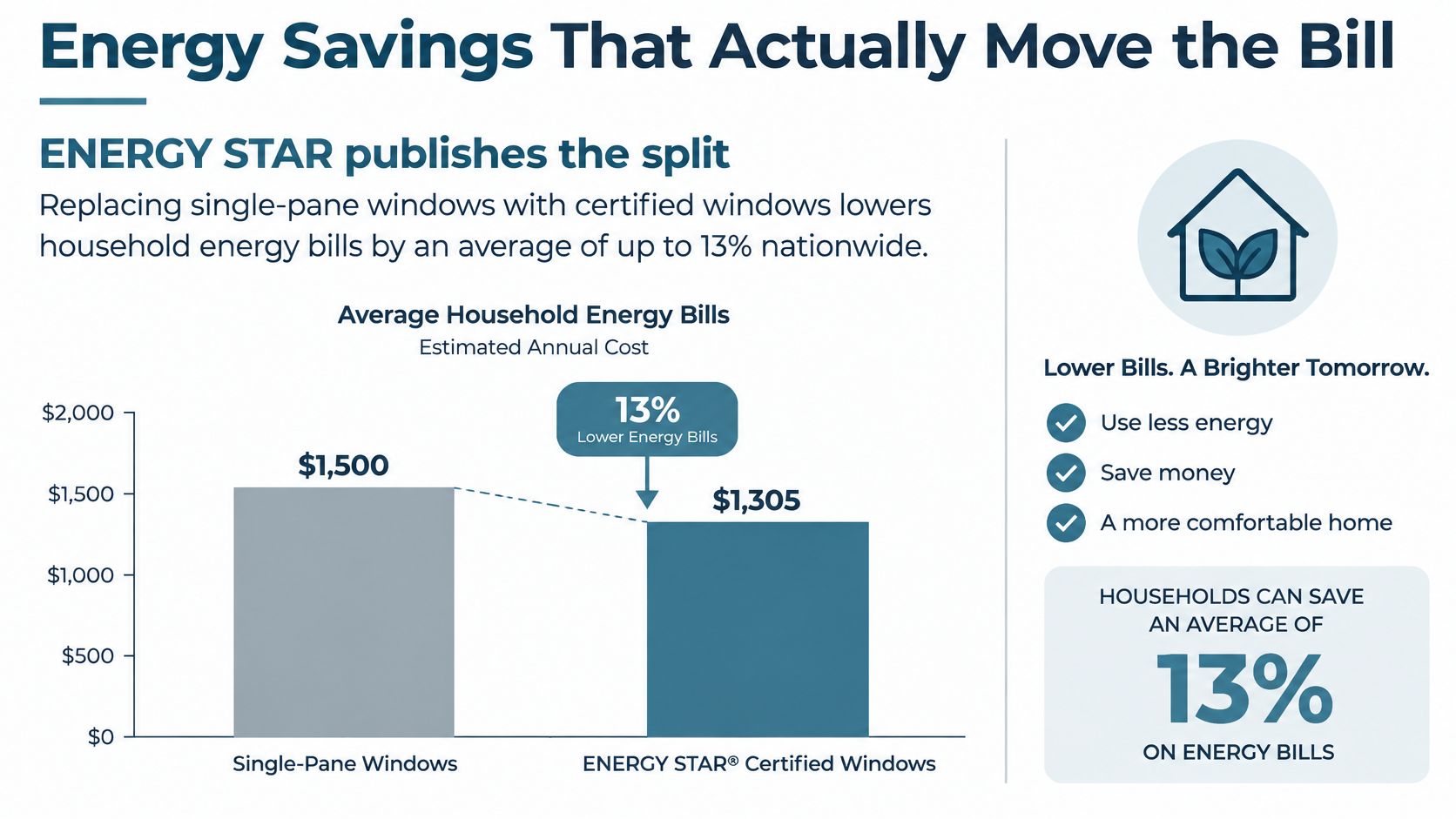
Replacing single-pane windows with ENERGY STAR certified windows lowers household energy bills by an average of up to 13% nationwide, while published savings estimates place annual savings at roughly $125 to $340 for single-pane replacement, compared with only $20 to $70 when an ENERGY STAR product replaces a typical clear-glass double-pane window, figures reported on ENERGY STAR's windows, doors, and skylights guidance. Same product, same installer, wildly different payback depending on the glass you already have.
EPA also estimates that low-e ENERGY STAR storm windows installed over single-pane clear glass can reduce annual heating and cooling bills by about 20%, with an approximately three-year payback for the incremental storm-window cost. That path keeps a sound frame and skips demolition entirely.
The Two Ratings That Matter
U-factor measures how fast heat flows through the glass and frame. Lower is better, and it matters most on cold nights and shaded walls.
Solar heat-gain coefficient, or SHGC, measures how much sun gets in as heat. In East Texas, this number often decides comfort on south and west walls, where a room can overheat through glass with an excellent U-factor but a high SHGC. I would compare SHGC as carefully as U-factor on any sun-exposed elevation before signing anything.
The short video below walks through how these ratings show up in real energy use.
Rehabilitation work matters for comfort in a way ratings don't capture. Fresh weatherstripping, gaskets, and sealing stop the draft that makes a room feel worse than the glass rating suggests, and uncontrolled air leakage can undermine even good glass. What sealing won't do is turn single-pane glass into low-gain glass, so a sunny west wall may still need a low-e storm, exterior shade, or new glass.
Savings alone are not a payback promise. Climate, utility rates, and the house itself change the result.
If your existing unit is already a decent double-pane and your complaint is one leaky sash, replacement for efficiency is the weakest spend on the page. Fix the leak. Replacement earns its energy case when it solves failed seals, poor glass, operability, and water management in the same project.
What You Pay Across the Service Life
First price is the least informative number in a window replacement vs repair decision. The useful figure is total spend across the years the work must last, including the second round of spending that rarely appears in the quote. That total usually turns on which component failed, not on the age of the window.
Whole-house dollars frame the stakes. The 2024 Remodeling Cost vs. Value report, as cited in MyHomePros' 2025 residential window market report, estimated ten vinyl windows at an average of $21,264 in the United States. Set that against per-opening restoration and storm costs, and the gap becomes the budget for every other efficiency project in the house. If the glass on a sun-exposed wall is the failed part and the frame is solid, a sash or unit replacement captures much of the comfort gain without buying new frames. On sound frames, the whole-house gap is hard to justify with a thin energy gain.
Institutional work arrives at the same logic from a different direction. A National Park Service case study chose repair after weighing energy costs, construction costs, and finance charges. A house is not a federal building, but the arithmetic travels: when frames are sound, replacement prices buy a narrow slice of extra savings, and payback can run past the life of the new seals.
The Costs Ads Omit
- Disruption: days of open walls, moved furniture, and rooms out of use while old units come out and new flashing and trim go in.
- Finish repair: interior trim, paint, and sometimes drywall touch-ups around openings that were not disturbed before.
- Disposal: old units going to landfill, plus the manufacturing cost baked into every new frame and insulated unit.
- A second cycle: a modern insulated unit can need a sash or seal replacement long before a restored frame does. That restarts spending the ads present as finished.
That last item erases thin paybacks. If a new unit saves a modest amount each year but needs glass work partway through its life, the clock resets. A repair strategy spends again only on the piece that failed. I would weigh that risk heaviest on openings where the glass is the weak point and the frame is still square, solid, and weather-tight.
Replacement is the better lifetime buy in one clear case. When deterioration is widespread, when the opening cannot be made weather-tight, or when the frame will not survive to carry new glass, every retrofit dollar dies with the frame. Buying once, with correct flashing, beats repairing toward an inevitable tear-out. If resale timing is part of your math, this breakdown of window replacement return on investment helps separate resale value from energy payback.
Before you decide, write one stack per opening: initial price, expected years, maintenance, energy effect, disruption, and disposal. Six lines will tell you more than any advertised U-value. The stack also exposes the sales shortcut: a whole-house quote prices every opening as if the frame, glass, and seal had all failed together.
Match the Failure to the Fix
Before any quote, walk the house with a notepad and check five things at every opening. You're building the list that keeps a salesperson from pricing the whole house by default.
- Air leakage: Run a hand or a lit incense stick around the sash and meeting rail on a windy day.
- Condensation between panes: Fog, haze, or dust you can't wipe off means the insulating-glass seal has failed.
- Operability: Does the sash open, close, and lock without forcing it?
- Water evidence: Stains, soft wood, or bubbling paint at the sill and nearby drywall.
- Frame condition: Is the frame square and solid, or racked, rotten, or spongy at the corners?
Symptoms and the First Fix
| What You See | First Fix | Replace the Unit When |
|---|---|---|
| Fog or dust between panes | Replace the insulated glass unit or sash | The frame is racked or several units have failed seals |
| Draft at the rail or sill, solid frame | Weatherstripping, gasket, or caulk | The opening cannot be made weather-tight |
| Sash painted shut or hardware broken | Free the sash; repair balances, ropes, or cranks | The sash is distorted and will not stay in the opening |
| Dried glazing compound or a cracked pane in a single lite | Reglaze or replace that lite | The surrounding sash is decayed |
| Soft sill, rot, or interior water stains | Stop the leak and replace the failed assembly | Water has reached framing or drywall |
| Single-pane glass on a sunny west or south wall | Low-e storm, shade, or new low-SHGC glass if the frame is sound | Frame condition or water management already requires a new unit |
| Clear double-pane that still operates | Repair air leaks only | Comfort problems trace to failed seals or a wall that cannot be detailed any other way |
Fog between panes is the most oversold symptom. The seal failed, the desiccant saturated, and mineral deposits turned the glass hazy. If the frame is square, insulated glass replacement swaps the failed unit and leaves the frame, flashing, and trim alone. A draft with solid wood or vinyl is a weatherstripping or gasket job. A painted-shut sash or broken balance is hardware. None of those is a whole-window problem.
Water is different. Soft sills, rot into the frame, or staining on interior drywall mean the assembly stopped managing water, and replacement with new flashing is the honest fix. When several fogged units sit in racked frames, specify an NFRC-rated U-factor and SHGC for your climate and orientation instead of accepting a generic energy-efficient claim. ENERGY STAR's methodology models whole-home replacement using climate-specific U-factor and SHGC criteria across 132 U.S. cities and cautions that actual savings vary with climate, utility rates, and house characteristics, as set out in ENERGY STAR's methodology for window savings estimates.
Texas rule: Repair when the glazing and frame remain serviceable and the defect is localized. Replace when recurring leakage, failed seals, or poor solar control indicate a system-level limit.
One mixed house makes this concrete. A 1990s double-pane home with one fogged bedroom window on a west wall and drafty living room sashes needs one glass replacement plus weatherstripping. Not ten new windows.
How East Texas Heat Changes the Call
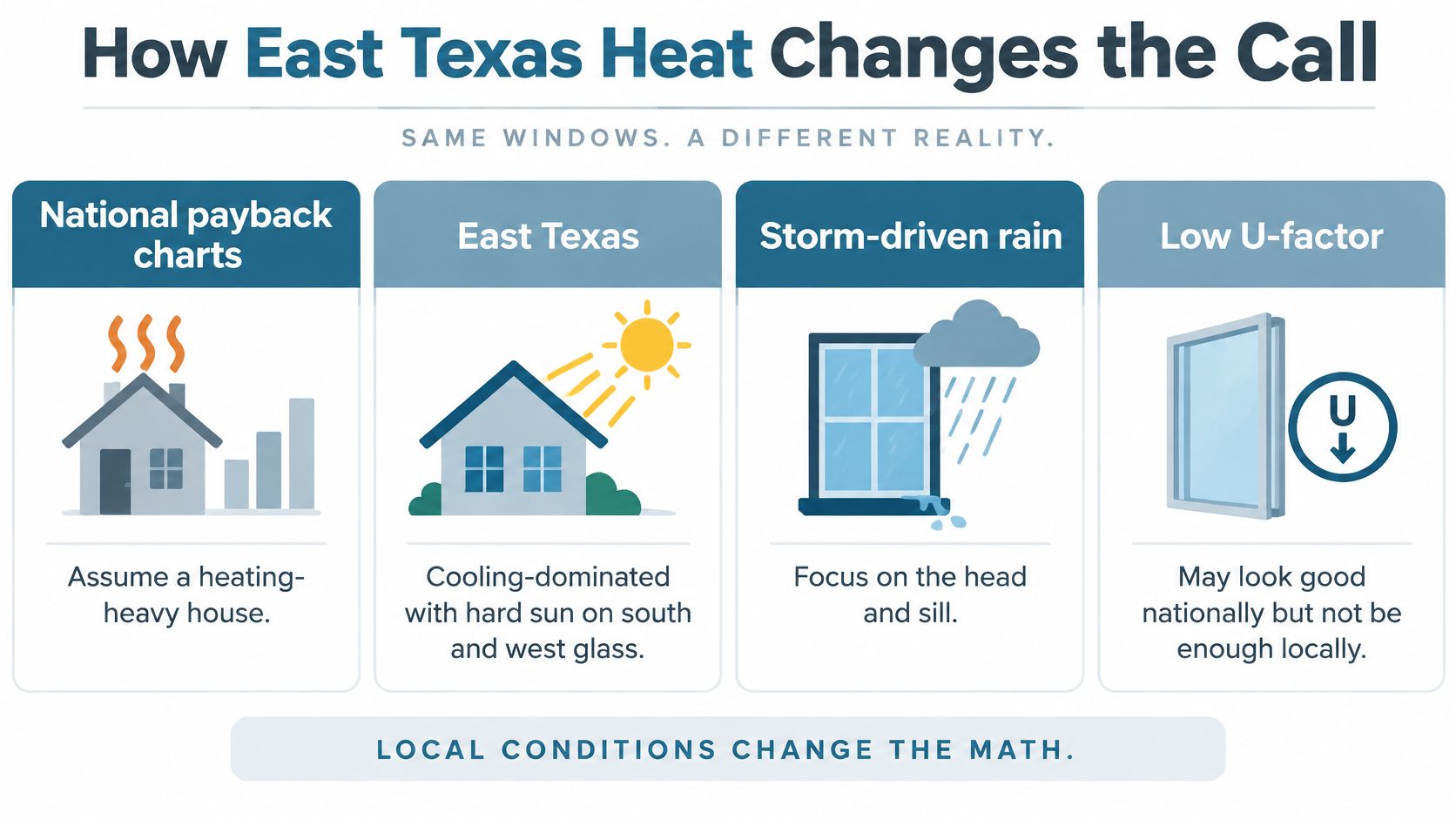
National payback charts assume a heating-heavy house. East Texas runs the other way. Cooling dominates, afternoon sun loads south and west glass for months, and storm-driven rain tests every head and sill joint.
Specifying for Sun, Not Averages
A northern label can mislead you here. Glass chosen to welcome winter sun up north will cook a Tyler living room in August, and your air conditioner pays for every point of unnecessary SHGC. When replacement is warranted, specify the NFRC label for that exact size, a low SHGC on sun-exposed elevations, and a higher SHGC only where winter light is welcome and summer sun is shaded by trees or an overhang.
That's why we sell custom-built, energy-efficient vinyl windows engineered for Texas and southwest climates rather than a one-climate national product. The glass package has to match the wall it sits in, not the warehouse it shipped from.
Repair stays rational in this climate when the frame is sound. Infiltration and solar gain can both be cut with weatherstripping, a low-e storm or interior panel, exterior shade, and sometimes new glass, without the landfill and manufacturing cost of a full unit. Don't expect a new window to fix a hot room caused by a leaky duct, thin attic insulation, or a west wall with no overhang. Diagnose the room before you blame the glass.
Installation Decides Whether Ratings Show Up
A rated unit only performs if the opening is detailed correctly. Flashing and sealant have to shed storm water outward, and a frame set out of square will drag, leak air, and stress its own seals. We guarantee window and door frames are installed level, plumb, and square so they open, close, and lock smoothly without catching or dragging. Our workmanship warranty covers airtight and waterproof seals against drafts, air leaks, or water penetration caused by installation flashing or caulking defects, and if a sealing defect shows up later, our local team comes out and fixes it at no cost.
The right kind of local evidence looks like this. Sarah M. of Tyler replaced ten old wood windows with vinyl units, her electric bill dropped immediately, and the crew left the house neat. That's a whole-house project starting from bad windows with a careful install. It isn't a promise that swapping serviceable double-panes will do the same.
Choose Repair or Replacement for Your Openings
Repair or retrofit when frames are sound and the defect is weatherstripping, hardware, glazing compound, one fogged unit, or a draft you can seal, especially if the glass is already double-pane. Add a low-e storm or exterior shade on single-pane glass that still has a solid frame, particularly on sunny elevations where solar gain drives the cooling bill.
Replace when rot, racking, repeated water entry, or many failed seals mean the opening can't be made tight. Replace also when poor solar control is a property of the glass itself and the frame isn't worth keeping. In those openings, repair money buys delay, not service life.
Ask any estimate to price it opening by opening. Repair, glass-only, or full unit, with NFRC U-factor and SHGC listed on every replacement and a note on how the flashing will be handled. If an estimator won't split the house that way, you're being sold a package, not a diagnosis.
We offer a free in-home consultation with no pressure and no obligation, plus free same-day quotes and free estimates, so you can compare that scope before committing. Bring your symptom list from the inspection walk. If your frames are fine, say so, and ask what repair or partial replacement costs beside the full-unit price.
If you're weighing window replacement vs repair in East Texas, start with an opening by opening diagnosis instead of a whole-house quote, and let Breaking Glass Co. price repair, glass-only, and full replacement side by side during a free, no-obligation in-home consultation. You'll get a same-day quote built around Texas heat, the correct SHGC for each wall, and installation guaranteed level, plumb, and square.