
You notice it on a bright afternoon first. The kitchen window looks cloudy in a way that wiping never fixes, and the haze seems to sit deeper than the surface glass. That's usually the moment homeowners realize they're not dealing with dirt, they're dealing with a failed insulated glass unit, and in East Texas heat that decision can't wait forever.
A good insulated glass replacement is often a straightforward repair, but only when the frame is sound, the unit was built correctly, and the new glass matches the old opening. If the seal has failed, the question isn't whether the glass looks bad, it's whether replacing just the unit makes sense for the long haul in a climate that beats on windows hard.
Table of Contents
- How to Tell Your Insulated Glass Has Failed
- What an Insulated Glass Unit Actually Is
- Replace the Glass Unit or Replace the Whole Window
- Measuring and Ordering the Replacement IGU
- Installation Day and the Replacement Process
- Cost Factors, Warranty, and Texas Climate Considerations
- Decision Checklist Before You Commit
How to Tell Your Insulated Glass Has Failed
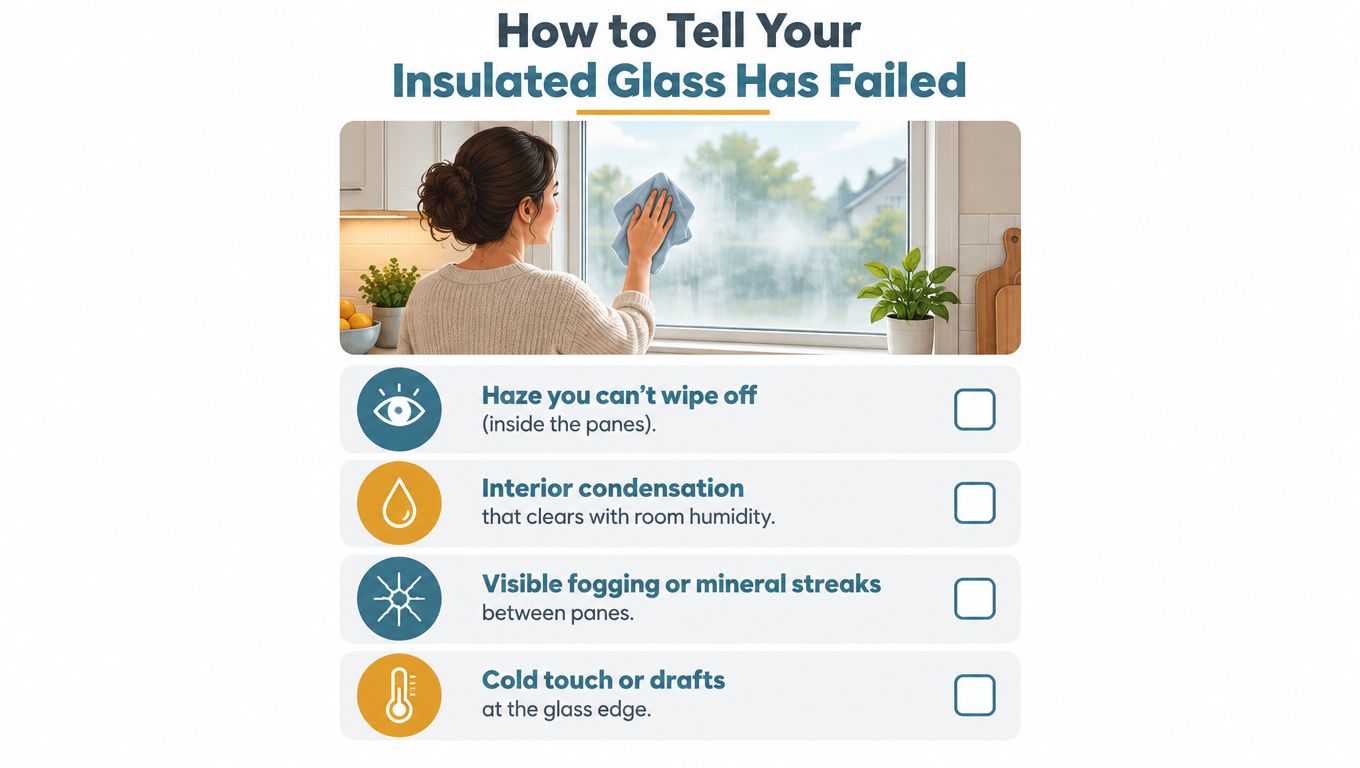
The first clue is usually a window that looks dirty from the inside, even after you've cleaned both sides. A homeowner will wipe the kitchen glass, step back, and still see a milky film or streaking that seems trapped between the panes. That's the point where insulated glass replacement starts becoming the practical fix, because the problem isn't on the surface anymore.
Separate fog from everyday moisture
Interior condensation is a humidity problem. It forms on the room side of the glass when indoor air is damp and the pane is cold, then it clears when conditions change. Exterior condensation is often just morning dew, especially on cool nights and humid mornings, and it wipes off like normal moisture.
A true seal failure is different. Moisture is trapped inside the sealed cavity, so the haze stays put, often starting as seasonal fog and then turning permanent. That's why a window can seem fine in one season and look ruined the next.
Practical rule: if the cloudy film is between the panes and you can't wipe it off from either side, you're not looking at a cleaning issue.
What the window is telling you
A failed unit often leaves other clues. The glass edge can feel colder than the rest of the pane, or you may notice a faint draft around the sealed perimeter if the frame or stop work is loose. Some homeowners also notice a musty or chemical smell near badly failed units, especially when the desiccant has been overwhelmed for a while.
The pattern matters. Early failure often shows up as a small patch of fog after a temperature swing, then spreads as the seal keeps degrading. If you're seeing that on a kitchen window, a patio door lite, or a sidelite near strong afternoon sun, the unit is usually telling you the same thing, the cavity is no longer dry.
For a simple visual reference, this fogged glass guide from Breaking Glass Co. is useful when you're comparing cosmetic condensation to a true failed seal.
What an Insulated Glass Unit Actually Is
An insulated glass unit, or IGU, is not just “double pane glass.” It's a built assembly with two or sometimes three panes, a spacer around the edge, a sealed cavity in the middle, and coatings or gas fills that improve performance. When one part of that system fails, the whole unit usually has to be replaced rather than patched.
The parts that actually matter
The spacer is the band that keeps the panes apart. It may be metal or a warm-edge material, and it does more than hold shape, it also defines the cavity depth and helps manage edge temperature. Inside that spacer system sits desiccant, which absorbs moisture for as long as the unit stays tight.
The seals are what keep the cavity dry. There's a primary seal and a secondary seal, and once both are compromised, humid air gets in, the gas gets out, and fogging starts. In well-built units, the failure point is usually the edge system, not the glass itself.
Low-E coatings sit on one of the interior-facing surfaces of the glass and control heat transfer. In Texas, that coating choice matters because west and south exposures take a beating from sun and attic heat. The wrong coating can leave you with a replacement that technically fits but still performs poorly.
Why the glass type can't be guessed
Not every pane can be swapped for any other pane. Tempered, annealed, and laminated glass all behave differently and serve different safety roles. A shower door panel or decorative lite doesn't automatically match a living-room window or a door sidelighted opening, especially where safety-glazing rules apply.
The unit you buy needs to match the opening, the coating position, the thickness, and the safety requirement. If one of those is wrong, the job may fit on paper and fail in the field.
A proper replacement order starts with understanding what failed, then matching the new assembly to the old one as closely as possible, or upgrading it intentionally where the exposure calls for it.
Replace the Glass Unit or Replace the Whole Window
The honest answer is that insulated glass replacement is often the right repair, but not always the right investment. A glass-only job usually costs less than a full-frame replacement, and it makes sense when the frame is sound, the sash operates correctly, and the failure is limited to one or two sealed units. If the rest of the window is aging badly, the math changes fast.
Compare the repair to the bigger job
| Factor | Glass-Only IGU Replacement | Full-Frame Replacement |
|---|---|---|
| Best fit | Sound frame, failed sealed unit | Rotted, warped, or leaky frame |
| Scope | Replaces the insulated glass only | Replaces the whole window assembly |
| Energy gain | Improves only the glass portion | Improves glass, frame, and air sealing |
| Risk | False economy if the frame is weak | Higher project scope, but more complete fix |
| Typical use case | One failed unit in an otherwise good window | Repeated failures or frame deterioration |
What usually decides it
If you've got a newer frame in good shape, glass-only replacement is a strong candidate. If you've got warped wood, rotted sills, failed weatherstripping, or a window from the single-pane era, the glass is only one weak point in a bigger system. In those cases, replacing the IGU can buy time, but it doesn't fix the air leakage or frame problems that keep driving heat gain.
Texas climate tilts the decision too. On south- and west-facing openings, the frame and installation quality matter as much as the coating on the new glass. A new IGU sitting in a leaky or distorted frame won't perform like a real upgrade, even if the cavity is perfectly sealed.
If you're comparing options, a resource like casement window cost breakdown can help you think through the broader cost structure before you commit to just one part of the opening.
Measuring and Ordering the Replacement IGU
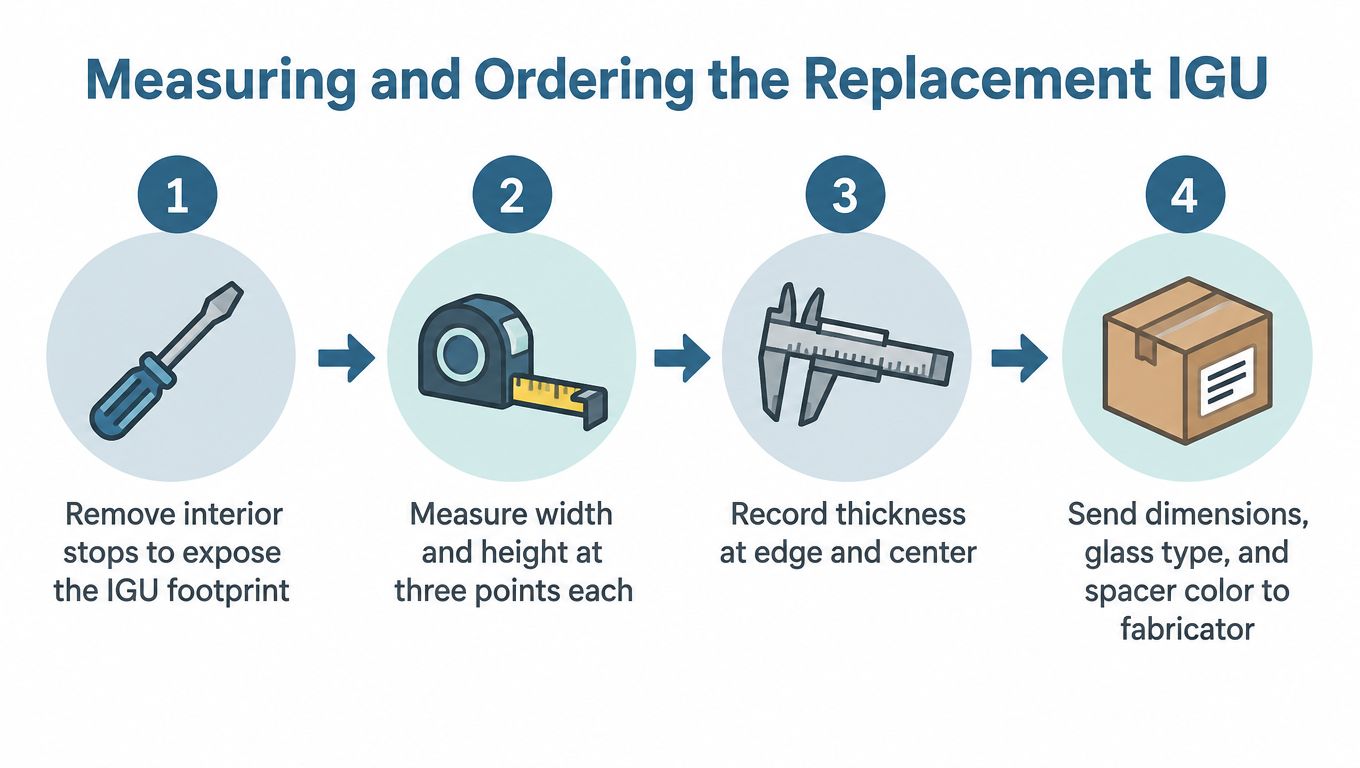
The measuring stage is where a lot of bad replacements are avoided. A tech doesn't just guess the size from the visible glass. The interior stops come off first on one side, because that exposes the exact footprint the new unit has to fit into without binding or rattling.
Measure the opening the way fabricators need it
Width and height should be taken at three points each, top, middle, and bottom, because older East Texas homes are often a little out of square. You also need the thickness, the spacer color and width, and the low-E orientation if the old unit still shows that detail. If the existing unit has a gas-fill label or an etched mark, photograph it before the glass goes out.
Photos matter more than most homeowners think. A clear shot of the bug etch, the corner construction, and any muntin pattern helps the fabricator match what's already there. If the unit has grids, privacy texture, or a specialty edge, the order should spell that out instead of leaving it to interpretation.
Don't skip the coating and safety details
If the opening is in a hazardous location or near a door, safety-glazing requirements may apply, and the replacement has to reflect that. The same goes for coat position and glass type, because a standard clear IGU isn't always the right answer for a bright west-facing wall.
Good order notes save install time later. If the dimensions are wrong, the coating is wrong, or the thickness is off, the crew ends up fighting the opening instead of setting the new glass cleanly.
For a step-by-step measurement reference, this window size guide from Breaking Glass Co. is useful if you're trying to understand what the installer is checking before the order goes in.
Installation Day and the Replacement Process
A clean IGU swap is more controlled than most homeowners expect. The crew protects the floor, removes the interior stops, cuts the old sealant bond, and lifts the failed unit out with suction cups. Once the glass is out, the frame gets inspected for rot, water intrusion, weep blockage, or corroded setting blocks, because skipping that check is how a small repair turns into a callback.
What happens during the swap
New setting blocks go in first, usually at the quarter points, so the weight is carried evenly. Then the replacement unit is bedded into sealant, seated against the shims, and aligned so the spacer and perimeter stay true. The stops go back on with fresh fasteners, and the exterior edge is tooled with weatherproofing sealant.
That sequence sounds simple, but the details matter. If the unit is forced into a tight opening, the seals can be stressed from day one. If the setting blocks are wrong, the glass can sit unevenly and telegraph problems later.
How long it usually takes
A single window swap is often a short visit, and a whole-home project with several failed units can usually be handled in one long day. The sealant needs time to cure before heavy rain or painting, so the work doesn't end the moment the truck pulls away.
A reasonable crew should leave the room clean, the glass seated square, and the opening checked one more time before they go. That's especially important in older Texas houses where the frame may look fine at a glance but still hide movement or moisture damage.
Cost Factors, Warranty, and Texas Climate Considerations
A homeowner in East Texas usually finds the quote changes for the same reason the failure started, heat, sun, and the condition of the opening. A basic clear IGU costs less than tempered glass, low-E coatings, gas fill, or decorative grids, and hard-to-reach upper windows add labor because the unit has to be handled, set, and sealed with more care. If you want a local price point for a full-window job instead of a glass-only repair, the casement window cost breakdown gives a useful comparison to keep in mind.
What pushes the price up or down
The biggest price jump usually comes from the glass spec. Clear replacement glass is the simplest order. Add low-E coating, argon fill, tempered or laminated safety glass, or a decorative pattern, and the fabrication cost rises because the unit has to be built to that exact spec. Frame damage also changes the math. If the pocket is rotted, warped, or packed with old sealant, glass-only replacement stops being a clean swap and turns into extra prep.
| IGU Configuration | Unit Cost Range | Expected Warranty |
|---|---|---|
| Basic clear IGU | About $250–$450 installed | Often shorter on entry-level units |
| Low-E IGU with gas fill | About $325–$600 installed | Commonly longer on premium units |
| Tempered or laminated IGU | About $400–$750 installed | Depends on glass spec and installer |
| Decorative or grid unit | About $450–$900 installed | Depends on manufacturer |
These ranges move with size, access, and exact spec. A small single unit in an easy opening may land at the low end, while a larger upper-story sash with a coated safety package can push higher.
Warranty is two different things
The glass unit warranty and the labor warranty are separate. The manufacturer covers the IGU itself, while the installer covers how it was measured, set, and sealed. If the frame shifts, settles, or gets damaged by pressure washing or water intrusion, that is often outside both warranties, so the written terms matter more than a verbal promise.
Independent industry guidance may describe properly made and installed IGUs as having lower failure risk over time, but in Texas the edge system takes the abuse. South and west exposures bake the perimeter seal, and standing water around the frame makes it worse. For more on how heat, storms, and exposure change window choices, see this Texas window replacement guide.
That is why a glass-only repair can save money on a solid frame and still be a false economy on a tired one. If the sash is already moving, the seal keeps failing, or the frame has moisture damage, you may only buy a few more years before a full replacement becomes the better spend.
Decision Checklist Before You Commit
The easiest way to avoid a bad quote is to treat the decision like a short field checklist. If you can answer these questions clearly, you're in a much better position to choose between glass-only repair and a full replacement.

Keep it simple on the quote call
- Window age under 10 years? If yes, glass-only replacement is often worth pricing first.
- Frame material and condition intact? If the frame is straight, dry, and solid, the IGU may be the only failed part.
- One unit failed or several? One bad unit points to a repair. Multiple bad units can point to a broader replacement plan.
- Glass spec documented in writing? Ask for coating, thickness, and gas-fill details before you sign.
- Warranty terms clear? Make sure glass and labor are both addressed in writing.
A quote that can't answer those questions isn't complete enough for a homeowner to trust. On-site, you want the installer to look at the frame, the glazing pocket, and the failed unit together, not just price the visible fog. If the opening shows rot, sash failure, or repeated seal loss, full-frame replacement starts making more sense than another glass-only patch.
Walk the list before you commit, photograph the opening, and ask for the glass specification in plain English. If the answers are vague, that's your sign to keep shopping.
If your window has fogged between the panes and you want a straight answer on repair versus replacement, contact Breaking Glass Co. for a quote that accounts for the frame, the glass spec, and Texas heat. They handle insulated glass replacement and full window projects, so you can compare the genuine options before you spend money on the wrong fix.