
Your living room may feel hotter than the rest of the house, the glass may fog after a cool morning, or energy bills may rise even though the thermostat setting has not changed. In Texas, strong sunlight can make ordinary glass feel like a radiant heater. A failed edge seal can also trap moisture inside the unit, leaving the window cloudy.
Insulated glass is a sealed assembly of two or more panes separated by a spacer, with air or inert gas in the cavity. That space slows heat transfer and can improve comfort indoors. The diagnostic detail matters: condensation on the room-side surface often reflects indoor humidity and a cold pane, while fogging between panes points to internal seal failure.
The practical question is whether the existing unit still performs adequately. In a sunny Texas exposure, upgrading from double-pane to triple-pane or vacuum glass may pay off when lower heat gain and better comfort justify the added cost. Performance labels and the window's condition help determine that choice.
Table of Contents
- Understanding Insulated Glass and Why Homes Need It
- How an Insulated Glass Unit Is Built
- Comparing Double-Pane, Triple-Pane, and Gas Fill Options
- Reading Window Performance Labels Without Confusion
- Diagnosing Condensation and Seal Failure in IGUs
- How Energy Codes and New Technologies Are Changing IGU Standards
- Choosing the Right Insulated Glass for Your Project
Understanding Insulated Glass and Why Homes Need It
An insulated glass unit, commonly called an IGU, joins two or more panes with a sealed cavity between them. A spacer holds the panes apart, while edge seals keep air or inert gas inside. This separation slows heat transfer, so the window can help moderate indoor temperatures more effectively than a single pane.
The practical benefit becomes obvious near the glass. On a sunny Texas afternoon, single-pane glass can send noticeable solar heat into a room. During a cold spell, its interior surface may feel chilly even while the heating system runs. An IGU creates a thermal buffer between those conditions.
Why single-pane glass feels uncomfortable
The cavity does not make a window perfectly airtight or remove every source of solar heat. It can, however, improve comfort near the opening and reduce the work required from heating and cooling equipment. Low-emissivity coatings, gas fills, and improved spacers can refine performance further.
If you are comparing replacement windows rather than repairing one pane, this guide to find energy saving window solutions offers a useful place to review related options.
How to tell what you already have
View the glass edge from an angle. An insulated unit usually has a spacer bar around its perimeter, while a single pane has no sealed cavity. A manufacturer's label may also be etched into the glass or attached to the frame.
Moisture location provides an important diagnostic clue. Water on the room-side surface may result from indoor humidity meeting a cold pane, and it should usually wipe away. Fogging between panes suggests that the internal seal may have failed, allowing moisture into the cavity. Those conditions call for different responses, so check where the moisture appears before ordering replacement glass.
Practical rule: Two panes do not guarantee a healthy unit. Pane count describes the original construction, while the seal determines whether the cavity is still protected.
The market's continued expansion reflects the role IGUs now play in modern building envelopes. A separate estimate placed the global market at USD 13.96 billion in 2024 and forecast USD 23.19 billion by 2033, with a 5.8% CAGR, as reported by MarketsandMarkets. These figures describe industry demand, not guaranteed savings for an individual home.
For a sunny Texas exposure, moving from double-pane to triple-pane or vacuum glass makes sense only when reduced heat gain, quieter interiors, or better surface comfort justify the added cost. A sound double-pane unit may already meet the home's needs, while a failed seal should be diagnosed before comparing upgrades.
How an Insulated Glass Unit Is Built
An IGU is easier to understand if you visualize it as a layered sandwich. The outside pane faces weather, the inside pane faces your room, and the space between them does most of the insulating work. Around the edges, a spacer and seal system protect that cavity from moisture intrusion.
The principal components are:
- Glass panes: These provide the physical barrier, daylight opening, and surface onto which coatings may be applied.
- Spacer: This maintains the gap between panes and forms part of the perimeter assembly.
- Desiccant: A moisture-absorbing material inside or associated with the spacer helps control residual humidity in the cavity during manufacturing.
- Primary and secondary seals: These close the unit and help retain the air or gas fill.
- Cavity fill: The space may contain ordinary air or an inert gas such as argon, depending on the specification.
The cavity isn't an empty decorative gap. It interrupts direct heat movement through the glass assembly. Argon is used because its properties can improve thermal performance compared with ordinary air, but the gas only helps if the unit is properly fabricated and the seals remain sound.
Why the edge deserves attention
Homeowners usually focus on the center of the glass, yet the perimeter can be the vulnerable part of an IGU. The spacer bridges the panes at the edge, and the seal must resist movement caused by temperature changes, weather, and building conditions.
A low-E coating adds another layer of control. It reflects selected heat energy while allowing useful daylight to pass, depending on the coating and its placement. Warm-edge spacer designs can reduce heat transfer at the perimeter compared with older spacer approaches, which matters when you're trying to limit cold edges and condensation.
The frame also affects the finished result. A high-performing IGU installed in a poorly fitted or poorly sealed frame won't deliver the same comfort as the glass specification suggests. Ask whether a quote covers glass-only replacement, sash replacement, or a complete frame and window assembly.
This video offers a visual explanation of the components and operating principle:
The seal is the part I want homeowners to remember. If it fails, the unit can lose its designed cavity condition and admit moisture, even though the panes and frame still look physically intact.
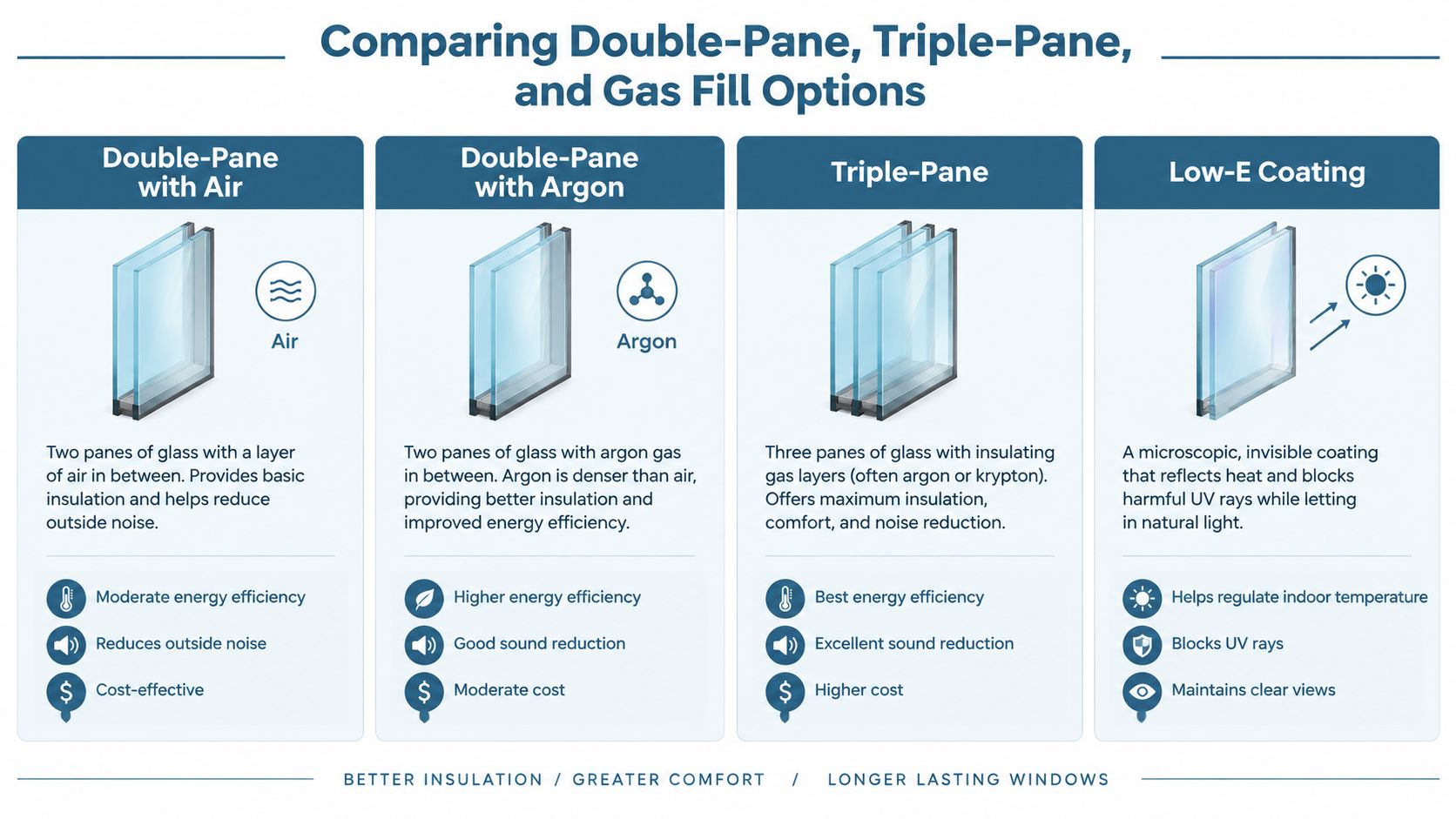
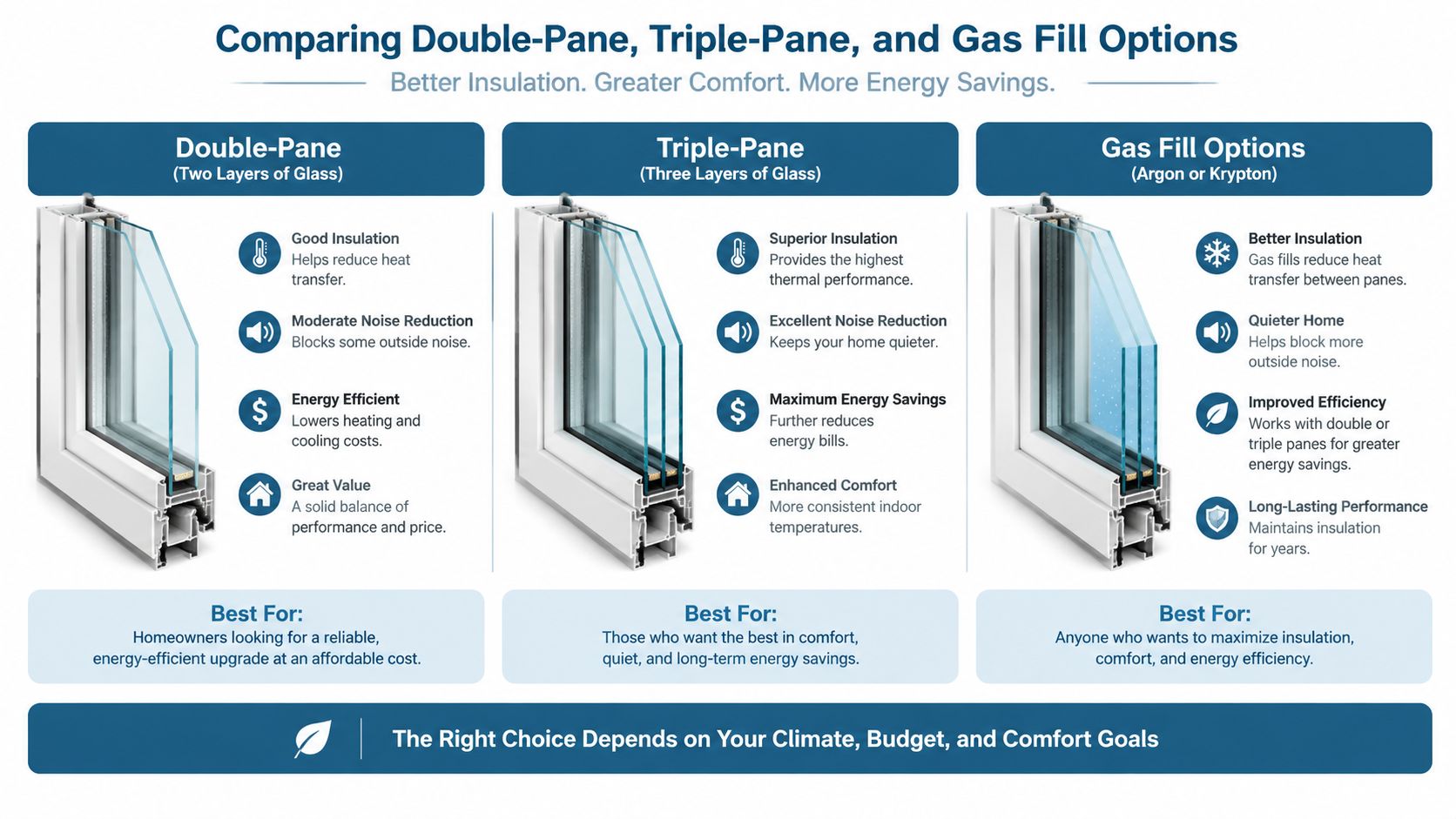
Comparing Double-Pane, Triple-Pane, and Gas Fill Options
The right IGU isn't automatically the one with the most panes. A Texas home often needs strong solar control, while a northern home may place greater emphasis on limiting winter heat loss. Glass orientation, window size, frame design, ventilation, and budget all affect the decision.
Double-pane with air
This is the straightforward insulated configuration. Two panes create one sealed cavity, and air occupies the space. It can be a sensible choice for a basic replacement where the existing window is single pane and the homeowner wants a meaningful construction upgrade without adding the weight or complexity of another pane.
Its limitation is that it may leave performance on the table in strongly sun-exposed rooms. Pairing double-pane glass with an appropriate low-E coating can matter more than choosing a thicker unit.
Double-pane with argon and low-E
Argon-filled, low-E double-pane glass is a common middle ground. The gas fill supports insulation, while the coating can help manage radiant heat transfer and solar gain.
For Texas, don't judge this option by U-factor alone. A west-facing window may need a solar-control low-E selection with a suitably lower SHGC, while a shaded opening may call for a different balance of daylight and heat control. Review a full window label rather than accepting a sales phrase such as “energy efficient.”
Homeowners weighing the basic differences can compare triple vs double pane windows and also review this explanation of single-pane versus double-pane windows.
Triple-pane glass
Triple-pane units add another glass layer and another cavity. That can improve insulation and reduce the temperature contrast at the interior surface, but the assembly is heavier and may require a frame and hardware designed for it.
Triple pane can be worthwhile when a home has severe comfort problems near large windows, when the design prioritizes high thermal performance, or when the project is in a climate where winter heat retention dominates. In a hot-sun Texas application, the extra pane isn't automatically the best investment if the selected coating and SHGC don't control solar gain.
Vacuum insulating glass
Vacuum insulating glass uses a very thin evacuated space rather than a conventional air or gas cavity. It represents a premium and more specialized path, particularly where a project needs improved performance in a relatively thin profile.
Availability, fabrication requirements, price, durability, and replacement logistics deserve careful review. Ask for whole-window values, not just center-of-glass claims, because frame and edge behavior influence real-world performance.
A practical selection test is simple:
- Identify the room's main problem, heat gain, cold interior glass, noise, condensation, or failed seals.
- Check the window's orientation and shade.
- Compare U-factor and SHGC together.
- Confirm that the frame and hardware can support the chosen unit.
- Review warranty language for seal failure and moisture between panes.
Reading Window Performance Labels Without Confusion
Window labels become useful once you stop treating every number as a universal score. Each metric answers a different question, and Texas homeowners usually need to consider both insulation and solar control.
U-factor describes how readily heat moves through the window assembly. A lower U-factor generally indicates better resistance to heat transfer. The Lawrence Berkeley National Laboratory's high-performance window resources identify ENERGY STAR-oriented technology around U ≈ 0.30, while advanced insulating glass research is pushing center-of-glass U-factors toward 0.10 Btu/hr-ft²-°F using three glass layers, two low-E coatings, and low-conductivity gas fills. These are different reference points, so don't compare a center-of-glass value directly with a whole-window rating.
R-value is the inverse-style insulation language many homeowners already know from walls and attics. A higher R-value suggests more resistance to heat flow, but window labels commonly emphasize U-factor instead. For a fuller explanation, review U-factor versus R-value before comparing quotes.
SHGC matters in sunny rooms
The Solar Heat Gain Coefficient, or SHGC, describes how much solar heat enters through the window. A lower SHGC can be useful on exposed Texas elevations, especially where afternoon sun drives room temperatures upward.
That doesn't mean the lowest possible SHGC belongs on every opening. A shaded window, a north-facing elevation, or a room that benefits from winter sun may need a different balance. Your supplier should evaluate orientation and shading instead of assigning one glass package to the entire house without discussion.
Visible Transmittance, or VT, describes how much visible daylight passes through. Lower solar gain and high daylight can coexist, but the final appearance depends on the coating, glass makeup, and window size.
A lower U-factor helps with heat transfer. A lower SHGC helps limit solar heat gain. They solve related problems, but they aren't interchangeable.
Read the label as a system document. Check whether the values apply to the whole window or only the glass center, then confirm the product configuration matches the quote, including pane count, coating, gas fill, spacer, and frame.
Diagnosing Condensation and Seal Failure in IGUs
A wet window doesn't automatically mean the IGU has failed. The location of the moisture is the first diagnostic clue, and homeowners often save money by identifying that clue before calling for replacement glass.
Start with the surface
If moisture forms on the room-side surface, indoor humidity may be condensing on a cold pane. Cooking, bathing, poor ventilation, and humid weather can all contribute. Wipe the glass, improve exhaust ventilation, and observe whether the moisture returns under the same conditions.
Exterior condensation can appear when the outside surface becomes cooler than the surrounding air. That can happen during weather conditions where the window surface reaches the outdoor dew point. Exterior moisture isn't proof that the seal has failed.
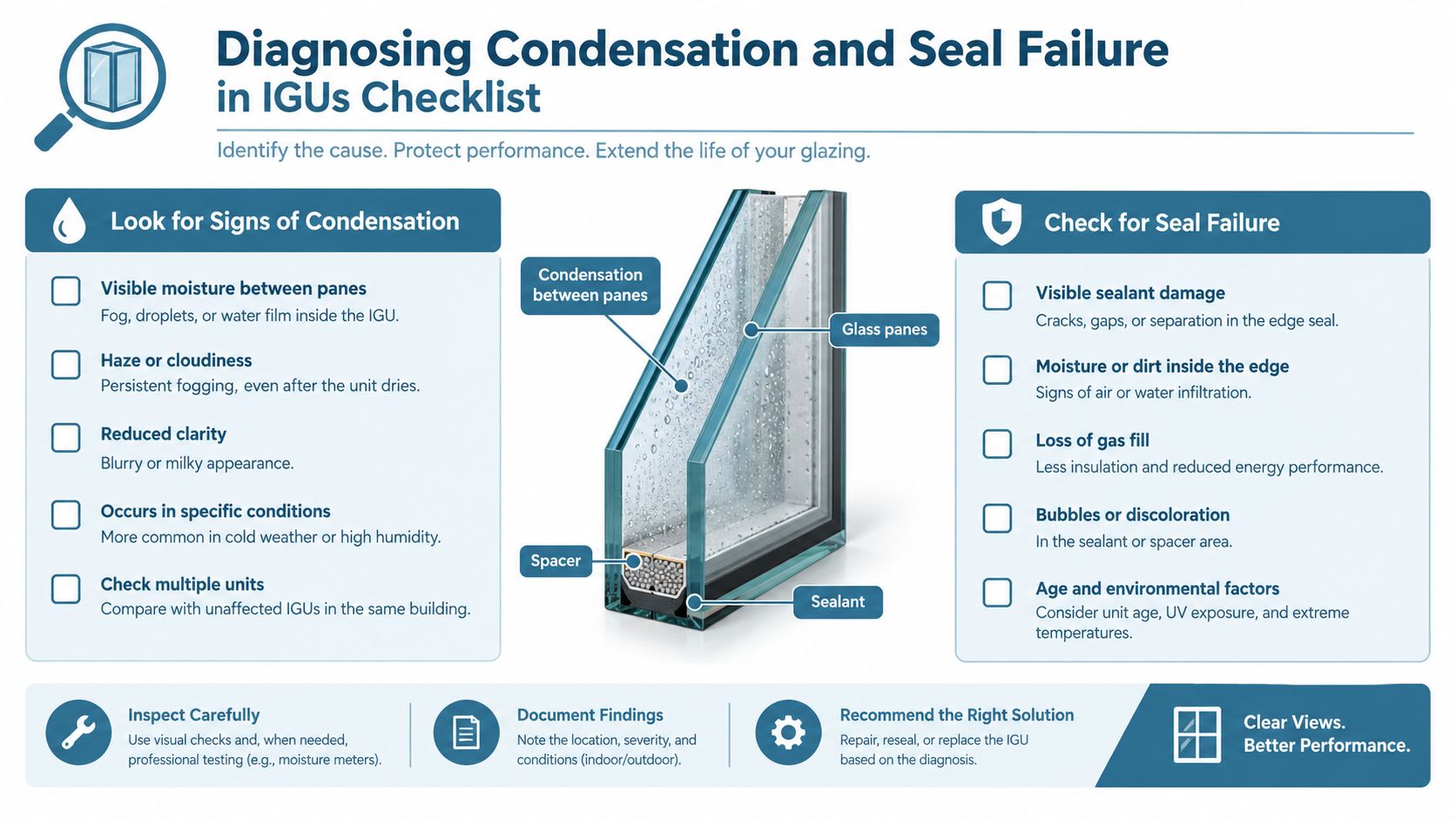
Moisture inside the cavity is different. If you can see fog, droplets, or a milky film between the panes and cannot wipe it away from either side, suspect a failed edge seal.
Use the location and behavior as evidence
Run through this quick check:
- Room-side moisture: Check indoor humidity, bathroom fans, kitchen ventilation, and air movement.
- Outdoor moisture: Note the weather and whether the water sits on the exterior face.
- Between-pane fogging: Look through the cavity from different angles and confirm that wiping the surfaces doesn't clear it.
- Persistent deposits: Watch for mineral-like marks or dust trapped inside the sealed space.
- Operational symptoms: Notice whether the frame is distorted, difficult to lock, or allowing air around the perimeter.
The seal isn't repaired by wiping the glass. Once the cavity has admitted moisture or lost its intended gas condition, a technician generally evaluates whether the IGU can be replaced within the existing sash or whether the entire sash or frame should be replaced.
Industry information cited by Future Market Insights describes seal degradation and dew-point increases as an important failure pathway. That source states that 3% to 5% of insulating glass failed after two years, and 63% of those failures were linked to increased dew point. Treat those figures as the cited industry estimate, not a prediction of what will happen to your particular windows.
For homeowners, the practical next step is documentation. Photograph the fogging, record where it appears, locate the product label if available, and check whether the warranty covers seal failure, moisture, or deposits between panes. More guidance on surface moisture is available in this resource about condensation inside home windows.
How Energy Codes and New Technologies Are Changing IGU Standards
Texas homeowners often face a practical choice: the existing windows block winter drafts reasonably well, yet rooms behind west-facing glass still feel hot. That discomfort does not automatically call for the thickest or most advanced IGU. It calls for matching the glass to the opening's actual heat gain, orientation, and frame capacity.
Efficient window design now extends beyond the familiar double-pane, argon-filled unit with one low-E coating. The Lawrence Berkeley National Laboratory high-performance windows program describes research using three glass layers, two low-E coatings, and low-conductivity gas fills, with center-of-glass U-factors near 0.10 Btu/hr-ft²-°F. Those figures describe advanced center-glass performance, not necessarily the result for a complete installed window.
Energy requirements can also change which specifications deserve review. Coverage of ENERGY STAR 7.0 identifies a Northern-climate window U-factor requirement lowered from 0.27 to 0.22. A project affected by that requirement may need more than a conventional double-pane specification.
Texas projects require a different emphasis. Solar heat gain, glass direction, exterior shading, low-E selection, spacer and seal durability, frame design, and installation quality can influence comfort as much as added insulating layers. A triple-pane unit may help where large glass areas create persistent temperature differences, but added weight and thickness can exceed what an older sash or frame can support.
When an upgrade makes sense
Consider a higher-performance package when:
- Large glass areas remain uncomfortable after shading and installation issues are addressed.
- Strong sun exposure calls for a better-matched low-E coating.
- The project has demanding energy targets.
- The frame can carry a heavier or thicker unit.
- The owner expects to keep the windows long enough to value improved comfort and lower HVAC strain.
Double-pane, argon-filled, low-E glass can still fit a Texas replacement when the frame, budget, and comfort goals do not justify extra complexity. Vacuum insulating glass may suit a premium retrofit where a thin profile matters, but confirm availability and service support first.
The useful question is which glass package solves the opening's problem and whether the complete window system can support it.
Choosing the Right Insulated Glass for Your Project
Start with a written quote that identifies pane count, low-E coating, gas fill, spacer type, whole-window U-factor, SHGC, frame material, and whether the work covers glass-only, sash, or full-frame replacement. Request warranty terms that clearly address seal failure and moisture between panes.
Ask the installer how the unit will be measured, supported, sealed, and tested after installation. A good product can still perform poorly if the opening is measured incorrectly or the perimeter isn't sealed correctly.
For broader door and glazing work, you can also review Yorkshire composite door installation as an example of why the surrounding frame and installation method matter alongside the glass.
Breaking Glass Co. supplies insulated glass replacement, Texas-focused window and door packages, and installation support for homeowners, builders, and contractors. Visit Breaking Glass Co. to request a quote and discuss whether glass-only replacement, double-pane low-E, triple-pane, or another IGU configuration fits your project.