
You're standing in the living room, the thermostat says the house is cool enough, but the room still feels hot. The air conditioner keeps running through the Texas afternoon, the west-facing windows radiate heat, and the electric bill is painful. Then someone tells you to replace every single-pane window with double pane, as if the answer were that simple.
It isn't. Single pane vs double pane is a climate decision, not a universal rule. In Texas and the Southwest, cooling demand and solar heat gain often matter more than winter heat loss. A window with an excellent U-factor can still make a room uncomfortable if its SHGC is wrong for the glass exposure.
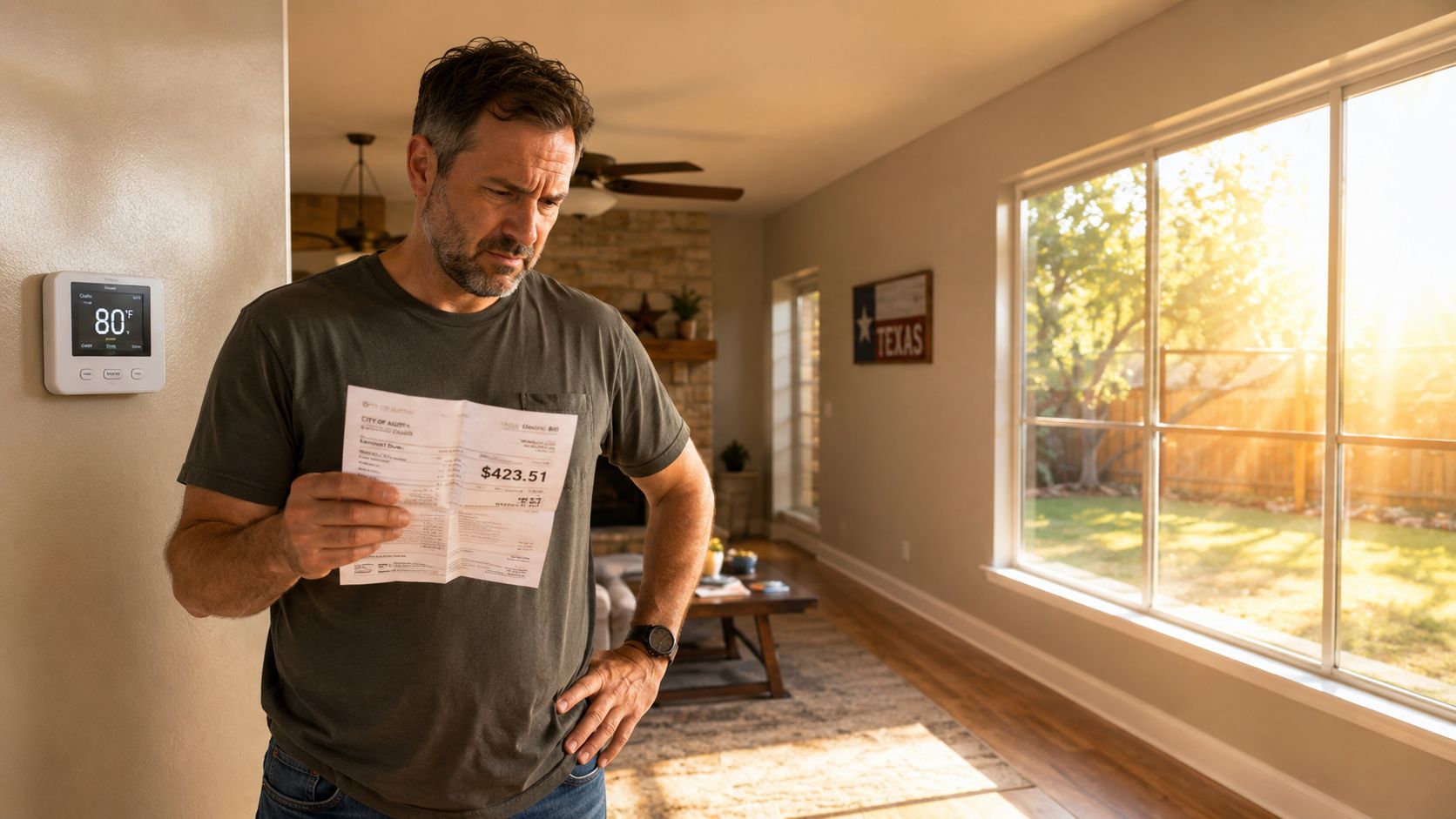
Table of Contents
- Why Texas Homeowners Ask About Single Pane vs Double Pane
- How Single and Double Pane Windows Actually Work
- Comparing Performance Across Energy and Comfort Metrics
- Real Energy Savings and Payback Timelines
- Choosing the Right Glass for Texas and Southwest Climates
- Retrofit Options Versus Full Window Replacement
- Which Window Type Fits Your Home and Budget
Why Texas Homeowners Ask About Single Pane vs Double Pane
Older Texas homes often have single-pane glass set in aluminum frames. Those windows keep rain out, but they provide little resistance to outdoor heat. Sunlight passes through the glass, the frame heats up, and the air conditioner has to remove that added load while trying to cool the rest of the house.
The homeowner usually notices the problem before seeing it on a utility statement. A chair near a south-facing window feels warmer than the rest of the room. A bedroom gets uncomfortable in the late afternoon. The glass may sweat during humid weather, and traffic noise comes through with little resistance.
That's why the question deserves a Texas-specific answer. National advice often emphasizes U-factor, which measures heat transfer through the window. In a hot climate, SHGC, or Solar Heat Gain Coefficient, deserves equal or greater attention because it indicates how much solar heat enters through the glass. The right double-pane unit can reduce heat gain, but a poorly selected unit may leave a west-facing room exposed to intense afternoon sun.
The practical decision behind the glass
Double pane became the modern efficiency baseline because the insulated air space changed what residential glass could do. The first commercial double-glazed windows appeared in the early 1930s, when Charles D. Haven introduced the Thermopane concept, announced it in 1932 and patented on 12 October 1934. The design used two panes, an air gap, and sealed edges, with the air dehumidified to reduce condensation, as documented in this historical and technical overview of single-pane and double-pane windows.
That history explains why double pane is usually the starting point for living spaces. It doesn't mean every Texas homeowner should order the most expensive glass package available.
Contractor's rule: Pick the glass for the wall it faces, then judge the frame, seal, installation, and budget as one system.
The decision should account for four things: whether the existing frames leak, how much direct sun reaches the glass, whether noise and condensation matter, and how long you plan to stay. A window upgrade can improve comfort immediately even when the energy-only payback is slow.
How Single and Double Pane Windows Actually Work
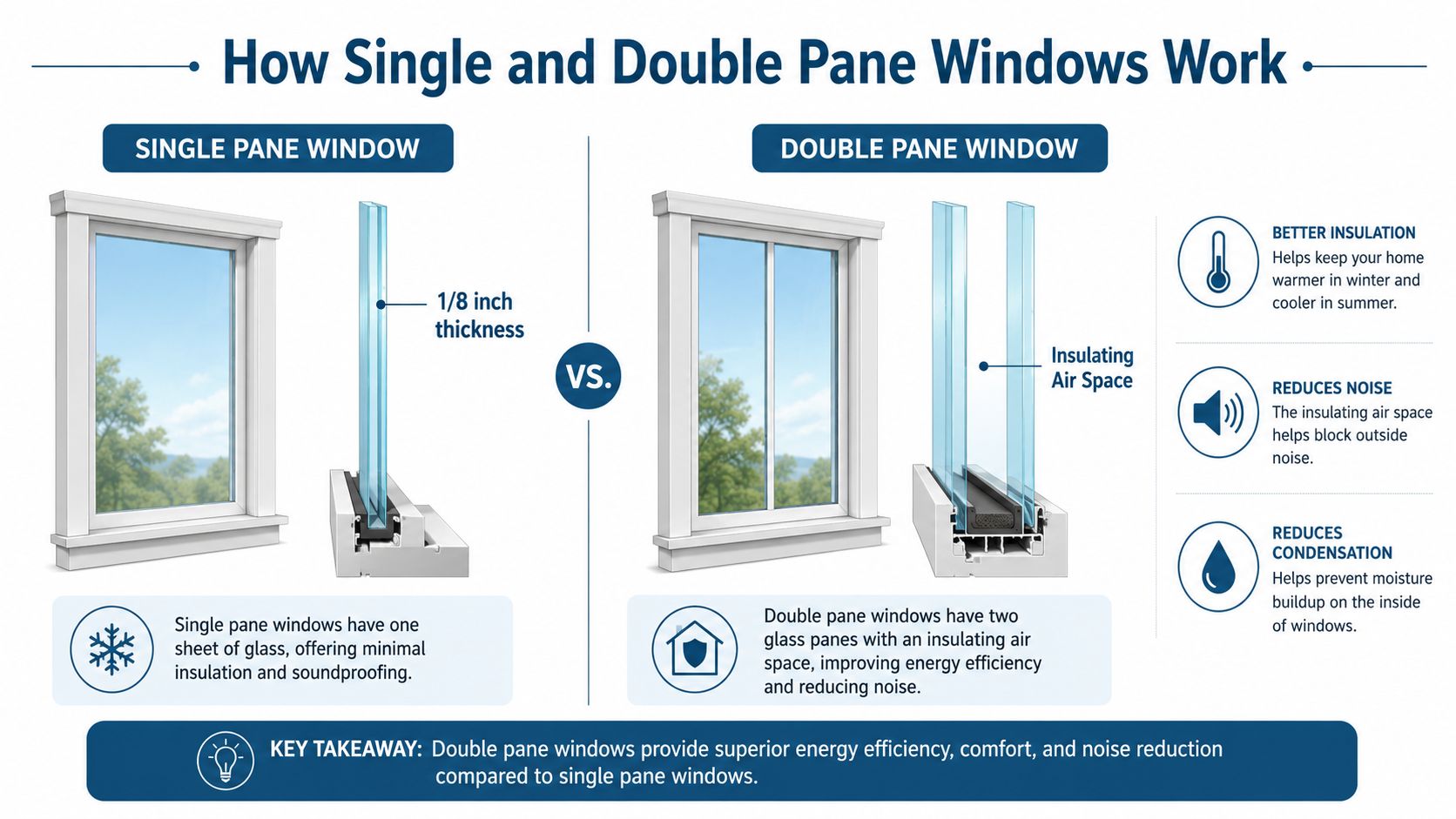
A single-pane window is one sheet of glass between the room and the outdoors. The glass itself may be thin, but thickness isn't the central issue. The problem is that there's no sealed insulating space between separate layers, so heat moves through the assembly with relatively little resistance.
A double-pane window, also called an insulated glass unit, uses two panes separated by a sealed gap. That space contains air or an insulating gas such as argon. The sealed unit slows conductive and radiant heat transfer, while the edge seal keeps the space intact and helps limit moisture entry.
Three numbers that matter
U-factor tells you how readily heat passes through the window. Lower is better. Verified comparison data places typical single-pane windows around 0.90 to 1.20, standard double-pane units around 0.45 to 0.55, and high-performance double-pane units with low-E coatings and argon around 0.20 to 0.30 (window efficiency data).
SHGC tells you how much solar heat the window admits. Lower is usually better for a sunny Texas room, especially on south- and west-facing walls. Clear single-pane glass commonly sits near 0.80 to 0.86, while low-E double-pane glass can be configured around 0.25 to 0.40 (hot-climate window guidance).
R-value expresses resistance to heat flow, with higher values indicating better insulation. It's useful as a general concept, but window labels typically emphasize U-factor, SHGC, visible transmittance, and air leakage rather than presenting one simple whole-window R-value.
Pane count isn't the whole specification
A basic double-pane aluminum window can perform much worse than a low-E double-pane vinyl or fiberglass unit. Frame material, spacer design, gas fill, coating, glass thickness, and installation all affect the result.
For Texas, start with SHGC and then check U-factor. A low SHGC helps keep solar radiation out during cooling season. A lower U-factor still matters, but chasing the lowest possible number can waste money if the main problem is direct afternoon sun.
Comparing Performance Across Energy and Comfort Metrics
The label “double pane” tells you the construction, not the complete performance. Two insulated units can have very different coatings, frames, spacers, and air-leakage results. Compare the entire window assembly instead of accepting pane count as the specification.
| Performance Metric | Single Pane | Double Pane | Winner |
|---|---|---|---|
| Cooling control | Allows substantial heat transfer and solar gain | Reduces heat transfer, with low-E options better suited to sunny rooms | Double pane |
| Condensation resistance | Interior glass can become cold enough for moisture to collect | Warmer interior glass generally resists condensation better | Double pane |
| Sound control | Offers limited separation from traffic and neighborhood noise | Extra glass and the sealed gap improve acoustic comfort | Double pane |
| Durability | Simple construction, but limited protection and insulation | More components, with seals that can eventually fail | Depends on unit quality |
| Upfront cost | Lower | Higher | Single pane |
| Comfort near glass | More hot spots and temperature swings | More consistent surface temperature | Double pane |
Energy performance should be judged with the window's listed U-factor and SHGC, not with a sales phrase such as “energy glass.” If you want a plain-language explanation of how these ratings differ, review this guide to U-factor versus R-value.
Condensation and indoor comfort
Single-pane glass can become close to the outdoor temperature. In humid Texas conditions, that makes interior moisture more likely to collect on the room-facing surface. Persistent moisture can damage finishes around the frame and signals that the glass surface is too cold for the indoor conditions.
Double pane raises the interior glass temperature by placing an insulating space between the room and outdoors. It won't solve every humidity problem, and it won't repair a leaking frame, but it gives the interior surface a better chance of staying dry.
Noise, seals, and real-world tradeoffs
The sealed gap also interrupts sound transmission. That matters near a highway, airport, busy intersection, or loud neighbor. Standard double pane isn't automatically soundproof, and a window's acoustic performance depends on glass thickness, spacing, frame construction, and installation.
Double pane introduces a component single pane doesn't have, the perimeter seal. If that seal fails, moisture can enter between the panes and create fogging that can't be wiped away. A good installer should inspect drainage, sash condition, frame alignment, and seal quality rather than treating replacement glass as a complete solution.
Real Energy Savings and Payback Timelines
Window replacement can save money, but Texas homeowners shouldn't buy windows on a national marketing percentage or assume the project will pay for itself quickly. DOE and ENERGY STAR guidance associates replacement of single-pane windows with annual savings of about $125 to $340 in many cases, while related consumer guidance cites approximately $126 to $465 per year depending on home size, climate, and installation quality (ENERGY STAR replacement guidance).
Those figures describe modeled or broad household outcomes, not a promise for your address. A Texas home with shaded windows and a tight envelope may save less than a home with poorly sealed single-pane units facing intense sun. HVAC condition, duct leakage, attic insulation, thermostat settings, and air infiltration can outweigh the glass upgrade.
Why the first upgrade matters most
The largest efficiency jump usually comes from moving from single glazing to insulated glazing. ENERGY STAR guidance shows that replacing clear double-pane windows with ENERGY STAR replacements produces much smaller modeled savings, about $20 to $70 per year in existing homes and $15 to $65 per year in new construction, as reported in the same ENERGY STAR comparison.
That distinction should shape your budget. Replacing failed or uncomfortable single-pane windows can make sense as a comfort project. Replacing decent double-pane windows solely to chase a slightly better rating deserves more scrutiny.
A simple payback calculation divides the project cost by annual savings. If the energy savings are modest and the installed price is substantial, the result can stretch well beyond the period many homeowners expect. A homeowner should therefore value cooler rooms, reduced drafts, less noise, and improved appearance separately from the utility-bill return.
The honest answer: In Texas, window replacement is often a comfort and building-envelope decision first, and an energy-only investment second.
Where the math improves
Payback can become more attractive when several problems overlap:
- Extreme solar exposure: West-facing rooms with large clear panes may have a disproportionate cooling burden.
- Failing units: Fogged insulated glass, warped frames, or damaged seals already require repair or replacement.
- Air leakage: A new unit can address drafts that weatherstripping alone can't stop.
- Whole-envelope work: Coordinating windows with attic insulation, duct sealing, shading, and HVAC improvements can produce a stronger combined result.
Use the savings figures as context, not a guarantee. Ask for a site evaluation that considers orientation, frame condition, glass specifications, and installation details.
Choosing the Right Glass for Texas and Southwest Climates
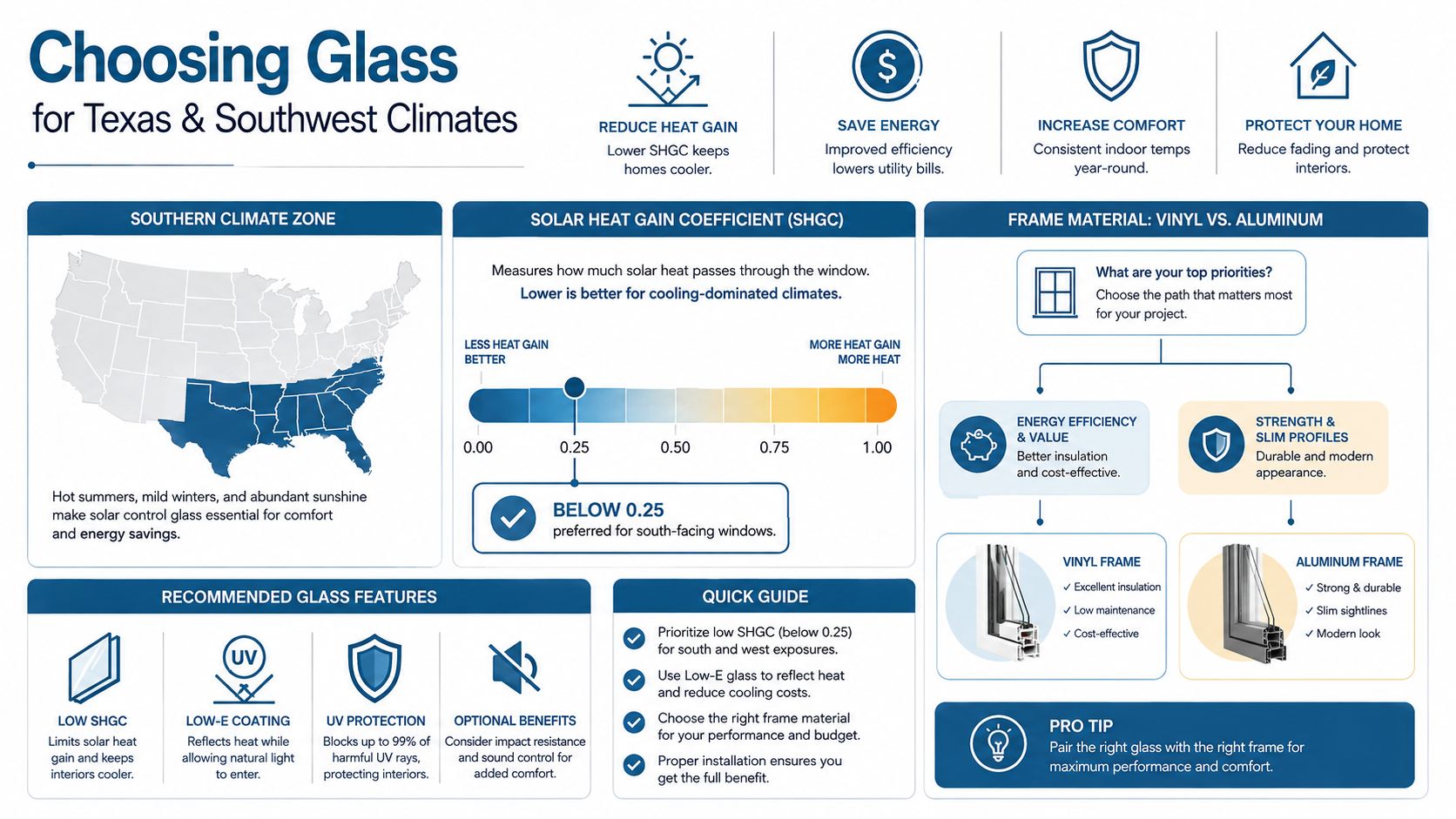
For a hot Texas home, start with the sun. A south- or west-facing window may need a lower SHGC than a shaded north-facing opening. Clear double pane can improve insulation while still admitting too much solar heat, so ask for the NFRC performance label and compare SHGC, U-factor, visible light, and air leakage.
The warm-climate benchmark is straightforward. Low-E double-pane units can be configured around 0.25 to 0.40 SHGC, while guidance for hot zones points toward SHGC at or below 0.25 in appropriate applications (energy-efficient glass guidance). A cited benchmark also notes that reducing U-factor from 0.50 to 0.25 can reduce winter heat loss by roughly 50%, but that doesn't make U-factor the only priority in a cooling-dominated home.
Match the frame to the exposure
Vinyl frames generally offer useful thermal performance with limited maintenance, but the product must be designed for local heat and sun exposure. Fiberglass provides a stable frame option and works well where long-term dimensional stability matters.
Aluminum conducts heat readily unless the frame includes an effective thermal break. Wood can perform well thermally, but it demands more maintenance in harsh sun, heat, and moisture. The frame should be evaluated with the glass, not treated as a separate afterthought.
Argon is a common gas fill for double-pane units. Krypton can be used in specialized designs, particularly where the available space or performance target calls for it. Warm-edge spacers can improve edge performance and condensation resistance, while tinted or spectrally selective glass can reduce solar gain when the visual effect and daylight tradeoffs are acceptable.
A practical Texas selection matrix
| Home condition | Budget position | Priority | Sensible starting point |
|---|---|---|---|
| Shaded north-facing rooms | Controlled | Basic comfort | Quality double pane with appropriate low-E |
| Bright south-facing rooms | Moderate | Cooling control | Low-E double pane with low SHGC |
| West-facing rooms with hot spots | Flexible | Solar protection | Spectrally selective low-E double pane and exterior shading |
| Highway or airport exposure | Flexible | Quiet interior | Double pane with carefully selected glass and frame |
| High-performance new construction | Long-term | Efficiency and comfort | High-performance double pane, with triple pane evaluated by orientation and goals |
Triple pane can make sense for severe noise exposure or difficult solar conditions, but it isn't automatically the best Texas purchase. For many homes, a properly specified low-SHGC double pane with a sound frame and careful installation is the better balance.
Retrofit Options Versus Full Window Replacement
You don't always need to remove the entire window. If the existing wood frame is straight, dry, and worth preserving, a retrofit can improve comfort without disturbing the historic character or interior trim.
Interior storm windows add a secondary sealed layer on the room side. Exterior storm panels add another barrier outside the original sash and can reduce drafts when fitted correctly. Window film can lower solar gain on selected exposures, while weatherstripping and caulking address gaps around operable sashes and trim.
Each option has limits. Film doesn't repair a warped frame. Weatherstripping won't turn a leaky aluminum assembly into a modern insulated unit. Storm windows can perform well when the original window is sound, but poor installation leaves air paths around the edges.
Choose retrofit when the frame deserves to stay
Retrofit is usually worth investigating when:
- Historic value matters: Original wood windows may be protected by local preservation rules or contribute to the home's character.
- The budget is tight: A targeted improvement can buy time while you plan a larger project.
- The room is lightly used: A garage, workshop, or secondary space may not justify a full replacement.
- The glass is serviceable: A sound frame and operable sash give the retrofit a better foundation.
A well-sealed single pane paired with a quality storm system can approach the practical insulation of double glazing in some installations, but the result depends heavily on fit, sealing, and maintenance. Don't assume a storm panel will fix every comfort problem.
Replace the whole unit when the assembly has failed
Full replacement makes more sense when the frame is rotted, warped, severely corroded, or allowing persistent air leakage. Fogging between panes indicates a failed insulated-glass seal, and repeated repairs may not be worthwhile if the sash and frame are also deteriorated.
Texas historic districts may require approval before changing visible frames, muntins, or exterior profiles. Check local requirements before ordering. For homeowners comparing installation paths, Texas window replacement services can be one source of project information, alongside independent bids from qualified local installers.
Don't choose based on the glass label alone. Measure the existing opening, inspect the sill and framing, and decide whether the project needs glass-only work, an insert, or full-frame replacement.
Which Window Type Fits Your Home and Budget
For a budget-conscious owner, keep the existing window if the frame is square, dry, and reasonably tight. Interior storm units, exterior storm panels, film on the harshest exposures, and fresh weatherstripping can reduce discomfort while you save for replacement. This approach is especially sensible in a historic home or a rental where a long energy payback doesn't justify major construction.
For the homeowner who is tired of hot spots, basic double pane isn't enough as a specification. Choose a well-built double-pane unit with a low-E coating, an argon fill, and SHGC below 0.25 where the orientation and product design make that appropriate. Pay close attention to west-facing glass, frame quality, and installation. A low-SHGC window paired with exterior shade can do more for a sunny Texas room than an expensive unit selected only for its U-factor.
For new construction or a homeowner planning to stay for many years, make high-performance double pane the baseline. Consider triple pane only when the site has exceptional noise, difficult solar exposure, or a comfort target that justifies the added cost. Research on advanced glazing also shows that pane count isn't the only path forward, with adjustable glazing and mechanically managed air gaps representing another direction in window design (ARPA-E window opportunity background).
Breaking Glass Co. supplies and installs residential and commercial windows and doors across Texas, offers factory-direct products for regional climates, and provides measurement, quotes, installation, and warranty support. Request a site-specific assessment that accounts for your home's orientation, frame condition, glass ratings, and local utility rates before committing to a whole-house upgrade.
Visit Breaking Glass Co. to request a same-day quote for Texas window and door options, including insulated glass packages suited to hot, sunny rooms. Ask the team to compare retrofit, glass-only, and full replacement paths so you can spend money where it will improve comfort instead of buying pane count without a climate plan.