
You're standing in a Tyler living room in August, looking at a south-facing window that feels hot enough to radiate into the room. The sash sticks when you try to open it, the frame gives a faint creak after a cool night followed by a 100°F afternoon, and the air conditioner keeps running while the glass is marketed as “energy efficient.”
The glass may be part of the problem, but the fiberglass window frame deserves equal attention. Frame material affects heat transfer, dimensional movement, weather seals, structural support, and how the complete window behaves over a long ownership period. In Texas, where intense sun, humidity, hail, and sharp temperature changes test every component, the frame isn't a cosmetic choice.
This guide takes a practical position. Fiberglass deserves serious consideration for Texas homes, especially when you're planning long-term ownership, large glass areas, difficult exposures, or a high-performance glazing package. It isn't automatically the right answer for every budget, but it is often the strongest residential compromise between vinyl's affordability and aluminum's structural usefulness.
Table of Contents
- Why Your Window Frame Matters More in Texas
- What a Fiberglass Window Frame Actually Is
- Stability and Thermal Performance in Harsh Climates
- Fiberglass vs Vinyl and Aluminum Frame Materials
- Maintenance and Real Ownership Costs
- Energy Efficiency and Comfort in Texas Climate Zones
- Cost, Warranty, and When Fiberglass Is the Right Call
- Choosing a Texas Supplier for Fiberglass Window Frames
Why Your Window Frame Matters More in Texas
A Tyler homeowner may blame the glass when a room stays hot, but the frame controls much of the window's real-world performance. It holds the insulated glass unit, carries hardware loads, joins the window to the wall, and helps maintain the perimeter seal. If it flexes, shifts, or transfers heat readily, even a premium pane cannot make the complete assembly perform well.
Texas exposures put that weakness under pressure. South- and west-facing frames absorb sustained UV and heat, then cool overnight as indoor air conditioning keeps the room stable. East Texas also brings humid Gulf air, while statewide temperature swings can exceed 30 degrees in a day. Over a 20-year ownership period, repeated expansion and contraction can lead to sticky operation, air leakage, failed seals, or trim gaps before anyone sees a visible crack.
Hail adds another reason to evaluate the complete unit. A durable frame will not prevent every glass break, but it must remain properly aligned after severe weather so locks, seals, and replacement components continue to fit.
Practical rule: Judge the frame, glass, spacer, installation, drainage, and weather sealing as one system. A strong pane installed in a weak opening is still a weak window.
Fiberglass is a reinforced composite structure made from glass fibers and resin. It supports the insulated glass and resists the heat-driven movement that challenges lesser materials. That construction makes it a serious option for large openings, harsh sun, and homeowners who plan to keep their windows for decades.
A quote that lists only “double pane” or “low-E glass” leaves out a major performance decision. Ask what the frame is made from, how the corners are joined, which glazing package suits each exposure, and what the warranty covers. Those questions matter more than a label that promises energy efficiency.
Start with an accurate measurement and an inspection of the existing opening. The Texas window replacement process should address frame material, installation details, drainage, flashing, and the climate stress the new unit will face.
What a Fiberglass Window Frame Actually Is
Think of a fiberglass frame as a reinforced fishing rod rather than a hollow plastic tube. Long glass fibers run through a resin binder, creating a composite member with strength along its length. The result is a frame that can support an insulated glass unit while maintaining its shape under heat, wind, and repeated operation.
Manufacturers may use hollow fiberglass profiles or foam-filled profiles. ENERGY STAR describes fiberglass frames as strong, durable, low-maintenance, and good at insulation, and notes that they may be hollow or foam-filled in qualifying window designs (ENERGY STAR window criteria). Federal purchasing guidance also identifies fiberglass as a nonthermally conductive frame material used to improve window efficiency.
The basic construction gives you four useful pieces of vocabulary:
- Composite member: Glass fibers reinforce resin, instead of relying on a single plastic or metal skin.
- Profile: The cross-sectional shape of the frame, which may be hollow or filled for added insulation.
- Insulated glass unit: The sealed glass assembly held by the frame. The fiberglass isn't the glass itself.
- Thermal behavior: How much heat the material conducts and how much it expands as temperatures change.
Vinyl is an extruded plastic profile. It insulates well compared with bare aluminum and can be a sensible budget choice, but its rigidity and movement depend heavily on the profile design, reinforcement, color, and manufacturing quality. Aluminum is a metal frame with high strength, though modern residential systems need thermal breaks to reduce conductive heat flow.
Fiberglass occupies a different category. It combines a low-conductivity composite with structural stiffness, which is why manufacturers use it for residential windows that need narrow profiles, substantial glass areas, and stable operation. The label matters less than the actual profile, glazing, hardware, corner construction, and installation specification.
Stability and Thermal Performance in Harsh Climates
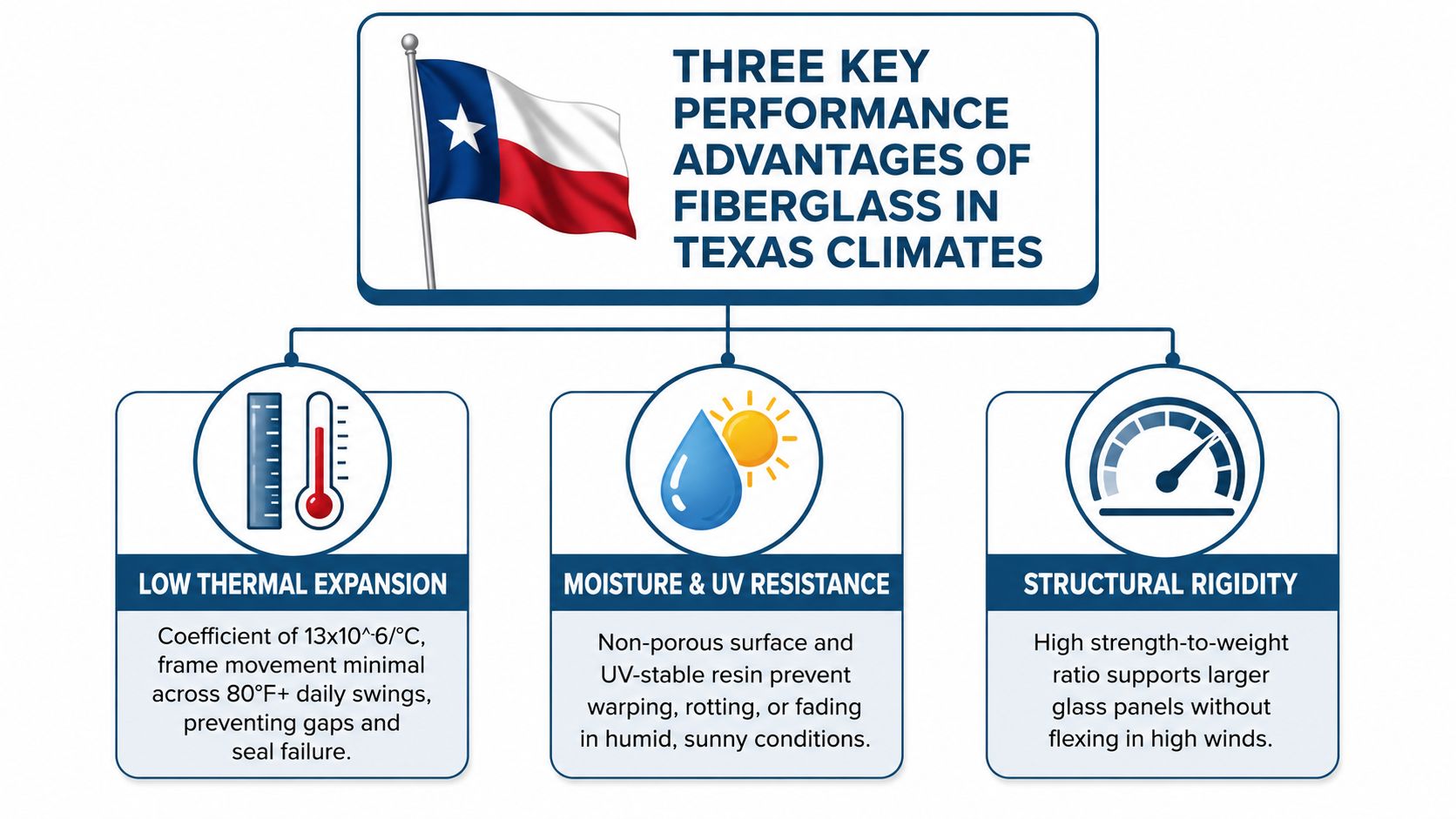
Texas puts window frames through sustained UV exposure, humid Gulf air, hail, and daily temperature swings that can exceed 30 degrees. In Tyler and Longview, a frame that looks fine during installation still has to operate after repeated 100°F afternoons and cooler nights. Fiberglass earns consideration through dimensional stability, low thermal conductivity, and structural rigidity.
Dimensional stability helps the frame hold its shape as temperatures change. Fiberglass generally expands and contracts less than vinyl, so the sash is more likely to stay aligned and the seals and operating hardware face less movement-related stress. That matters in a home expected to serve for 20 years or more, especially where dark finishes absorb intense sun.
Low thermal conductivity gives fiberglass a better starting point than an uninsulated metal frame. ENERGY STAR's frame guidance identifies fiberglass as a frame material with good insulation characteristics and distinguishes it from thermally conductive metal materials (ENERGY STAR's frame guidance). The frame is not a complete thermal barrier, however. Glass, spacers, seals, installation, and the surrounding wall assembly still affect the window's total performance.
What those properties feel like indoors
A stable, insulated frame can make the area beside the window more comfortable. In summer, it reduces the frame's role as a heat path around the insulated glass. During a January cold spell, it can limit the cold-surface effect near the opening and reduce conditions that contribute to condensation when warm indoor air reaches a cooler frame.
Rigidity becomes more valuable as glass areas grow. A flexible frame can place extra demand on hardware and allow the sash or meeting rail to drift out of alignment. Fiberglass supports large units without requiring excessive frame bulk, but the complete assembly still needs correct sizing, anchoring, corner construction, and installation. Material alone cannot correct a poorly specified opening.

A technical comparison in the Cascadia fiberglass white paper places fiberglass around R-4.1, compared with R-2.0 for comparable aluminum, and models fiberglass window lifespans at 50 to 80 years. Those figures provide product and modeling context, not a guarantee for every brand or installation. The practical takeaway is clear: specify the frame, glazing, and installation as one system, then verify that the package suits Texas sun, humidity, temperature swings, and long-term ownership.
Fiberglass vs Vinyl and Aluminum Frame Materials
Texas buyers usually compare fiberglass with vinyl first, then aluminum when the project involves large openings, commercial design, or a specific architectural look. The right choice depends on which compromise you can live with.
Vinyl wins on entry price. A well-made vinyl window can provide useful insulation and low routine maintenance without the higher initial cost of fiberglass. It makes sense for a rental property, a tight replacement budget, or a house where standard-size openings and moderate glass areas keep the design straightforward. The weakness is that vinyl's behavior depends strongly on profile design, reinforcement, color, and exposure. Cheap vinyl is not the same product as a properly engineered vinyl system.
Fiberglass wins when stability and long ownership matter. It resists moisture-related swelling and offers stronger structural behavior than ordinary plastic profiles. That makes it a better fit for large picture windows, dark finishes exposed to sun, and homeowners who don't want to revisit the same openings after a shorter service interval.
Aluminum still has a role. Commercial curtain wall and storefront systems often prioritize structural spans, appearance, and project-specific engineering. Aluminum is strong and familiar, but it conducts heat more readily than fiberglass unless the system uses effective thermal breaks. For a Texas residence, an uninsulated or poorly detailed aluminum frame is rarely my first recommendation for comfort.
| Criterion | Fiberglass | Vinyl | Aluminum |
|---|---|---|---|
| Heat transfer | Low-conductivity composite with good insulating potential | Insulating plastic profile, performance varies by design | Conductive metal, thermal breaks are important |
| Movement in heat | Strong dimensional stability | More movement can occur, especially in demanding exposures | Metal expands and contracts, system design controls the result |
| Sun and moisture | Resists common moisture-related swelling and offers durable finish options | Low routine maintenance, but finish and profile quality matter | Can corrode or show finish wear when poorly specified or exposed |
| Large glass areas | Strong structural choice for residential openings | May need reinforcement or more visible bulk | Strong, often suited to commercial systems |
| Upfront cost | Usually higher than vinyl | Usually the budget-friendly option | Varies widely by system and project |
| Texas recommendation | Best middle path for long ownership and demanding exposures | Sensible when budget leads and the product is well engineered | Consider for commercial or specialized architectural applications |
A hailstorm also exposes the difference between a flexible plastic surface and a rigid composite, but no frame material makes a window hailproof. Glass selection, impact requirements, installation, exterior protection, and the severity of the storm still control the outcome.
Maintenance and Real Ownership Costs
Fiberglass isn't maintenance-free. It is low maintenance, which is a more honest and useful description. You won't eliminate cleaning, hardware care, weatherseal inspections, or the occasional finish decision just because the frame is composite.
A sensible routine looks like this:
- Regular cleaning: Rinse exterior surfaces and clean the frame with a mild household solution. Remove grit from tracks before it interferes with rollers or locks.
- Hardware care: Lubricate moving hardware when operation becomes stiff, using the product recommended by the manufacturer.
- Storm inspections: After hail, high winds, or driving rain, inspect weatherstripping, screens, locks, sealant, and interior trim.
- Finish planning: If you want to change the exterior color, confirm whether the manufacturer permits painting and follow its preparation instructions. A homeowner may choose a refresh around 10 to 15 years, but that is a preference-based maintenance decision, not a universal service interval.
- Moisture checks: Look for staining, soft trim, or recurring condensation. Those symptoms can point to installation or ventilation problems, not necessarily a failed frame.
The 20-year ownership question is where fiberglass becomes easier to judge. Don't compare only the purchase invoice. Compare the initial frame and glass package, installation quality, cleaning and repair demands, potential finish work, energy performance, hardware service, and the possibility of replacing a lower-cost unit earlier.
Vinyl typically asks less of your paint schedule and less of your initial budget. Fiberglass usually asks for more money at purchase but gives you a stiffer, more stable frame for a long ownership horizon. Wood can deliver excellent appearance and performance, but it demands a more active exterior maintenance program in Texas moisture and sun.
Ownership test: If you expect to stay in the house for decades, price the window as a system you'll operate and maintain, not as a product you'll forget after installation.
For routine care techniques that also apply to demanding weather exposure, these high-elevation window care tips offer useful guidance on cleaning, inspection, and protecting operating components.
Energy Efficiency and Comfort in Texas Climate Zones
A west-facing room in El Paso, a humid replacement project near Houston, and a winter-exposed home in the Panhandle do not stress a window in the same way. Texas needs a frame and glass package matched to the local exposure, not a generic efficiency label.
South and west elevations take the hardest afternoon sun. A low-conductivity fiberglass window frame can reduce heat flow around the glass, but the complete unit still determines comfort. East Texas adds humid Gulf air and frequent moisture exposure, so stable dimensions and dependable seals matter. Panhandle and Hill Country homes see sharper temperature changes, which can expose weak profiles and poor installation.
High-performance windows use the complete assembly, not the frame alone, to establish insulating performance. ENERGY STAR's criteria distinguish improved products from ultra-efficient products through whole-window ratings, including insulating values of R-3 or higher and R-5 or higher (ENERGY STAR key product criteria). Treat those figures as a starting point, then review the actual label for the proposed unit.
Keep utility expectations realistic. High-performance systems and ENERGY STAR-rated windows can reduce energy use, but results depend on the home, glass, installation, attic, and cooling equipment. Fiberglass supports a good design. It cannot fix leaky openings, poorly chosen solar control, an unconditioned attic, or an oversized air conditioner.

Match the frame to the glazing
Ask for the complete performance label before comparing bids. Review U-factor, solar heat gain coefficient, visible transmittance, air leakage, and glass configuration. A fiberglass frame with the wrong solar-control package can still leave a west-facing room hot during a 100°F Texas afternoon.
Thin triple-pane designs also deserve review. A cited market summary reports average whole-home heating savings of 12% and cooling savings of 27% compared with double-pane baseline windows (fiberglass window market and performance summary). Those figures describe a glazing comparison, not a guarantee from the frame material.
Use the label correctly. This U-factor versus R-value guide explains why the two measures should not be treated as interchangeable. Then confirm that the installer seals the rough opening properly. Review this sealing gaps to save energy, because a high-performing unit loses value when air leaks around its perimeter.
Cost, Warranty, and When Fiberglass Is the Right Call
The higher upfront price is fiberglass' most obvious drawback. I wouldn't dismiss that objection. Vinyl remains the sensible choice when the budget is tight, the openings are conventional, and the owner values lower initial cost over maximum rigidity and long-term design flexibility.
The better question is whether the added frame performance solves a real problem in your project.
Homeowners replacing a handful of windows
If you're replacing five to ten windows in East Texas, start with exposure and ownership plans. Put fiberglass at the top of the list for south- and west-facing rooms, large openings, dark exterior colors, or a home you expect to keep for a long time. Choose quality vinyl instead when the project is primarily a budget repair and the proposed profiles, glass, seals, and installation are all properly specified.
Ask the supplier to separate frame cost from glazing cost. That shows whether you're paying for a meaningful system upgrade or just a premium label.
Builders planning a package
Builders should choose a frame platform early, before rough openings and exterior details lock in the decision. Fiberglass is a strong fit when the plan uses expansive glass, modern narrow sightlines, or a finish package intended to remain stable through years of Texas sun. Vinyl may be more appropriate for price-sensitive subdivisions where standard openings and simplified procurement matter more.
Require written performance data, corner and mullion details, installation instructions, and warranty responsibilities before approving the package.
Contractors and facility managers
Commercial buyers should not default to residential fiberglass without reviewing the scope. Aluminum may still make more sense for curtain wall, storefront, or engineered commercial assemblies. Fiberglass becomes more compelling where residential-style windows, thermal comfort, corrosion resistance, and long ownership are central to the specification.
Warranty language deserves the same scrutiny as price. Confirm coverage for the frame, glass seals, finish, hardware, labor, and transferability. If you want to understand how a supplier frames long-term coverage, review this lifetime window warranty information, then compare it against the actual manufacturer documents for your selected product.
Choosing a Texas Supplier for Fiberglass Window Frames
A fiberglass frame only performs as well as the product selection and installation around it. Choose a Texas supplier that can discuss solar exposure, opening conditions, glass packages, flashing, drainage, hardware, and warranty responsibilities without reducing the conversation to a single U-factor.
Look for these practical capabilities:
- Climate-specific recommendations: The supplier should distinguish a west-facing Tyler opening from a shaded north-facing project and explain how glazing changes the result.
- Measurement and installation control: Factory-direct access means little if the opening is measured poorly or the unit isn't flashed and sealed correctly.
- Project range: Builders and contractors may need new-construction packages, while homeowners need replacement units that fit existing openings.
- Service reach: A statewide installation team can keep product selection and field responsibility with one organization.
- Communication: Bilingual support can make scheduling, takeoffs, and warranty conversations clearer for English- and Spanish-speaking customers.
- Written coverage: Ask for the actual product and labor warranty before signing, not a verbal summary.
Breaking Glass Co. supplies and installs residential and commercial windows and doors, provides factory-direct product options, supports projects across Texas, and ships products nationwide. Its East Texas service area includes Tyler, Lindale, Bullard, Jacksonville, Longview, Athens, Whitehouse, and Canton, with installation available statewide. That makes it one practical option for comparing fiberglass, vinyl, and other window systems against a Texas-specific scope.
My recommendation is straightforward. Choose fiberglass when you want a rigid, low-conductivity frame for difficult exposures, large glass, and long ownership. Choose vinyl when the budget leads and the product is properly engineered. Choose aluminum when the project demands a commercial structural system. In every case, compare the complete window and installation package, not the frame material in isolation.
Breaking Glass Co. offers factory-direct fiberglass and other window systems, professional installation across Texas, warranty support, and nationwide shipping for out-of-state projects. Request a same-day quote through Breaking Glass Co. and have your openings, exposures, glazing needs, and ownership plans reviewed before you buy.