
You're staring at a window quote, and the phrase lifetime warranty looks reassuring enough to sign on the spot. Then, five years later, a pane fogs up, the installer says the issue is “covered,” and the manufacturer says the paperwork only pays for the part, not the labor. That's the moment most homeowners realize the word lifetime did a lot less work than they expected.
For East Texas buyers, that gap matters even more because heat, sun, moisture, and storm exposure put real stress on window systems. A warranty can be a real long-term asset, but only if you know what it covers, who has to perform the work, and whether the promise follows the home if you sell it. Plain English beats brochure language every time.
Table of Contents
- The Promise and the Fine Print of a Lifetime Window Warranty
- What Lifetime Actually Means in Window Warranties
- What Coverage Includes by Component
- Common Exclusions and Ownership Traps to Watch For
- How to File a Lifetime Window Warranty Claim
- Reading the Fine Print Without Falling Asleep
- How Breaking Glass Co. Supports Long-Term Ownership
- A Quick-Reference Checklist Before You Sign
The Promise and the Fine Print of a Lifetime Window Warranty
A homeowner sees a fogged insulated glass unit and expects the warranty to make the repair straightforward. The phrase lifetime warranty on windows sounds like it should cover the whole problem, yet the answer often depends on how the contract divides parts, labor, and installation responsibility.
The word that sells, and the document that decides
Consumer guidance explains that lifetime often refers to the expected life of the product or the time you own and live in the home, not your biological lifetime. Window warranties also commonly use fixed coverage periods that still sound generous on the brochure, even though they usually fall into a limited term. That is why the written warranty matters more than the headline. If the contract covers the frame but leaves labor out, the marketing label does not change what the company is required to pay.
Practical rule: the warranty brochure is an advertisement, the written warranty is the rulebook.
The confusion grows because many buyers read “lifetime” as one single promise. In practice, one part may be covered for a long stretch, another part for a shorter stretch, and service work may be excluded entirely. A homeowner who only notices the label can end up with a warranty that sounds broad but behaves in a narrow way.
Why this matters before you sign
A careful buyer reads a window warranty the same way a careful homeowner reads a roof estimate. The brand name matters, but the scope matters more. A strong warranty can still leave you paying for removal, reinstall, service calls, or diagnostics if the fine print says those items are not included.
That is especially important for East Texas homeowners comparing offers from installers like Breaking Glass Co. The useful question is not just whether a window carries a lifetime label, but what happens later if the glass fails, the seal breaks, or the repair requires labor that the warranty does not cover. Once you can separate marketing language from contractual coverage, you can compare bids, ask better questions, and avoid the common surprise of a warranty that sounds broad but acts narrowly.
What Lifetime Actually Means in Window Warranties
A “lifetime” window warranty sounds simple until you read the terms. The phrase usually points to a promise that lasts as long as the product, or as long as you own it, but the contract still decides what counts as covered, who can make a claim, and which repairs come with a bill.
The common meanings behind the label
Independent warranty guidance says a “lifetime warranty” on windows is usually component-specific rather than absolute, and limited lifetime programs often fall in the 3–15 year range (Homedit). That is why the word alone can be misleading. One part of the window may stay covered for a long time while another part drops out much sooner, and the paperwork may still call the whole package a lifetime warranty.
There are a few common structures:
- Standard term warranty. Coverage lasts a fixed number of years.
- Limited lifetime warranty. Coverage lasts for a defined product life or ownership period, but only for specific parts or conditions.
- Prorated warranty. Coverage shrinks over time, so the owner's share of the cost rises as the product ages.
- Full replacement language. Sounds broad, but still may exclude labor, finish, or transfer rights.
A car warranty offers a useful comparison. The label can sound generous, but the contract still sets mileage limits, ownership limits, and wear-item exclusions. Window warranties work the same way. The headline tells you the product belongs in the premium category, while the written terms tell you how each part is treated over time.
A quick way to read the label
If a window document says lifetime, look immediately for three details, who qualifies, what parts are included, and whether the coverage is prorated. Those answers usually matter more than the word itself. A warranty with narrow conditions can be less useful than a shorter warranty that clearly covers labor and transfers cleanly.
A homeowner comparing window bids in East Texas should also ask how the warranty treats glass upgrades, because better glass packages often carry their own rules. For example, an installer may offer impact-resistant glass options with coverage that looks different from the frame warranty attached to the rest of the unit.

What Coverage Includes by Component
A window is a system of interdependent parts. The frame, sash, insulated glass, hardware, weatherstripping, and screens all wear in different ways, so warranty language usually separates them instead of treating every part as one uniform promise.
The parts do not age on the same clock
Warranty guidance from Canada shows how uneven that coverage can be. Typical ranges often run 20–25 years for vinyl frame and sash coverage, 10–20 years for insulated glass units, 5–10 years for hardware, and 2–10 years for installation labor, while screens may be covered for only 10–90 days. That spread explains why a homeowner can still have frame protection after a latch, seal, or screen has already fallen out of coverage.
The parts of a window do not wear out together. A frame can stay sound while the hardware loosens. The glass can stay clear while the seal fails. Warranty terms usually follow the component that has its own failure pattern, not the one that looks fine from the street.
A homeowner often thinks, “the window failed.” The warranty often asks a different question, which component failed, and when?
A U.S. warranty example shows how proration can change claim value. Coverage starts at 100% in years 0–10, then drops to 50% in years 10–15, 30% in years 15–20, 20% in years 20–25, and 10% after 25 years. That structure matters because a window can still carry a “lifetime” label while reimbursement shrinks over time.
A practical example makes the split easier to see. A homeowner may receive full protection for one part of the window, but only partial help for another part that fails later. That is why a warranty review should focus on the component list, not only the marketing headline.
What that means in plain English
The word lifetime can hide several separate promises. The frame may have one term, the insulated glass another, and the hardware another. If you are comparing options, ask which component is covered, how long that coverage lasts, and whether the payout is full or prorated.
A good example comes from impact-resistant glass options. The glass package can carry its own rules, and those rules may differ from the frame warranty attached to the rest of the unit.
The practical value of a warranty comes from the weakest line in the document, not the strongest slogan.
Common Exclusions and Ownership Traps to Watch For
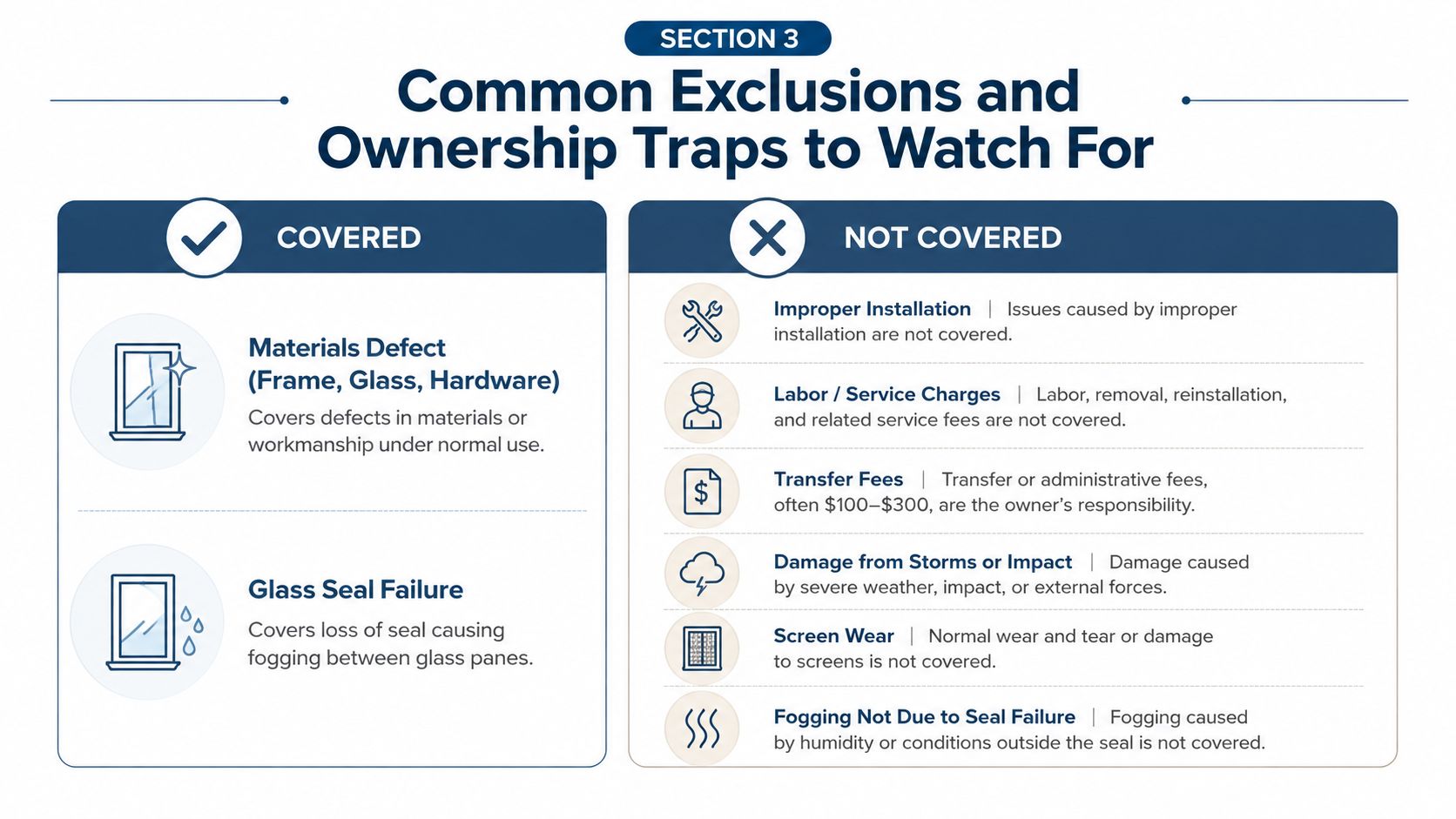
A lifetime warranty on windows can sound like full protection for every part of the product, every visit, and every repair. The fine print usually tells a narrower story. Exclusions are where the boundaries sit, and for a homeowner, those boundaries often decide whether a claim feels helpful or disappointing.
The usual things the warranty leaves out
A warranty can still leave out improper installation, labor and service calls, removal and reinstallation, and damage from storms or impact. Screens, finishes, cosmetic flaws, and wear tied to poor maintenance may also fall outside the promise, depending on the document. If the problem is not a material defect, the manufacturer may send the homeowner in another direction.
Labor is the part many buyers underestimate. A glass unit may be approved, but someone still has to remove the sash, replace the part, and put everything back together. That can leave the homeowner with out-of-pocket costs even when the claim itself is accepted. A warranty can cover the part and still leave the work to the owner, which matters just as much in practice as the repair label on the page.
A phone warranty helps make the idea easier to see. It may cover a bad battery, but it does not cover a cracked screen from a drop. Window warranties follow the same logic. A seal failure or another covered defect can be included, while impact damage from a storm or a ladder strike can be excluded. For buyers comparing replacement choices, the details around window installation services can shape how much real-world help the warranty delivers after a problem shows up.
Transferability matters more than most homeowners expect
Some warranties apply only to the original purchaser, and that makes the promise shrink when a house changes hands. Buyers who may sell in a few years should ask whether the warranty transfers, whether registration is required, and whether any fees or ownership paperwork apply. A warranty that disappears at resale has less value than one that follows the home.
The same issue matters for builders and sellers. If the warranty does not transfer cleanly, the next owner may get no benefit at all. Ownership rules deserve the same attention as the coverage list because they decide who can use the promise later. For homeowners who care about storm resistance and glass performance, it also helps to understand how impact-rated products fit into the broader replacement plan, including options like impact-resistant glass.
How to File a Lifetime Window Warranty Claim
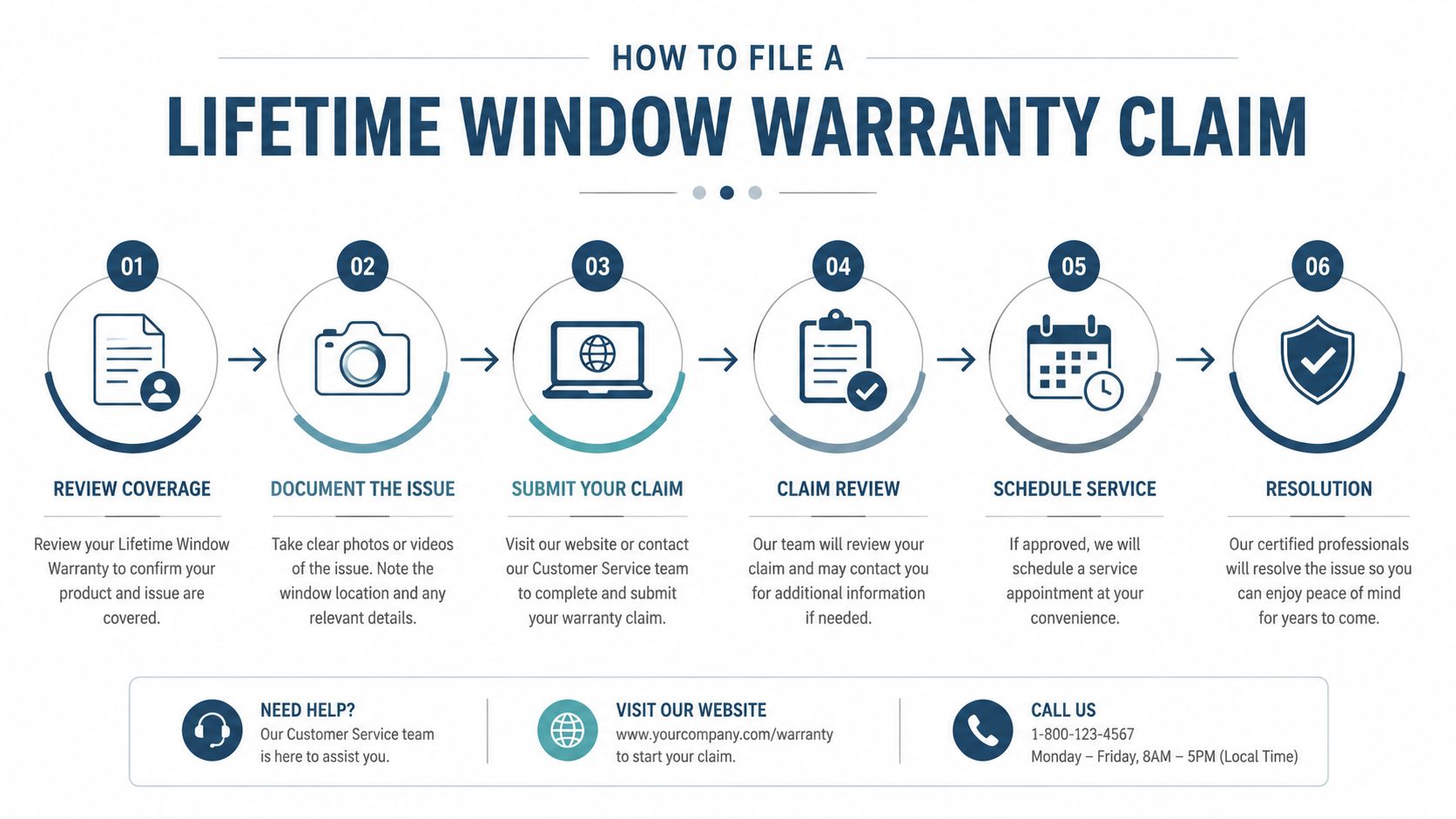
A warranty only helps if the claim process is workable. The best time to learn the process is before something fails, because the homeowner who already has the paperwork usually moves faster and gets fewer surprises.
Start with the documents, not the complaint
The first step is locating the original purchase paperwork and the actual warranty document. You also need the window brand, model, and any identifying sticker or label information. Without that, even a legitimate claim can stall while the manufacturer tries to confirm what was installed.
The next step is to figure out who owns the promise. Some claims belong to the manufacturer, some to the installer, and some require both parties to be contacted. If the issue looks like workmanship, the installer may be the right starting point. If the issue looks like a component defect, the manufacturer may be the main contact.
Make the claim easy to evaluate
Document the problem with clear photos, written notes, and the date you noticed it. Moisture between panes, a failed latch, or a sticking sash is easier to review when the claim includes visual proof and a short timeline. If the warranty requires inspection, keep your schedule flexible enough for that visit.
The process often looks like this:
- Gather paperwork. Keep the purchase contract, warranty document, and registration proof together.
- Identify the product. Find the brand and model number from the window itself.
- Contact the right party. Manufacturer for product defects, installer for workmanship concerns.
- Schedule inspection. A technician may need to verify the issue.
- Wait for the determination. The decision may involve part replacement, labor direction, or denial.
Practical rule: if you can't find the warranty in under two minutes, you probably won't enjoy filing a claim under pressure.
A simple cloud folder can save real time later. Put the contract, warranty PDF, photos, and any email threads in one place so anyone in the household can find them. For homeowners who want a cleaner install-and-support path from the start, it helps to work with a team that also handles window installation services.
Reading the Fine Print Without Falling Asleep
Warranty language sounds dense because it's built to define limits. Once you know which phrases matter, though, you can scan a document quickly and spot risk areas without memorizing legal jargon.
The phrases that change the outcome
Start with non-transferable and original purchaser. Those words tell you whether the promise stays with the house or dies with the first owner. Then look for prorated, which means the owner's share usually rises over time, and for exclusions like improper installation, normal wear and tear, acts of God, and consequential damages.
A useful reference point is a new-construction window provider's warranty language. Mechanical parts such as locks, tilt latches, vent locks, and balances are covered for 10 years, while the insulated glass unit is covered for 20 years against vision-obstructing seal failure (American Window and Glass). That kind of specificity is better than vague lifetime phrasing because it shows which parts are protected and on what schedule.
A five-minute reading method
Use this order when you open any warranty:
- Find the owner rule. Check whether the warranty is tied to the original buyer or can transfer.
- Identify covered components. Separate frame, glass, hardware, and labor.
- Look for proration. If coverage shrinks over time, the document should say how.
- Scan for exclusions. Installation problems and storm damage are common examples.
- Check the claim path. See who decides, who repairs, and who pays the service cost.
One short passage can tell you a lot. If a warranty says the coverage is limited to the original purchaser and excludes labor, the actual value may be much smaller than the sales pitch suggests. If it clearly names the glass unit, the parts, and the time period, the document is at least giving you something measurable.
The goal isn't to become a lawyer. The goal is to know whether the promise is broad, narrow, transferable, and workable before you commit.
How Breaking Glass Co. Supports Long-Term Ownership
A good warranty is strongest when the product, the installer, and the climate all line up. That matters in Texas, where windows deal with intense sun, heat, and severe weather patterns that make long-term performance a real ownership issue.
Warranty strength depends on accountability
Breaking Glass Co. positions its lifetime warranty alongside factory-direct windows and doors built for Texas and Southwest conditions, plus statewide Texas installation coverage and nationwide shipping. That combination matters because a warranty isn't just a promise on paper, it's a support path. If the same business helps with product selection, installation, and follow-through, the homeowner isn't forced to stitch together answers from separate parties.
That's especially useful when claims involve labor or service coordination. A broad manufacturer promise can still feel thin if the homeowner has to bounce between a remote call center, a distributor, and a third-party installer. A local team that handles the work gives the warranty more practical value because the fix has a place to land.
For East Texas buyers, the difference is often about speed and clarity. Local presence can make it easier to confirm the problem, document the issue, and move the claim forward without guesswork. That reduces the gap between a written promise and the experience of getting help.
The company's stated lifetime warranty guarantee is described here: Breaking Glass Co. lifetime warranty guarantee.
Why the installer matters as much as the brand
A strong installer warranty can be more valuable than a broad manufacturer promise if it covers labor and installation quality. That's the lesson buried in most warranty disputes. Parts are useful, but the person who installs, adjusts, and stands behind the job is often what determines whether the homeowner has a smooth claim or a frustrating one.
A Quick-Reference Checklist Before You Sign
Before you sign a window contract, read the warranty like a buyer who expects to use it someday. Confirm what lifetime means in writing, check which components are covered, and find the proration schedule if one exists. Then verify whether labor, installation, and transfer rights are included.
Ask these three questions every time:
- Is the warranty non-prorated?
- Does it transfer to the next homeowner at no cost?
- Who pays for labor if a covered part fails?
If those answers are clear, the warranty is easier to value. If they're vague, the promise may be smaller than it sounds.
Breaking Glass Co. helps homeowners, builders, and contractors choose and install windows and doors with warranty support that's meant to hold up after the sale. If you're comparing lifetime coverage and want a local team that understands Texas conditions, visit Breaking Glass Co. to review your options and request a quote.