
There is no single “hurricane proof” certification, and severe-wind assemblies commonly span roughly 110 to 170 mph depending on the product and application. A real hurricane-rated door is a complete opening, with the leaf, frame, hardware, threshold, glazing, and anchorage tested and documented together.
The most popular advice is also the least useful: buy the thickest steel door you can afford and call the job finished. That approach ignores the frame, fasteners, sill, glass, wall connection, and local wind exposure. A premium slab installed into a weak opening is still a weak door.
For a homeowner or builder in Texas, the decision starts with regional code requirements and assembly documentation, not a marketing phrase. Coastal Gulf conditions, inland wind exposure, driven rain, salt air, and debris risk all change the right specification. The sections below give you the practical way to separate a legitimate severe-weather door from an expensive standard entry door with storm-themed advertising.
Table of Contents
- What “Hurricane Proof” Really Means
- The Codes and Tests Behind the Label
- Door Materials and Construction Options
- Wind Speed, Design Pressure, and Missile Levels Explained
- Installation Details That Make or Break Performance
- Choosing the Right Door for Texas Coastal and Severe-Weather Zones
- Specification Checklist Before You Buy
- Maintenance and Long-Term Ownership
What “Hurricane Proof” Really Means
Hurricane proof door is a marketing label, not a certification. Real performance comes from documented testing for impact, structural pressure, cyclic pressure, and water penetration. FEMA P-361 provides federal guidance for tornado and hurricane safe-room doors, while coastal codes use standards such as ASTM E1886, ASTM E1996, ASTM E330, and TAS 202/203. FEMA P-361 storm-door guidance shows why the rating must follow a code-driven assembly approach.
The deciding word is assembly. Testing covers the leaf, frame, hinges, locks, threshold, glazing or infill, fasteners, and anchorage together. A slab pressure rating without documentation for the matched frame and installation method does not prove opening performance. In Texas, that distinction matters. Gulf Coast projects may require impact protection and stronger wind-load documentation, while inland Texas buyers often get sold coastal products they do not need. Specify for the site, code, and exposure, not the sales label.
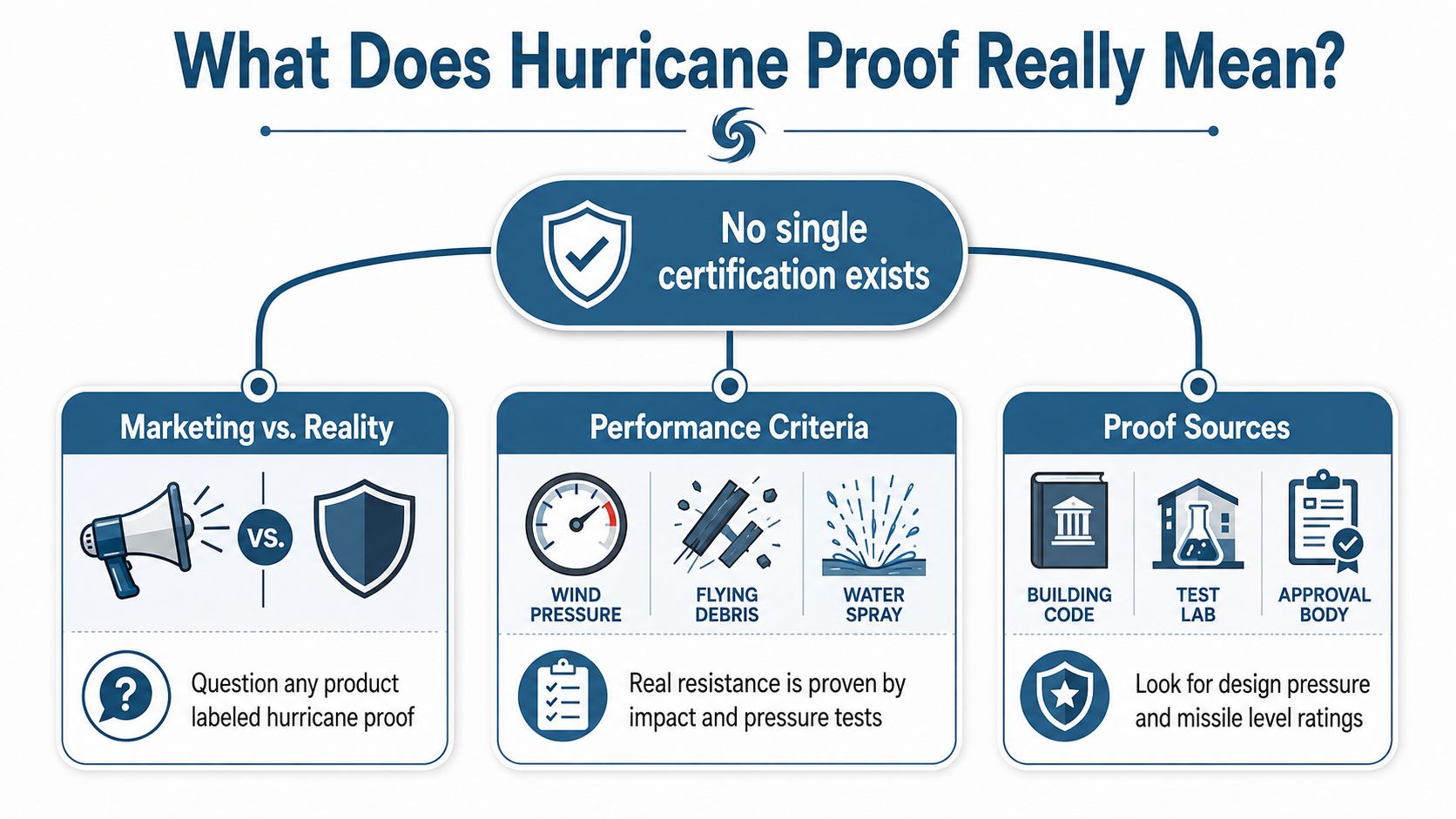
Impact and pressure are different jobs
An impact-rated assembly must resist windborne debris. A wind-rated assembly must handle positive pressure pushing inward and negative pressure pulling outward. One rating does not establish the other, so buyers should require documentation for both where the project calls for them.
Labels such as “storm ready,” “coastal grade,” and “hurricane proof” prove nothing alone. Request the applicable product approval, test report, design-pressure schedule, missile classification, and installation instructions. Also find out if hurricane damage is covered before assuming a stronger door settles every insurance question.
Glazing needs the same review. A decorative lite, sidelight, or transom must appear in the approved configuration, not be substituted after testing. For glass details, see this guide to impact-resistant glass, including its interlayer, frame, and tested assembly.
Practical rule: If the seller cannot identify the tested assembly and approved components, treat “hurricane proof” as advertising, not engineering.
The Codes and Tests Behind the Label
A legitimate severe-weather door is documented as a complete assembly, not sold as a reinforced slab with a vague label. Every test answers a different performance question, and approval applies only to the configuration tested.
ASTM E1886 and ASTM E1996 cover impact protection and cyclic pressure for exterior doors and impact protective systems. Review the report for the listed door size, frame, hardware, glazing, and anchorage. Impact testing addresses debris striking the opening. Cyclic pressure testing shows whether the assembly continues to perform as wind loads change.
ASTM E330 measures structural response under uniform static pressure, including positive and negative loads. The resulting design-pressure value is useful only when it matches the specific assembly being sold. A manufacturer should identify the approved size range and components rather than offer a pressure number detached from the installation.
Florida's High Velocity Hurricane Zone adds separate requirements. FEMA recovery guidance notes that all doors in Florida's HVHZ must be tested for water-penetration resistance. Outside the HVHZ, side-hinged doors must at least carry a design-pressure rating derived from ASTM E330. Florida also uses the Miami-Dade TAS series, including TAS 202 for structural testing and TAS 203 for impact and cyclic pressure. The Florida code presentation shows why missile resistance and wind-load resistance remain separate approval questions.
What the main standards tell you
| Test / Standard | What It Measures | Typical Use |
|---|---|---|
| FEMA P-361 | Safe-room door performance and protective criteria | Tornado and hurricane safe rooms |
| ASTM E1886 | Impact and cyclic-pressure test procedure | Exterior impact assemblies |
| ASTM E1996 | Windborne debris missile classifications | Hurricane-prone regions |
| ASTM E330 | Uniform static pressure and structural response | Design-pressure verification |
| TAS 202 | Structural performance under Miami-Dade protocols | Florida HVHZ approvals |
| TAS 203 | Impact and cyclic pressure | Florida HVHZ impact assemblies |
FEMA or ICC-style shelter doors occupy the high-protection end of the market. Published examples report resistance above +201/-201 psf. The missile classification on an approval document identifies the tested impact level, so verify that classification instead of relying on a sales phrase. The ANSI A250.13 reference also addresses windstorm conditions in the 110 to 150 mph range, reinforcing that severe-wind performance depends on measured loads and the tested assembly, not material thickness alone.
A high-pressure test does not make a door a safe-room door. Gulf Coast buyers need a rating suited to the building, opening, and jurisdiction. Inland Texas buyers should reject coastal-only marketing unless the project requires that level of protection. If insurance requirements matter, use documented assembly information when you calculate hurricane coverage savings, then confirm eligibility with the insurer.
Door Materials and Construction Options
Choose the material for the Texas exposure, maintenance plan, and appearance you want. Then confirm that the complete door assembly carries the required approval. A slab's material alone does not establish hurricane performance.
Fiberglass is usually the best starting point for homeowners who want balanced insulation, stability, and appearance. Its composite skin and foam core handle heat and moisture changes well, and many finishes imitate wood. For impact applications, examine the skin's thickness and the core's density. A lighter construction may suit an ordinary entry door, while a higher-density core can provide a firmer substrate for the face and reduce damage under impact. The tested fiberglass assembly, not the marketing name, determines whether it meets the project's requirement.
Steel offers a rigid, secure feel and strong forced-entry resistance. It can also deliver impact toughness, but the tradeoffs are weight, thermal transfer, and corrosion. Gulf Coast buyers should specify protected steel, treated edges, compatible hardware, and a finish maintenance schedule for salt exposure. Inland Texas buyers may prefer steel when security and impact resistance outweigh thermal and corrosion concerns.
Reinforced wood or composite construction fits custom projects where grain, proportion, and tactile quality carry more weight. These doors require disciplined finish maintenance, particularly at exposed edges and around hardware. Wood-based construction can also add substantial weight, so confirm that the selected product is approved as a complete opening rather than assuming reinforcement can be added later.
Compare the material choices
| Material | Strengths | Weaknesses | Best Fit |
|---|---|---|---|
| Fiberglass | Stable, insulated, paintable, wood-like appearance | Impact performance varies with skin, core, and tested design | Texas homes seeking balanced performance and appearance |
| Steel | Rigid, secure, and resistant to forced entry | Corrosion, thermal transfer, and added hinge load | Inland security-focused projects or protected coastal installations |
| Reinforced wood or composite | Premium appearance and substantial construction | More maintenance, weight, and exposure sensitivity | Custom homes where design and finish have high priority |
For any material, compare the approved leaf, frame, threshold, glazing if present, and hardware as one listed configuration. A decorative slab paired with a generic frame is not a hurricane solution. Review opening dimensions, wall connection requirements, and finish exposure before selecting a panel style. This front door replacement guide can help compare construction and opening details before you commit to appearance alone.
Wind Speed, Design Pressure, and Missile Levels Explained
A door rated for a high wind speed is not automatically the right door for your house. Wind speed describes the storm environment. Design pressure, measured in pounds per square foot, tells the engineer how much load that specific opening must resist after accounting for exposure, building height, location, and wind direction.
Use the pressure schedule as the buying requirement. Do not compare products by mph alone, and do not confuse design pressure with ultimate pressure. The approval should identify the pressure value, while your engineer, building department, or plans should identify which pressure basis applies.
A Texas example: the same rating does not fit every site
Assume a project calls for +60/-60 psf. A home in Corpus Christi may need that rating because Gulf exposure, wind direction, opening height, and surrounding terrain produce significant calculated loads. The same rating could be excessive or insufficient for a home near Tyler. Tyler is inland, so the surrounding exposure and local design criteria may produce a different opening requirement. The point is simple: apply the rating to the actual address and wall, not to the broad label “Texas.”
For a Corpus Christi buyer, request the product approval and the project's positive and negative pressure schedule before choosing a coastal-rated assembly. For a Tyler buyer, do not pay for a coastal package by default. Confirm the required pressure, debris exposure, and local code path first. A higher printed mph number does not prove better performance for either location.
Missile testing adds a separate decision
ASTM E1996 missile levels classify the debris threat. Large-missile testing uses a wood missile, while small-missile testing uses a smaller steel projectile. The approval must identify the tested missile, impact locations, pressure cycles, and complete door configuration. A sales summary cannot replace that documentation.
Cyclic testing also matters. Storm winds reverse direction, so the laboratory applies positive and negative pressure cycles before checking whether the leaf, frame, locks, seals, and anchors still function and resist weather.
| Exposure / Wind Zone | Typical Design Pressure (psf) | ASTM/TAS Missile Level | Common Use |
|---|---|---|---|
| Severe-wind residential exposure | Product-specific | Product-specific | Inland and coastal openings requiring documented pressure resistance |
| Florida HVHZ | Approval-specific, with published examples reaching +100/-120 psf | Missile level and wind zone shown on approval | High-exposure Florida applications |
| FEMA or ICC safe-room application | Published examples above +201/-201 psf | 100 mph, 9 to 15 lb missile example | Safe rooms and near-absolute protection |
Missile resistance and pressure resistance answer different questions. Debris exposure determines whether the impact classification controls. Calculated wind loads determine whether the pressure rating controls. Gulf Coast openings often require both, while inland Texas projects may need a different balance based on the site-specific approval and code review.
Installation Details That Make or Break Performance
A tested assembly can fail in the field because the opening doesn't reproduce the laboratory connection. The installer must verify the substrate, confirm the rough opening, keep the frame straight, and transfer loads into structural framing rather than relying on sheathing alone.
Start with the wall. Identify the actual backing material, inspect for rot or movement, and confirm that the rough opening matches the manufacturer's tolerances. Shim the frame so it stays in plane, then fasten through the specified locations with the approved anchor type and embedment. Coastal work calls for corrosion-resistant hardware, such as stainless or hot-dip galvanized components where the approval and exposure require them.
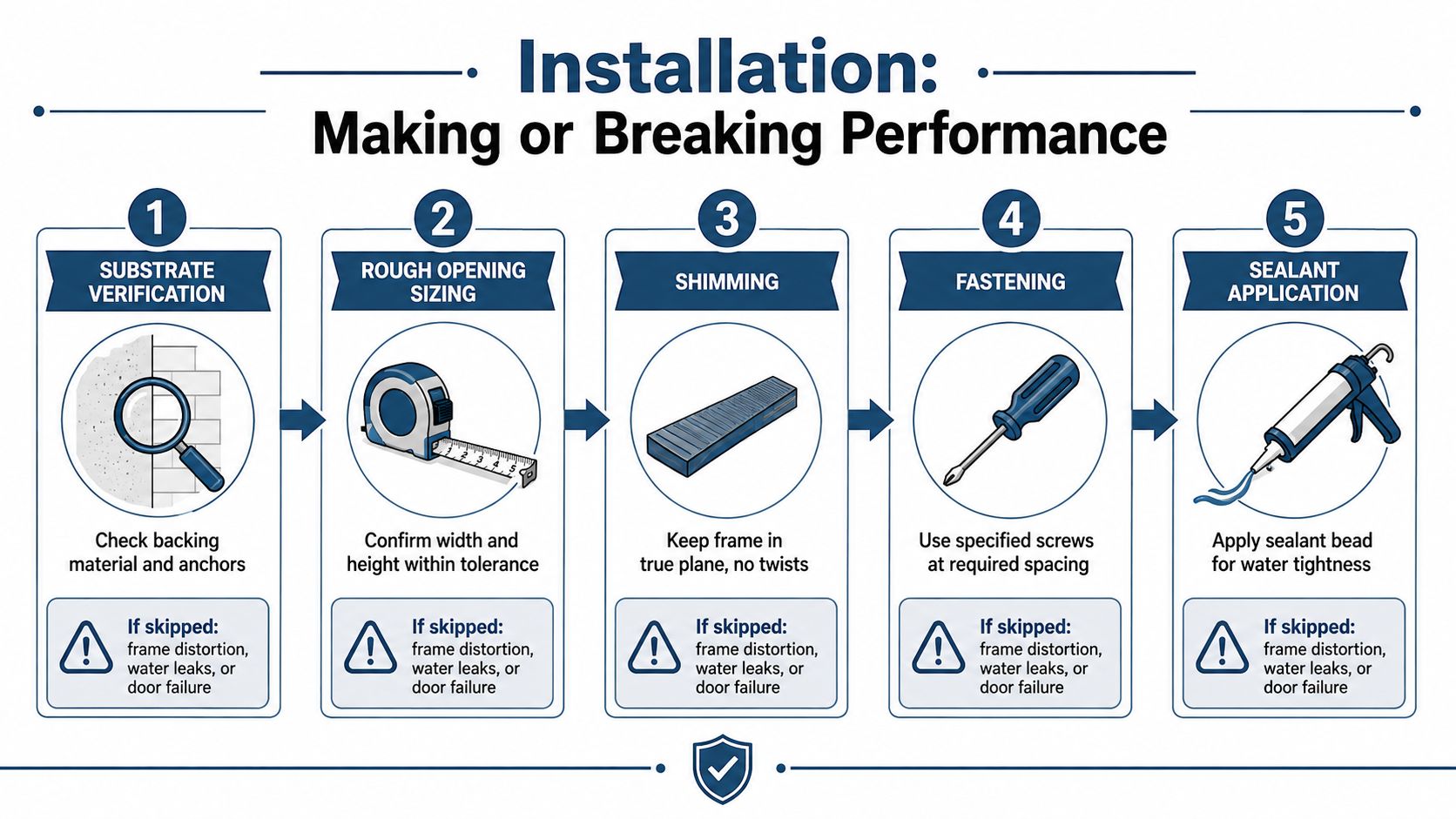
Water enters at the sill first
The threshold needs more than a bead of caulk. Use a compatible sill pan, integrate self-adhered flashing with the water-resistive barrier, and lap the layers so driven rain drains outward instead of behind the threshold. Back dams, end dams, sealant compatibility, and the transition to the wall membrane all matter.
The frame-to-wall interface also needs an air and water seal. A door can remain structurally intact yet leak because the installer skipped a pan-flashing detail or left a gap at the threshold. This exterior door installation diagram is useful when reviewing the sequence with a builder or installer.
Inspect the hinges, lock-side reinforcement, weatherstripping, and threshold adjustment after the frame is secured. A missed anchor can let the frame rack during cyclic loading, while poor shimming can keep the latch from compressing the seals. For a practical visual walkthrough, use this installation reference:
Installation standard: The product approval tells you what was tested. The installer must reproduce the approved substrate, anchors, spacing, flashing, and sealant conditions.
Choosing the Right Door for Texas Coastal and Severe-Weather Zones
Texas doesn't have one universal hurricane-door specification. A Gulf-facing opening in Galveston, Corpus Christi, or South Padre Island faces a different combination of wind, salt, humidity, and driven rain than an inland opening near Houston, San Antonio, or the I-35 corridor.
That doesn't mean inland buyers should dismiss impact-rated doors. Building-science guidance recommends pressure- and impact-rated or protected exterior doors in hurricane-prone areas, and windborne-debris requirements depend on wind speed, exposure, and building type, not on distance from the shoreline. The PNNL exterior-door guide is a useful independent reference for that distinction.
Use the local approval, not a coastal slogan
For a Texas project, ask the designer, building official, or product representative which locally adopted IRC or IBC provisions apply. Then request the applicable Texas Department of Insurance wind-zone information, evaluation report, or product approval. A generic “HVHZ rated” label may be a helpful benchmark, but it doesn't automatically authorize installation at every Texas address.
Read the approval report for:
- Design pressure: Confirm positive and negative values for the actual size and configuration.
- Wind zone: Verify the product is approved for the jurisdiction's exposure.
- Missile requirement: Determine whether impact testing is required or preferred.
- Operation: Check outswing or inswing requirements, hinge arrangement, and lock hardware.
- Water control: Confirm threshold, flashing, drainage, and weather-seal details.
Gulf Coast humidity and salt air push you toward corrosion-resistant hardware, durable coatings, sealed edges, and installation details that shed water. Inland buyers may place more emphasis on wind pressure, debris protection, solar exposure, and outward-swing operation without paying for a Florida-specific configuration they don't need.
A broader storm-readiness plan should also cover other openings and emergency steps. This home protection checklist for Tampa Bay can help organize those decisions, but your Texas door still needs local approval and a complete installation scope.
Specification Checklist Before You Buy
Don't accept a quote that names only a door brand, material, and finish. Require a complete assembly listing and matched components before anyone orders the unit.
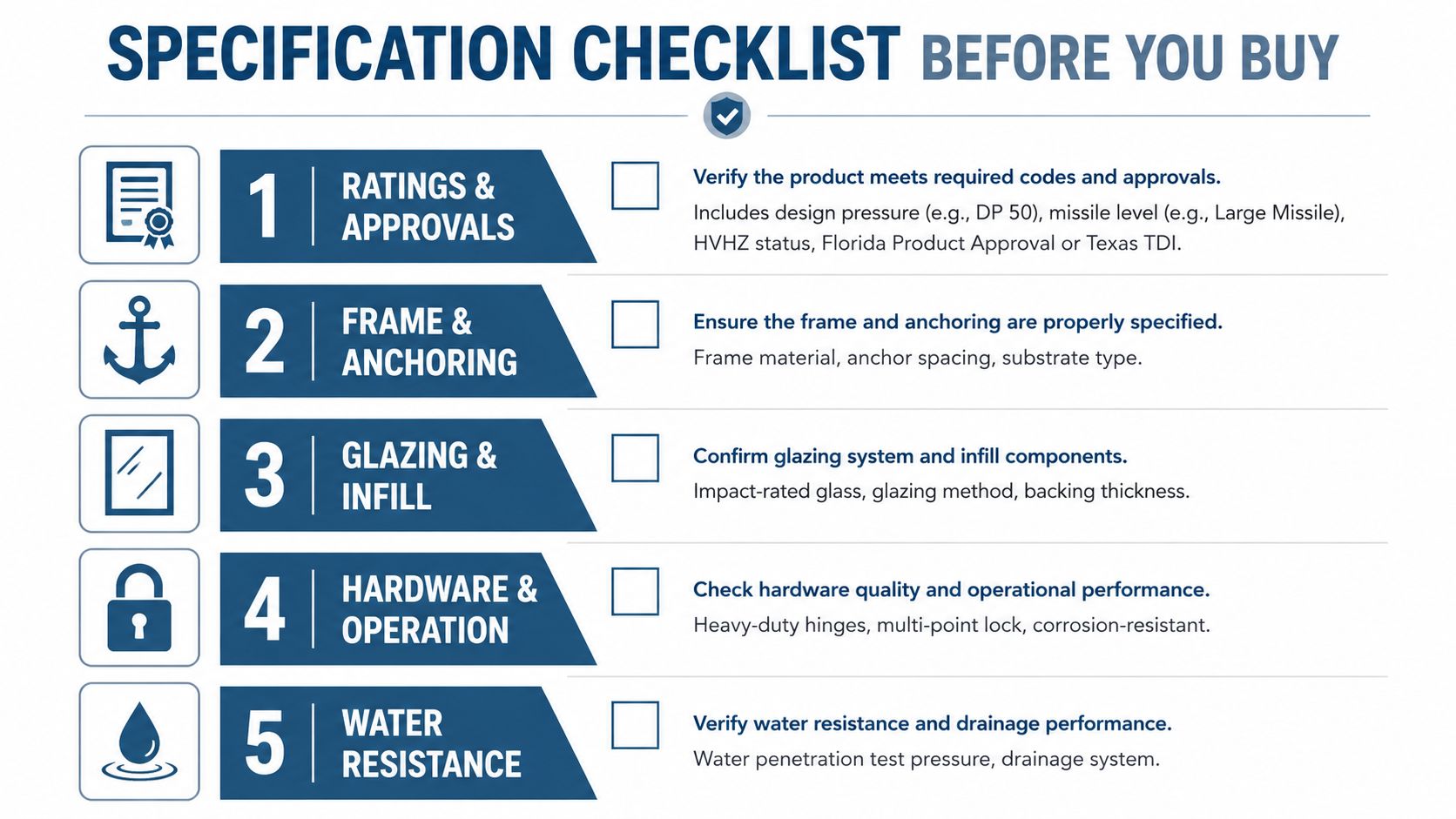
Ratings and approvals
- Design pressure: Record positive and negative ratings for the exact size.
- Missile level: Identify the tested impact classification and standard.
- Regional approval: Request the Florida Product Approval, Miami-Dade NOA, Texas evaluation report, or other jurisdictionally relevant document.
- Code cycle: Confirm which locally adopted code cycle governs the project.
Assembly completeness
- Matched frame: Verify the frame appears in the listing.
- Hardware: Check hinges, locks, strike plates, and reinforcement.
- Glazing: Confirm every lite, sidelight, and transom matches the approved configuration.
- Threshold: Require the listed threshold, weatherstripping, drainage, and sill details.
Installation scope
- Substrate: Identify the structural backing and repair requirements.
- Anchors: Write down anchor type, spacing, embedment, and corrosion protection.
- Flashing: Specify the pan, membrane, sealant, and water-resistive-barrier transitions.
- Tolerance: Include rough-opening dimensions, shim requirements, and frame-plumb checks.
Warranty and verification
Ask what voids the warranty, which maintenance tasks the manufacturer requires, and whether coastal exposure changes the coverage. Have the supplier identify the third-party listing, test report, product approval, and installation instructions before you sign.
Hand this to the supplier: “Provide the full tested assembly listing, exact frame and hardware schedule, design pressures, missile classification, approved installation details, and local code documentation with the quote.”
Maintenance and Long-Term Ownership
A hurricane-rated door doesn't keep its listing in practical use if the owner lets seals, fasteners, finishes, and hardware deteriorate. Put the opening on a recurring inspection schedule and document the work.
Inspect the threshold seal, frame-to-wall joint, glazing gaskets, and exterior trim for gaps or movement. Clean impact glazing with a gentle, non-abrasive product that won't attack the interlayer or surface coating. Avoid aggressive solvents and ammonia-based cleaners unless the manufacturer specifically approves them.
Lubricate hinges and locks with the manufacturer's approved corrosion-resistant product. Salt exposure makes hardware inspection especially important, and galvanic corrosion can occur where dissimilar metals meet. Check fastener heads, hinge leaves, lock components, and exposed frame edges for coating failure or corrosion.
At Gulf Coast properties, plan for periodic renewal of exterior caulk at trim and flashing terminations. The right interval depends on the sealant, exposure, substrate movement, and manufacturer instructions. Don't wait for visible interior leakage before checking the sill pan and threshold.
Keep a service record with inspection dates, products used, repairs completed, and photographs of changed components. That record supports warranty discussions and future insurance claims. A neglected or undocumented assembly may still carry the original label, but the opening's real-world condition no longer matches the tested product.
The decision that matters most comes before the order: buy a documented assembly matched to your Texas exposure, then install and maintain it as a system. Material, color, and glass style come after that requirement.
Breaking Glass Co. supplies and installs fiberglass entry doors, impact-resistant glass solutions, and residential or commercial door packages for Texas projects, with product guidance, installation support, quotes, and warranty coordination. Visit Breaking Glass Co. to discuss the opening, rating documents, and installation details before you purchase.