
Fog or droplets trapped between the panes that won't wipe off usually mean the perimeter seal has failed, while moisture on the room-facing glass usually points to humidity or temperature. The first thing to establish is whether you can touch the wet surface, not how cloudy the window looks.
Table of Contents
- Where the Fog Sits Tells You the Cause
- How to Run a Seal Check Step by Step
- Signs of a Failed Seal Inside the Glass
- Check the Edge and Frame Before You Decide
- When to Repair the Seal and When to Replace
- Your Next Step With the Installer and Warranty
Where the Fog Sits Tells You the Cause
In a 2025 survey of 1,000 U.S. homeowners, This Old House found that 7.6% replaced windows because of condensation between panes. That's a reason to investigate trapped moisture, not a reason to replace every window that fogs up.
The survey doesn't establish whether homeowners correctly identified the moisture's location. That distinction matters because surface condensation and a breached insulating cavity need different fixes.
Moisture location and likely cause
| Where the moisture appears | How it behaves | Likely cause | First action |
|---|---|---|---|
| Between the panes | Stays after the glass is dried; doesn't wipe off | Failed insulating-glass seal | Confirm with the check steps, then plan glass-unit replacement |
| Room-facing glass surface | Wipes off; returns in winter, after showers or cooking | High indoor humidity or cold glass | Measure indoor humidity and improve ventilation |
| Outside-facing glass surface | Forms on cool, clear mornings and often clears by mid-morning | Glass temperature below dew point | Usually normal; monitor only |
| Sill or frame, no fog inside the glass | Water or staining along the sill or frame | Drainage problem or air leak at the frame | Inspect frame drainage and weatherstripping |
| Several windows at once | Fogging appears on multiple units in the same room or floor | Humidity, ventilation or a shared installation issue | Assess the whole house before replacing any unit |
An insulated-glass unit, or IGU, is the sealed glass assembly held inside the sash or frame. Its perimeter seal is different from the caulk around the window opening and the weatherstripping where the sash closes.
That difference explains why a window can be drafty but have sound glass, or have a failed glass seal without an obvious air leak into the room. Ordering a complete window before separating those problems can turn a targeted repair into unnecessary construction.
Practical rule: Identify the wet surface before choosing the repair.
If your symptoms match the cavity-moisture row, document the pattern and investigate the glass unit. If they match room humidity or frame drainage, address that condition first and watch what changes. Multiple affected windows deserve a shared-cause assessment, but simultaneous fogging doesn't automatically mean every IGU has failed.
How to Run a Seal Check Step by Step
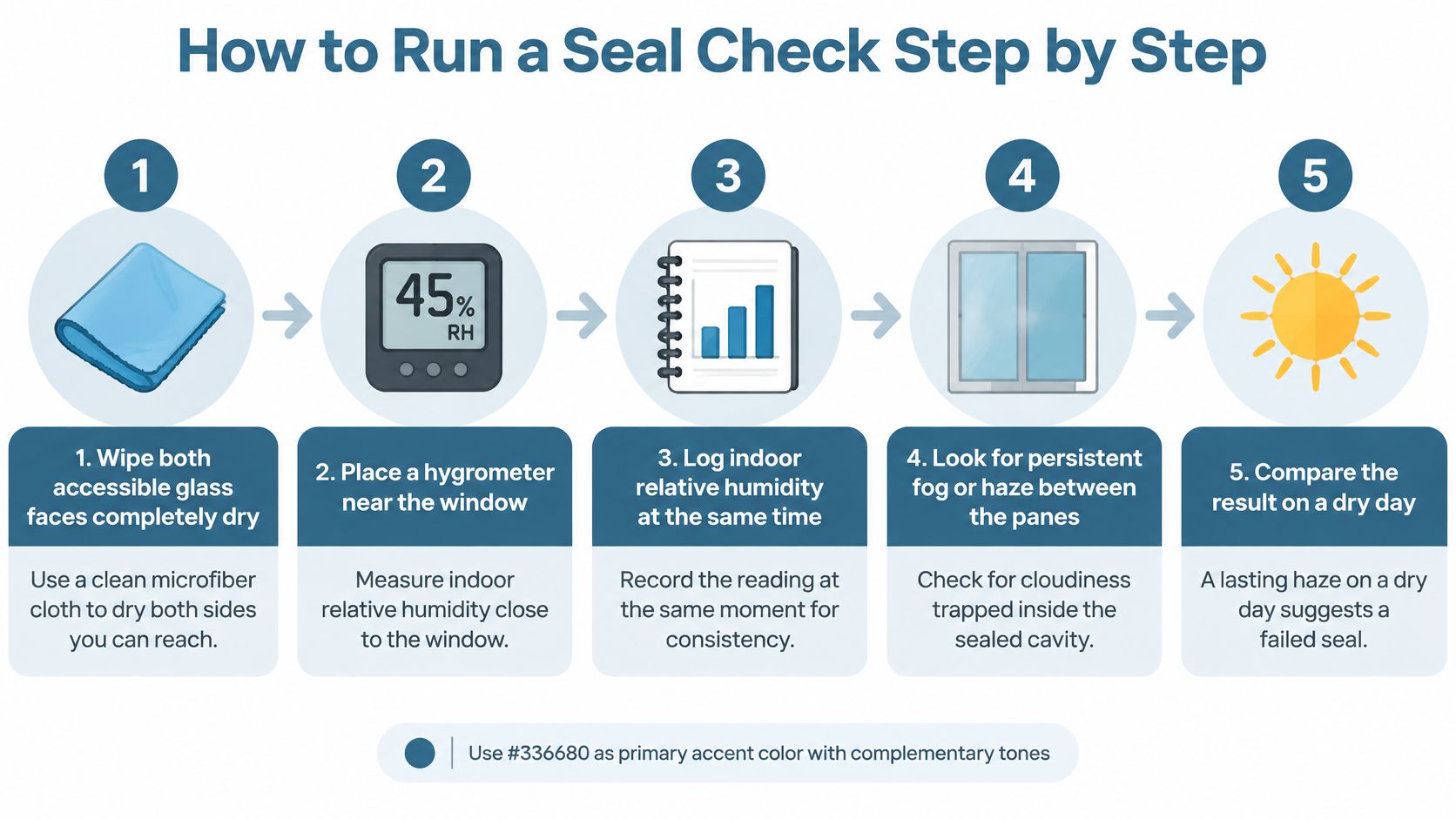
You don't need to remove glazing beads or probe the edge seal to make a useful initial assessment. Gather a clean microfiber cloth, a hygrometer, a phone camera and a notebook.
ENERGY STAR's window guidance explains that surface condensation develops when glass falls below the dew point of humid air, and that it can occur even on certified windows during cold weather. Cold glass alone isn't proof of defective glazing.
Establish a clean baseline
Dry both accessible faces. Wipe the room-facing glass and the outdoor-facing glass completely dry with a microfiber cloth. Only clean exterior glass you can reach safely; don't lean out of an upper-floor opening.
Place a hygrometer near the suspect window, away from direct sun, a supply vent or a wet sill. Record indoor relative humidity at the same time each day so you're comparing similar conditions.
Photograph from a fixed position. Take pictures with room lights on and then off. Changing the lighting helps distinguish a reflection from haze within the glass.
Observe after morning sun reaches the window, during heating or cooling cycles, and after rain. Note whether the cloudy area moves, clears or returns.
Locate the returning moisture. Test the exposed surfaces again with the cloth. If neither wipe changes the fog, inspect from an angle to judge whether it sits within the cavity.
Compare with a clear window facing the same direction. Similar exposure gives you a better baseline than a shaded window on the opposite side of the house.
Record outdoor conditions. Note outdoor temperature and whether the weather is sunny, rainy or overcast alongside each photograph. A weather-linked pattern is more useful to an installer than a single close-up.
Keep this visual checklist handy while inspecting the accessible glass.
Interpret the pattern, not one photograph
If room-side moisture disappears after drying and stays away when you improve ventilation, start with indoor moisture control. Run bathroom and kitchen exhaust fans that discharge outdoors, check dryer venting, and open blinds enough to allow room air to circulate over cold glass.
Don't chase a universal humidity target without considering the weather and window construction. A setting that works during mild weather may still allow condensation when the outdoor temperature drops.
A clear window at noon doesn't cancel out a documented pattern of inaccessible morning fog.
When figuring out how to tell if a window seal is broken, persistence means recurrence inside the cavity, not necessarily uninterrupted cloudiness. Watch the window across changing conditions before calling a room-side film a failed seal.
Signs of a Failed Seal Inside the Glass
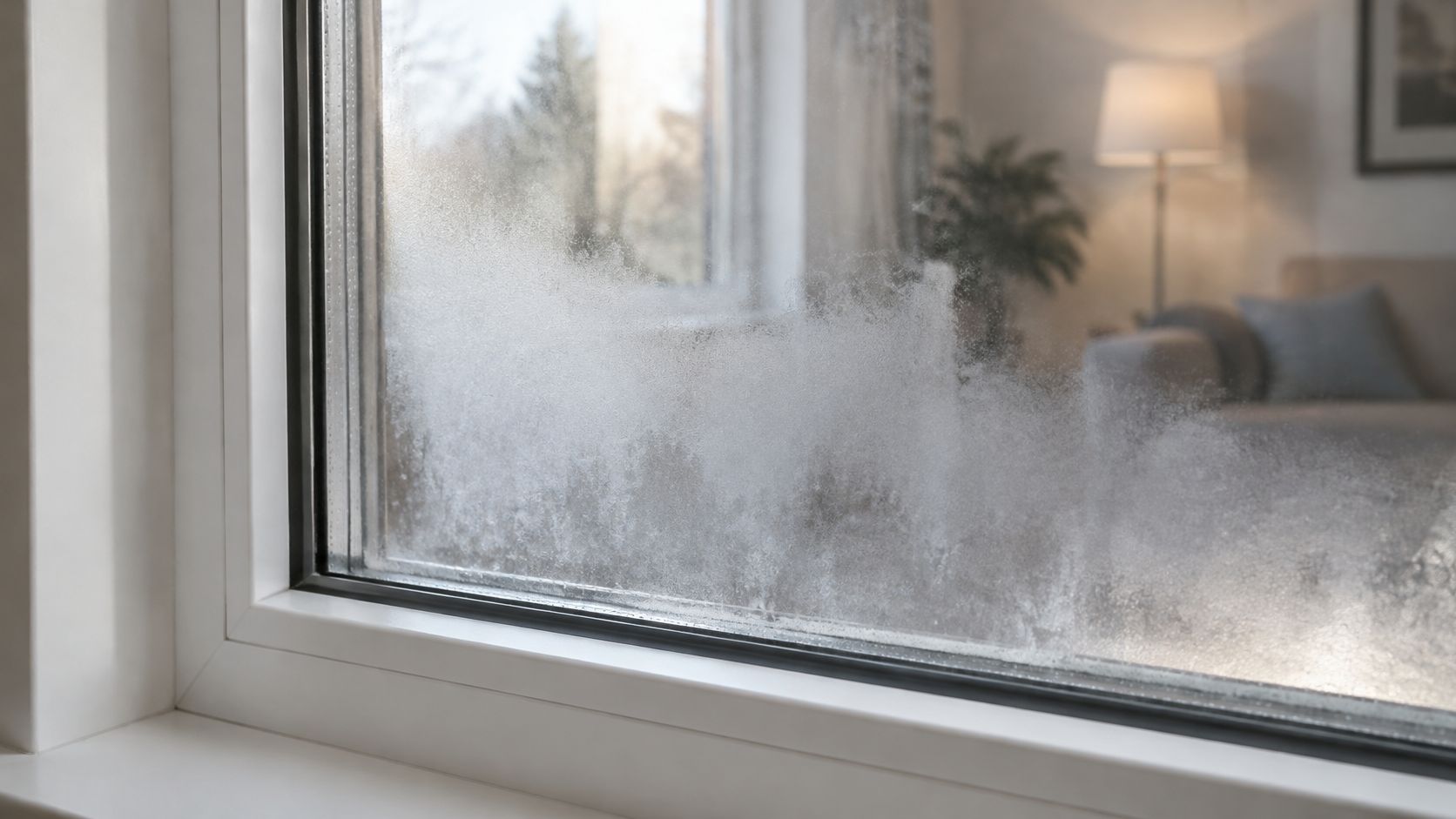
Persistent internal haze is the strongest visible starting point. Cardinal's insulating-glass technical guidance states that condensation in the airspace is usually caused by failure of the insulating-glass seal.
Look closely at the moisture's depth rather than judging the whole window by its appearance.
What develops inside the cavity
Early on, you might notice a faint cloud only when sunlight hits the glass at an angle. Later, droplets, dried streaks or mineral-like residue may become easier to see, especially against a dark outdoor background.
A neighboring window can reveal a loss of clarity you've gradually stopped noticing. However, a tint difference alone isn't conclusive because adjacent units may have different coatings or replacement histories.
Temperature cycling offers another clue. Moisture within a breached cavity can evaporate as the glass warms, then condense again when it cools.
- Recurring internal fog: The pattern returns despite clean, dry exposed surfaces.
- Inaccessible deposits: Streaks or pale residue remain beyond the reach of cleaning.
- Localized discomfort: The area beside the suspect unit feels noticeably different from a comparable window.
A pattern worth having inspected
Say a bedroom window looks foggy on a dry winter morning, and wiping both accessible faces changes nothing. It clears by noon, then clouds again the next morning, while the area beside it feels colder than the neighboring window.
That combination supports an IGU inspection. An actual moving draft still needs a separate frame-leak check; a failed cavity seal doesn't automatically create a direct passage for outdoor air into the room.
Use the video alongside your photographs, keeping the moisture's location central to the assessment.
Visual clues can justify an inspection, but they can't measure the remaining insulating value or establish how much gas fill remains. Ask the glazier to assess the assembly rather than estimating performance from the size of the cloudy patch.
Check the Edge and Frame Before You Decide
A cold or wet window isn't necessarily a glass problem. Before approving replacement, inspect the parts that hold the glass and connect the window to the building.
Separate glass-edge damage from air leakage
- Inspect under side lighting. With the window closed, use a flashlight to look for displaced gaskets, cracked sealant, corrosion, edge discoloration or a dark ring near the spacer. Don't pry out glazing beads to expose a concealed seal.
- Check the sash gently. Notice rattling or movement during normal operation, but don't press hard on the glass. Loose glazing needs professional attention even when the cavity looks clear.
- Trace moving air. On a windy day, hold a strip of tissue along sash joints and frame joints. Movement suggests leakage there, although indoor air currents can also move the tissue.
- Check drainage. Look for blocked exterior drainage openings and debris in accessible tracks. Don't seal weep holes with caulk.
If the glass is clear but tissue moves at a closing joint, investigate weatherstripping and sash adjustment. This guide to stopping drafts from windows helps distinguish those repairs from glazing work.
Use thermal images cautiously
An infrared camera can help compare the suspect window with a sound unit under similar exposure when indoor and outdoor temperatures differ clearly. Sun, blinds, reflections and moving air can distort the image, so a colder-looking patch isn't a seal-failure diagnosis.
ASTM E2188 addresses standardized testing of sealed insulating-glass construction. A handheld thermal image isn't equivalent to that performance testing; ask for calibrated professional assessment when an energy claim or warranty dispute depends on the result.
Don't buy glass to fix a gap between the frame and the wall.
If staining extends onto drywall, several openings leak, or water appears after wind-driven rain, broaden the investigation. RestoTek TX's explanation of what a building envelope inspection covers provides context for checking the surrounding wall and moisture pathways.
Route a confirmed frame leak toward drainage, adjustment or perimeter sealing work. Route confirmed cavity moisture toward glazing assessment, while treating concealed water damage as its own repair scope.
When to Repair the Seal and When to Replace
Repair or replace by situation
Moisture on the room-facing or outdoor surface does not call for glass replacement. Moisture sealed between the panes does. Use that distinction before comparing prices.
| Situation | Usual fix | What the quote covers | Check before paying |
|---|---|---|---|
| Fog between the panes on one window | Replace the insulated-glass unit | Matched replacement IGU and installation | Wipe both exposed faces; confirm the moisture remains inside the cavity |
| Visible water pooling or mineral deposits inside the glass | Replace the insulated-glass unit | Replacement IGU plus spacer and edge-seal inspection | Confirm the deposits sit between the panes rather than on an exposed surface |
| Perimeter air leak with no fog inside the glass | Reseal or weatherstrip the perimeter | Joint sealing, weatherstripping or sash adjustment | Verify that the glass cavity is clear and the leak follows the perimeter |
| Fogging on several windows at once | Whole-house moisture and installation assessment | Humidity and ventilation review plus window-by-window cavity inspection | Separate surface condensation from individual IGU failures |
| Sash or frame damaged, glass sound | Repair or replace the damaged sash or frame | Component repair and reuse of the sound glass where compatible | Confirm whether the existing glass can be retained |
| Failure inside an active warranty | Warranty claim before paid repair | Manufacturer or installer review and the authorized remedy | Read the terms and keep records |
The 2025 Airtasker U.S. cost guide lists $150–$300 per window for window seal repair and $40–$120 per seal for broken window seal repair. I would treat those figures as broad market ranges and ask which component the quoted amount covers.
Match the scope to the defect
An isolated failed unit with a sound frame usually calls for glass-unit replacement. Ask whether the existing sash can accept a replacement assembly with matching thickness, coating and safety-glass specifications. This overview of insulated-glass replacement is useful when comparing that scope with a complete window quote.
Water pooling needs careful location checking. Water inside the cavity belongs in the glazing assessment; water in the sill track may involve drainage instead.
For a clear-glass air leak, spend money on the leaking joint. Applying exterior caulk to an otherwise sealed glass package won't remove trapped moisture or recreate its internal seal.
Professional Window Cleaning's discussion of DIY repairs for cloudy window seals is useful context when evaluating repair proposals. Before accepting a cleaning or defogging service, ask whether it merely improves appearance or supplies a new sealed assembly.
When several windows fog together, pause the purchase order until the assessor separates surface moisture from individual cavity failures. If the sash or frame is damaged, establish whether it can hold replacement glass correctly before ordering it.
Warranty approval should come before alterations or paid work. Keep the failed unit intact until the responsible manufacturer or installer confirms what evidence it needs.
Your Next Step With the Installer and Warranty
Prepare a usable inspection request
Gather the records. Collect dated photographs, indoor humidity readings, outdoor conditions, the purchase receipt and any visible label or spacer code. Don't dismantle the window to find identification.
Call the original installer and describe where the moisture sits and when it returns. Request inspection of the IGU, spacer, edge seal and surrounding drainage.
Get a written scope. The quote should distinguish glass only, sash replacement and full-window replacement, including removal, disposal and finishing responsibilities.
Read the warranty before authorizing work. Ask whether it covers labor as well as glass; compare the terms with this explanation of lifetime window warranty coverage. For newer homes, Foundation's a homebuilder's guide to post-close care provides useful context for organizing service requests.
Compare equivalent proposals. If the original installer isn't available, send the same evidence and scope questions to local glaziers or a residential and commercial window supplier.
An intact fogged unit usually isn't an emergency, but arrange an inspection rather than leaving the cause unresolved. Escalate promptly if you find loose glass, cracking or active water entry into the wall.
Breaking Glass Co. supplies and installs residential and commercial windows and provides quotes and warranty support. Visit Breaking Glass Co. with your photographs and window details to discuss the appropriate replacement scope before committing to a full-window purchase.