
You can stand in a showroom, hold two front doors side by side, and still not know which one will hold up in a Texas summer. A nine-light door can look right in the hand and still be wrong for the wall opening, the sun exposure, or the code path. The pane count is only the starting point, and that's where most buyers get misled.
Table of Contents
- What a Nine-Light Door Looks Like and Why the Pattern Endures
- Reading the Grid Muntins, Panels, and Glass Types
- Comparing Vinyl, Fiberglass, and Wood for Texas and Southwest Climates
- Energy Performance That Comes From the Whole Door Not Just the Glass
- Security, Storm Compliance, and the Hidden Value of Smaller Lites
- Where Nine-Light Doors Work Best Entry, Patio, and Interior Applications
- Customization, Installation, Sourcing, and Shipping Made Simple
What a Nine-Light Door Looks Like and Why the Pattern Endures
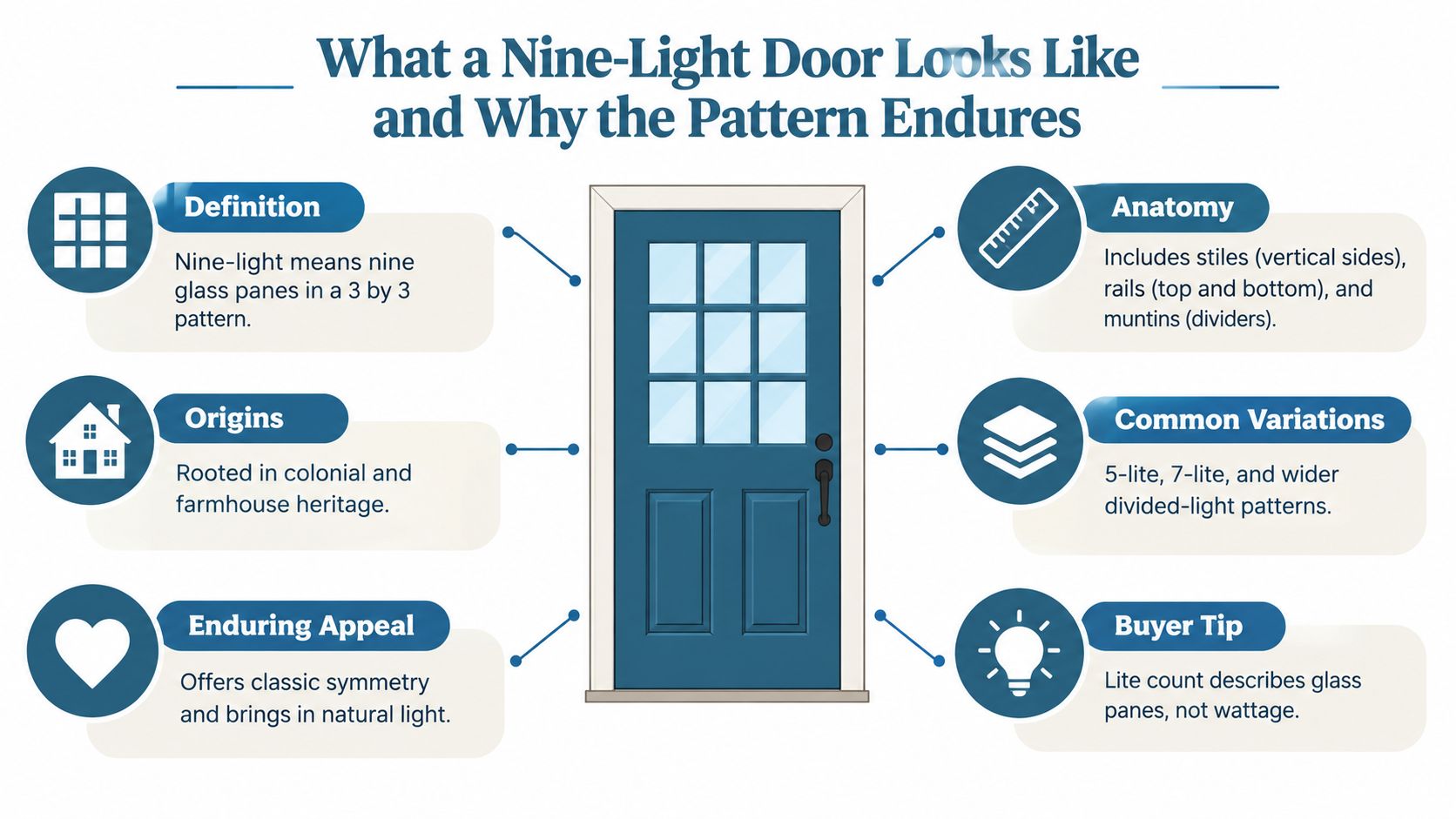
A homeowner in East Texas often starts with a simple comparison. One door has the familiar 3 by 3 grid of glass, the other has a cleaner panel look, and both seem close enough until you begin asking what the glass, frame, and muntins are doing. A nine-light door is a glazed door with nine individual panes, and the pattern usually reads as an orderly square grid that lets in daylight without turning the opening into a full wall of glass. Traditional Pine Doors notes that this configuration became especially associated with Victorian and Edwardian domestic architecture, which is why it still shows up in catalogs today.
The language that matters on a quote sheet
Lights are the panes of glass. Muntins are the slender members that divide them. True divided lites use separate pieces of glass, while simulated divided lites create the same look with a larger sheet and applied or internal grid components. Those terms matter because a door that looks like a nine-light can be built in very different ways, and the quote sheet usually tells you which version you're buying.
Historical glazing also explains why the pattern lasted. As manufacturing improved during the 19th century, larger sheets became available, but dividing a large opening into smaller lights still made practical sense. Nine panes balanced daylight with the limits of earlier glass production, and historical accounts show the style staying popular through the Edwardian period. That's why a nine-light pattern can feel traditional without being antique.
Practical rule: treat pane count as the visual decision, then check the frame, glass package, and hardware for the real performance story.
For a buyer, that means the first question is not whether the door has nine lights. It's whether the door's proportions, muntin profiles, panel layout, and glass type match the opening and the house. The number tells you what your eye will see. The rest tells you what the door will do.
Reading the Grid Muntins, Panels, and Glass Types
A nine-light door can look straightforward in a product photo and still be built three different ways. The easiest way to read it is to start with the grid, then check whether the lines you see are structural or decorative. A true divided lite behaves like nine smaller windows. A simulated divided lite gives you the same pattern with one larger pane underneath, which changes cleaning and repair even if the front elevation looks identical.
What to look for first
Start with the rails and stiles. The vertical sides are the stiles, the horizontal members are the rails, and the narrow dividers inside the glass field are the muntins. If the quote sheet lists decorative grilles, internal grids, or applied bars, you're probably not looking at a true divided lite. That doesn't make the door bad, it just changes what you should expect from maintenance and performance.
Glass choices matter just as much. Privacy glass can soften sightlines in an interior door or a front entry that faces a busy street. Low-E coatings help manage solar gain, and decorative details like starburst corners can create a period look without changing the overall count of lites. The design language is often borrowed from older homes, which is why nine-light doors stay useful in modern remodels and in projects like glass door cabinet conversions in Orlando, where the same visual logic gets scaled down for cabinetry.
A door that looks historic on the front can still be modern in the middle. That's normal, and it's why the spec sheet matters more than the photo.
If you're comparing two similar doors, ask three questions. Is the grid structural or applied? Is the glass clear, privacy, or coated? Does the layout use true divided lites, simulated divided lites, or grilles-between-glass? Those answers tell you whether the door will be easier to clean, easier to repair, and better suited to your climate.
Comparing Vinyl, Fiberglass, and Wood for Texas and Southwest Climates
A nine-light design can be built in vinyl, fiberglass, or wood, and the material choice changes the whole buying decision. In Texas, the issue isn't only appearance. It's sun, thermal cycling, humidity, and the fact that a front door spends its life taking abuse from heat and weather. For that reason, many projects end up favoring fiberglass or vinyl for low maintenance, while wood stays in the conversation when the home needs a traditional feel or a period match.
Material trade-offs at a glance
| Material | Maintenance | Climate Fit for Texas | Paintable | Typical Price Band |
|---|---|---|---|---|
| Vinyl | Low, simple cleaning | Good for everyday exposure | Usually limited | Value-oriented |
| Fiberglass | Low to moderate | Strong fit for heat and weather swings | Yes | Mid-range to higher |
| Wood | Higher, needs upkeep | Can work with care, but more sensitive | Yes | Wider range, often higher |
Fiberglass usually earns the best balance for exterior performance because it handles heat and weathering without the same swelling concerns wood can show. Wood still wins when a project needs authentic grain, a stained finish, or a historically sympathetic look. Vinyl is often attractive for straightforward upkeep, especially when the goal is a practical replacement rather than a heritage detail.
Breaking Glass Co. uses a factory-direct model for door and window supply, which can help align the product with the project rather than forcing the project to adapt to a random stock size. Their wood vs fiberglass front door page is a useful reference point if you're deciding between those two materials for a Texas entry.
The right choice usually comes down to the house, not the catalog. A builder-grade remodel on a hot, exposed elevation often calls for fiberglass. A historic-style home with deeper trim and a stained finish may justify wood. A simple replacement on a budget can still make sense in vinyl if the opening, exposure, and appearance line up.
Energy Performance That Comes From the Whole Door Not Just the Glass
A nine-light door can look efficient because the glass is broken into smaller panes, but real performance comes from the entire door assembly. Frame material, glazing package, edge conditions, and the way the unit is tested all work together. On a sun-exposed Texas entry, the wrong glass can bring in unwanted heat even when the door itself looks refined and traditional.

What the NFRC label actually tells you
The NFRC rating is the number set you want for the full unit, not just the center of the glass. U-factor measures heat transfer, so lower values mean better insulation. SHGC, or solar heat-gain coefficient, shows how much solar energy gets through, and lower is usually better on hot, exposed Texas elevations. VT, visible transmittance, tells you how much daylight the door admits, so a brighter entry can also bring more glare if the balance is off.
The U.S. Department of Energy notes that SHGC values for fenestration products commonly range from 0.20 to 0.80 (DOE fenestration rating guidance). For a west-facing door, that matters more than a decorative grille. NFRC also uses U-factor, SHGC, and VT as the core comparison metrics for fenestration ratings.
There is also a code threshold worth checking. A door with glazing covering at least 25% of its total area is treated as a fenestration product under the cited energy-code guidance, which means you should be looking at NFRC-certified values or the applicable table path rather than assuming it performs like an opaque door (energy-code guidance). That is the point where the whole assembly becomes the spec, not just the attractive front face.
Request the NFRC label for the full door, then compare the door by orientation, not by appearance.
A good quote should list the glazing percentage, Low-E coating, gas fill, spacer type, and the whole-door NFRC values. If those pieces are missing, the product may still look right, but you are buying blind on comfort and cooling load.
Security, Storm Compliance, and the Hidden Value of Smaller Lites
Homeowners usually ask whether a nine-light door is safe because the glass is what they notice first. Security starts with the full assembly, including the frame, threshold, lockset, and the glass type specified for that opening.

Why pane size matters more than people think
Exterior door glazing is generally treated as hazardous-location glazing under building-code guidance, so each lite has to be chosen with care. Impact classifications also get stricter when an individual pane exceeds 9 square feet (legal summary of code treatment). A multi-lite layout can keep each pane smaller, which may make compliance easier in some cases, but only when the tested assembly and local rules support it.
Tempered and laminated glass are not interchangeable. Tempered glass breaks into small, blunt granules instead of sharp shards, which is why code treats it as safety glazing. Laminated glass holds together on impact and resists forced entry, so it is often selected where impact resistance matters, and our impact-resistant glass overview explains how those assemblies are built and tested.
Texas adds another layer. The Texas Department of Insurance says windstorm-related work may need to comply with the applicable residential or building code, and shutters may be required in some circumstances. Coastal and high-wind projects need the right tested door, frame, and installation method for the site.
A replacement pane that fits is not the same thing as a compliant door. The tested assembly is what gives you confidence about performance, storm exposure, and how the door behaves under load. On many projects, a full prehung unit is the cleaner choice because it ties the slab, frame, and hardware together as one system.
Where Nine-Light Doors Work Best Entry, Patio, and Interior Applications
A nine-light layout shines where a home wants daylight but still needs a defined frame around it. That's why the pattern shows up so often in front entries, interior French doors, and some patio applications. The grid gives the opening a traditional rhythm, and that visual order can make a door feel more settled than a large single-lite pane.
Matching the layout to the opening
For a front entry, the classic 3 by 3 pattern usually works best when the architecture leans traditional, farmhouse, or Victorian-inspired. It gives the door a familiar face without overwhelming the façade. On an interior door, the same layout can move light between rooms while frosted or privacy glass keeps bedrooms, offices, and baths from feeling exposed.
Patio doors need a more careful read. A divided-light pattern can preserve the look of a nine-light door while still keeping the opening bright, but the visual balance changes when the door is wider or paired with sidelights and a transom. Double-door entries use the same language on a bigger scale, and the grid has to be proportioned carefully or the door starts looking crowded instead of intentional.
- Entry doors: Best when you want a classic face and clear architectural rhythm.
- Interior French doors: Best when daylight transfer matters more than view.
- Patio and double doors: Best when the grid can be balanced with the width of the opening.
A tighter grid feels more historic. A larger lite layout lets in more daylight. That trade-off is the central design decision, and it's why nine-light doors stay useful across so many house styles.
Customization, Installation, Sourcing, and Shipping Made Simple
Ordering a nine-light door goes more smoothly when you treat it like a measured assembly, not a decorative object. The rough-opening size, handing, glazing percentage, glass package, and NFRC documentation should all be settled before the order is placed. If those details are fuzzy, the installer ends up solving problems in the field that should've been solved at quote time.
What to lock down before you buy
A useful quote should confirm the opening size, swing direction, frame depth, and whether the project needs a replacement insert or a full prehung unit. It should also spell out the glass type, Low-E coating, gas fill, spacer type, and complete-door rating. That's the difference between a door that fits on paper and one that lands cleanly in the wall.
For Texas projects, statewide installation coverage matters because heat, exposure, and scheduling pressures don't look the same in every market. For buyers outside Texas, nationwide shipping can still keep the spec consistent as long as the crate, finish, and glass package are ordered correctly. Builders and remodelers should also coordinate lead times with other trades so trim, threshold work, and final paint don't stall the closeout.
If you're comparing finish options, this how to paint fiberglass entry door resource is useful for understanding how the surface is handled before you commit to a color plan. The same rule applies here as everywhere else in door work. The material, finish, and opening details all need to line up before the truck shows up.
A simple buyer checklist helps:
- Measure the rough opening carefully.
- Confirm handing before ordering.
- Ask for the NFRC label for the full door.
- Verify glass type for safety and climate.
- Match the frame and threshold to the existing wall.
Nine-light doors look simple from the street. They're not simple to spec, and that's exactly why the right supplier matters.
If you're weighing a nine-light entry, a replacement slab, or a full prehung assembly, Breaking Glass Co. can help with product selection, quotes, installation planning, and shipping for Texas and nationwide projects. Visit Breaking Glass Co. to compare door options, get a same-day quote, and match the right nine-light configuration to your opening and climate.