
A 2026 window replacement typically costs about $300 to $2,500 per installed window, with many homeowners landing near $750 to $1,050, while a 10-window project often runs about $7,000 to $18,000. The spread is wide because the quote includes more than the glass and frame, it also reflects labor, removal, trim, permits, taxes, installation method, and the conditions inside the wall.
You're probably asking because a contractor gave you a number that felt higher than the online “average,” or because you're trying to budget before anyone visits the house. That sticker shock usually comes from comparing a window-unit price with a complete installed project. Those are different products.
In Texas, the practical question isn't “What does a window cost?” It's what will this opening cost to measure, remove, prepare, install, seal, trim, and warranty? National guides show installed pricing from roughly $300 to $2,100 or even $3,000 for premium or complex units, and the same house can receive very different bids depending on whether the contractor performs an insert replacement, full-frame replacement, or specialty installation. Home Depot's replacement-window cost guide reflects that project-based pricing model.
Table of Contents
- What Goes Into the Price of a New Window
- How Frame Material and Glass Packages Move the Price
- Price Ranges by Window Style and Type
- Texas Regional Pricing and East Texas Service Areas
- Energy Efficiency, Warranties, and Long-Term Value
- Ways to Finance a Window Replacement Project
- Getting a Same-Day Quote From Breaking Glass Co
What Goes Into the Price of a New Window
A window quote has several layers. The unit is only one of them, and it often isn't the line item that creates the biggest surprise.
The seven costs behind the installed number
The window unit. This includes the frame, sash, glass, hardware, screens, and factory options. A basic vinyl window may sit near the lower end of the market, while a large, custom, wood, fiberglass, or specialty unit can push into the thousands.
Removal and installation labor. Crews have to protect the room, remove the old unit, prepare the opening, set the replacement, fasten it correctly, insulate gaps, and seal the exterior. A retrofit insert generally requires less demolition than a full-frame replacement.
Debris hauling and disposal. Old frames, glass, trim, and packaging have to leave the property. Some bids include hauling as part of labor. Others list disposal separately, so ask before comparing totals.
Interior and exterior trim. Removing a frame can damage existing casing, brick molding, siding, drywall, or paint. A clean installation may require new trim, caulk, flashing, patching, or repainting.
Permit fees. Same-size replacements may be treated differently from structural alterations, but the contractor should identify whether permits are included, excluded, or unnecessary for your location.
Sales tax. Tax treatment varies by the transaction and location. It still belongs in the final project budget, not in the fine print after you've accepted a quote.
Job overhead. Estimating, transportation, insurance, supervision, scheduling, warranty administration, and business operations are part of a legitimate installed price. The cheapest unit price doesn't automatically produce the cheapest completed job.
Here's a useful way to view a 10-window project. If a basic unit is priced at $450, the finished opening can approach $900 installed after labor, removal, disposal, trim, and project costs are added. That isn't a universal quote. It's a reminder that unit pricing alone tells you very little.
| Line Item | Typical Range (per window) | Notes |
|---|---|---|
| Window unit | Varies by specification | Frame, glass, size, hardware, screens, and options |
| Removal and installation | Varies by scope | Insert work is usually simpler than full-frame work |
| Debris hauling | Varies by project | Confirm whether disposal is included |
| Interior and exterior trim | Varies by condition | May include casing, brick molding, patching, and caulk |
| Permit fees | Varies by jurisdiction | Structural changes may trigger additional requirements |
| Sales tax | Varies by location and transaction | Confirm whether the written total includes tax |
| Job overhead | Included in contractor pricing | Covers coordination, insurance, supervision, and warranty support |
The costs homeowners discover after demolition
Rot repair is the big one. Water damage around the sill or framing can't be covered with a new window and hope. The damaged material needs to be removed or repaired before the new unit can perform properly.
Drywall patching and paint also deserve a written line. Full-frame work can disturb interior finishes, particularly when the existing opening has been altered over time. Near doors, tubs, showers, and low areas, tempered glass may be required by code, which can change the product specification and price.
Practical rule: Compare the installed total and the scope beneath it. A $450 window that excludes removal, trim, and repairs isn't cheaper than a $700 window with those items included.
Ask for one written number that shows the window, labor, removal, disposal, trim, repairs, permit treatment, tax, and warranty. If the contractor only gives you a price per unit, you don't yet have a reliable project quote.
How Frame Material and Glass Packages Move the Price
Frame material changes both the purchase price and the feel of the finished room. Vinyl usually occupies the broadest budget-friendly range, while fiberglass and wood offer different performance, appearance, and maintenance trade-offs.
Market summaries place installed vinyl windows around $300 to $1,300, fiberglass around $500 to $2,200, and wood around $800 to $1,900. The available window price index also notes that triple-pane units generally cost more than double-pane units. Composite and wood-clad products can vary substantially because the construction, interior finish, exterior protection, and custom sizing differ from one manufacturer to another.
Start with the frame, then specify the glass
A standard Texas replacement conversation often starts with vinyl, double-pane, Low-E glass. Low-E coatings help manage solar heat and improve insulation without requiring a premium wood interior. Fiberglass can make sense when you want a rigid frame and a different appearance or durability profile, but the installed quote rises with the material.
Wood and wood-clad products bring a finished interior look that vinyl doesn't replicate. They also demand more careful attention to moisture management, factory finish, installation, and long-term maintenance. That combination is why wood interiors commonly move a project toward the upper end of the range.
The glass package adds another layer:
- Double-pane Low-E: A sensible baseline for many replacement projects. It balances cost, insulation, and availability.
- Triple-pane: Adds another glass layer and generally carries a noticeable premium. It can improve insulation, but the value depends on the opening, exposure, frame, and the rest of the home's envelope.
- Gas fill: A modest upgrade that can improve the insulating assembly when properly manufactured and sealed.
- Warm-edge spacers: A smaller specification change that can improve edge performance and reduce heat transfer at the perimeter of the glass.
For insulated-glass terminology and construction details, review this guide to what insulated glass means.
| Frame Material | Standard Double-Pane Low-E | Triple-Pane / Low-E / Gas Fill |
|---|---|---|
| Vinyl | About $300 to $1,300 installed | Above the standard vinyl range, depending on size and package |
| Fiberglass | About $500 to $2,200 installed | Higher than standard fiberglass, with glass and hardware affecting the total |
| Composite | Varies by product and configuration | Usually above the comparable baseline package |
| Wood or wood-clad | About $800 to $1,900 installed | Often reaches the upper end once upgraded glazing and finish options are added |
The biggest visible jumps usually come from triple-pane glass, wood interiors, larger sizes, and custom configurations. Gas fills and warm-edge spacers generally create smaller increases, but they still matter when you're building a performance package opening by opening.
Don't let a salesperson sell you a glass upgrade without showing the actual specification. Ask for the frame material, pane count, Low-E designation, gas fill, spacer type, and performance values on the written quote.
Price Ranges by Window Style and Type
Window operation affects price because it changes the hardware, sash weight, frame construction, glass area, and installation difficulty. A small single-hung unit is a different job from a wide casement, a heavy patio slider, or a bay window that needs structural and finish work.
The ranges below are practical installed bands, not promises for every opening. Size, access, frame condition, glass package, and finish work can move any style outside its normal range.
| Window Style | Installed Cost Range | What Drives the Price |
|---|---|---|
| Single-hung | About $300 to $900 | Simple operation and common sizing keep the cost controlled |
| Double-hung | About $400 to $1,200 | Two moving sashes add hardware and weight |
| Casement | About $500 to $1,400 | Crank hardware, hinges, larger glass, and tighter installation tolerances |
| Awning | About $500 to $1,300 | Hinged operation and weather sealing affect the assembly |
| Picture or fixed | About $350 to $1,200 | Large glass areas raise material and handling costs |
| Sliding | About $450 to $1,400 | Wider frames, rollers, sashes, and patio-style configurations add cost |
| Bay or bow | About $1,500 to $4,000 or more | Projection, seat or roof work, structural preparation, and interior finishing |
| Tilt-turn | About $900 to $2,500 or more | Specialized hardware, imported configurations, and installation expertise |
Why the style changes the quote
Double-hung windows are common and familiar, but the second moving sash adds parts compared with a single-hung unit. Casement and awning windows use hinges and operating hardware, and their opening geometry can require more careful flashing and sealing.
Picture windows have fewer moving parts, but large panes need more careful handling and can cost more because of the glass area. Sliding windows and patio sliders also become expensive as width, panel weight, and hardware requirements increase.
Bay and bow units are not just oversized windows. They project beyond the wall and may involve a seat board, roof, support, insulation, interior casing, and exterior weatherproofing. That's why they sit in a separate pricing class.
A specialty window is priced as a small construction project, not as a standard replacement opening.
Round-top, arched, geometric, and other custom shapes deserve a separate warning. Curved or unusual glass can routinely double the unit cost compared with a standard rectangular opening, especially when the frame, screen, trim, and installation all need custom fabrication.
Use a simple decision rule. Small openings with straightforward operation land near the low end. Large glass, moving hardware, projection, unusual geometry, and finish restoration push the price toward the top. If a quote lists every window as the same price despite major differences in size and style, ask how the contractor handled those differences.
Texas Regional Pricing and East Texas Service Areas
National averages are useful for orientation, but Texas quotes are local. Labor availability, travel distance, disposal arrangements, energy requirements, opening conditions, and municipal permitting can all change the installed total.
A neutral U.S. pricing dataset places a standard double-hung, vinyl, double-pane Low-E retrofit at roughly $681 to $860 per window across 524 metro areas. The same dataset cites real-life invoices averaging about $600 per window, with observed invoices ranging from $200 to $980. The metro-area window cost data shows why a national average can't predict a specific Texas address.
East Texas versus major metros
East Texas projects in places such as Tyler, Longview, Nacogdoches, Lufkin, and Henderson may benefit from lower local labor costs than larger metro markets. That advantage can narrow when a crew travels a long distance, needs special equipment, or has to coordinate with a rural permitting office.
Dallas, Houston, Austin, and San Antonio can produce higher quotes because labor markets are more competitive and operating costs are higher. Climate and code requirements also affect product selection. Texas homes face intense heat and sun exposure, so a contractor may recommend Low-E glazing, solar-control options, improved seals, or reinforced assemblies based on the opening and local conditions.
The Gulf region adds another consideration. Impact-rated glass and reinforced frames can materially raise the cost of an opening when the project requires them. Don't accept a vague “Texas upgrade” line. Ask which product rating is required, who requires it, and whether the amount includes the complete installation assembly.
| Region | Avg. Installed Per Window | 10-Window Total | Key Cost Drivers |
|---|---|---|---|
| Tyler or nearby East Texas | Varies by scope and travel | Varies by product and opening condition | Local labor, travel, disposal, and regional installation conditions |
| Houston or another major metro | Varies by scope and code requirements | Varies by product, labor, and permitting | Higher operating costs, local labor demand, code treatment, and product requirements |
Permits and travel need clear answers
Ask whether the project is an insert replacement or a structural change. Removing and replacing a window in the same opening may be treated differently from enlarging an opening, moving a window, changing a header, or converting a window to a door.
For East Texas homeowners, the service radius matters. A nearby crew may reduce travel time, while a contractor coming from farther away may include a trip charge even if the per-window labor rate looks attractive. A written quote should identify travel, permit handling, and disposal instead of burying them in a general allowance.
For a project-specific overview of local replacement work, review Texas window replacement services. The right comparison is not “Tyler versus Houston” in the abstract. It's the same scope, same window specification, same installation method, and same finish responsibility priced at two addresses.
Energy Efficiency, Warranties, and Long-Term Value
If a Texas room feels hot every afternoon, an “energy-efficient” label alone will not tell you whether a replacement window will help. Put performance values and the installed scope directly on the quote. A 2026 homeowner planning study found that 21% planned to upgrade to energy-efficient windows or doors within 12 months, showing that comfort and operating costs now influence purchase decisions alongside appearance. The 2026 window market coverage connects that demand with efficiency-focused upgrades.
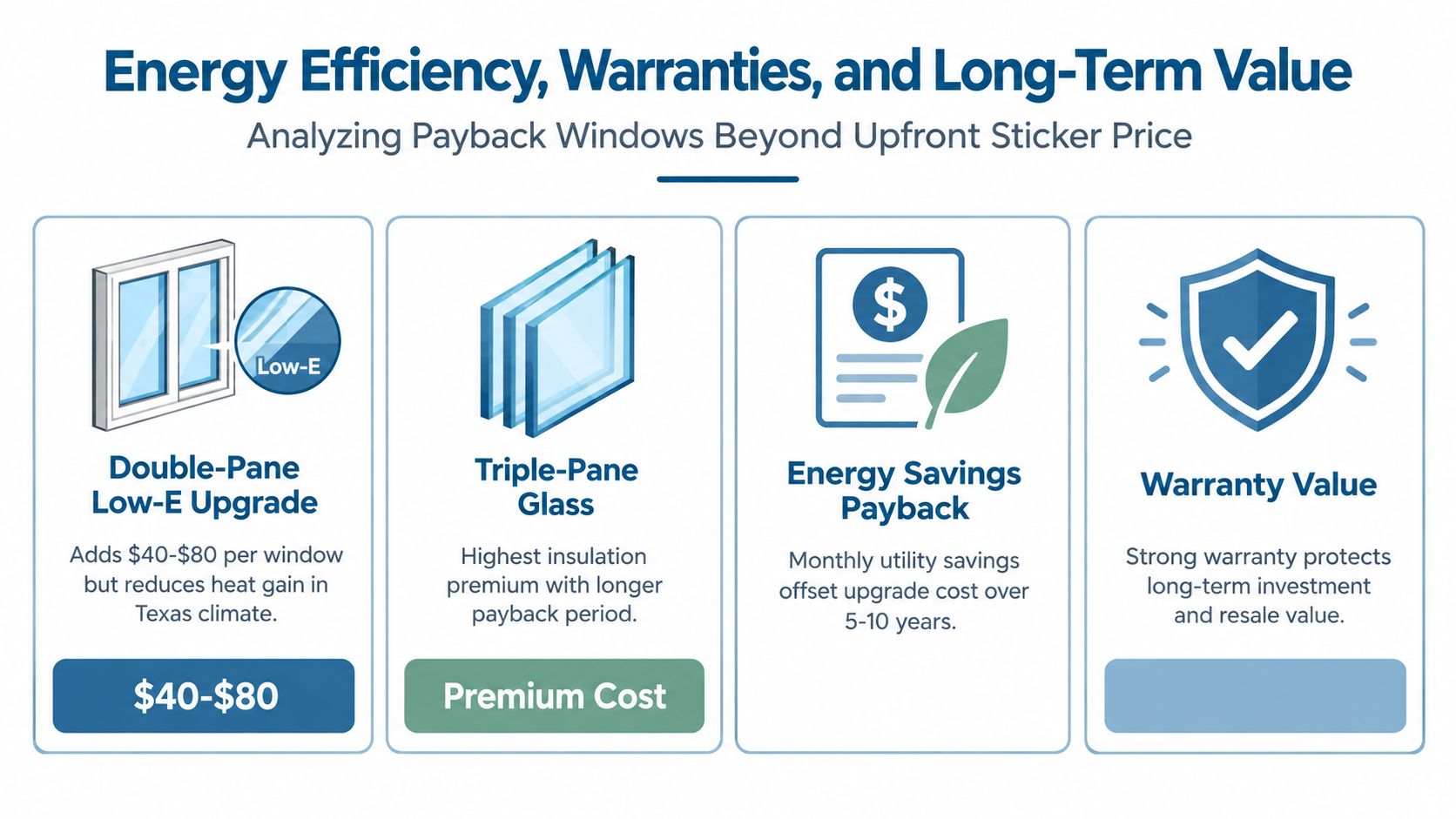
Independent 2026 coverage places energy-efficient windows at roughly $444 to $1,086 installed for a reference unit. Another industry estimate places replacement at about $450 to $1,500 per window. Treat those as reference ranges, not a Texas quote. Glass specifications, opening condition, access, and installation complexity can move the installed total quickly.
Pay for performance you can verify
Ask for the window's U-factor and SHGC, not a vague “energy efficient” note. U-factor addresses heat transfer through the assembly. SHGC shows how much solar heat enters through the glass, which matters in hot Texas rooms with strong afternoon exposure.
A Low-E double-pane package is usually the sensible starting point. Triple-pane may fit a noisy room, a comfort-sensitive space, or a highly insulated home, but the contractor should explain the added cost and expected benefit for your exposure and HVAC goals. Request the exact glass package and performance values before approving an upgrade.
Warranty terms deserve the same scrutiny. Ask whether coverage transfers to a future owner, whether labor is included, how glass breakage is handled, and which exclusions apply. A lifetime product warranty may exclude installation labor and accidental damage.
watch: energy-efficient window upgrades explained
Ways to Finance a Window Replacement Project
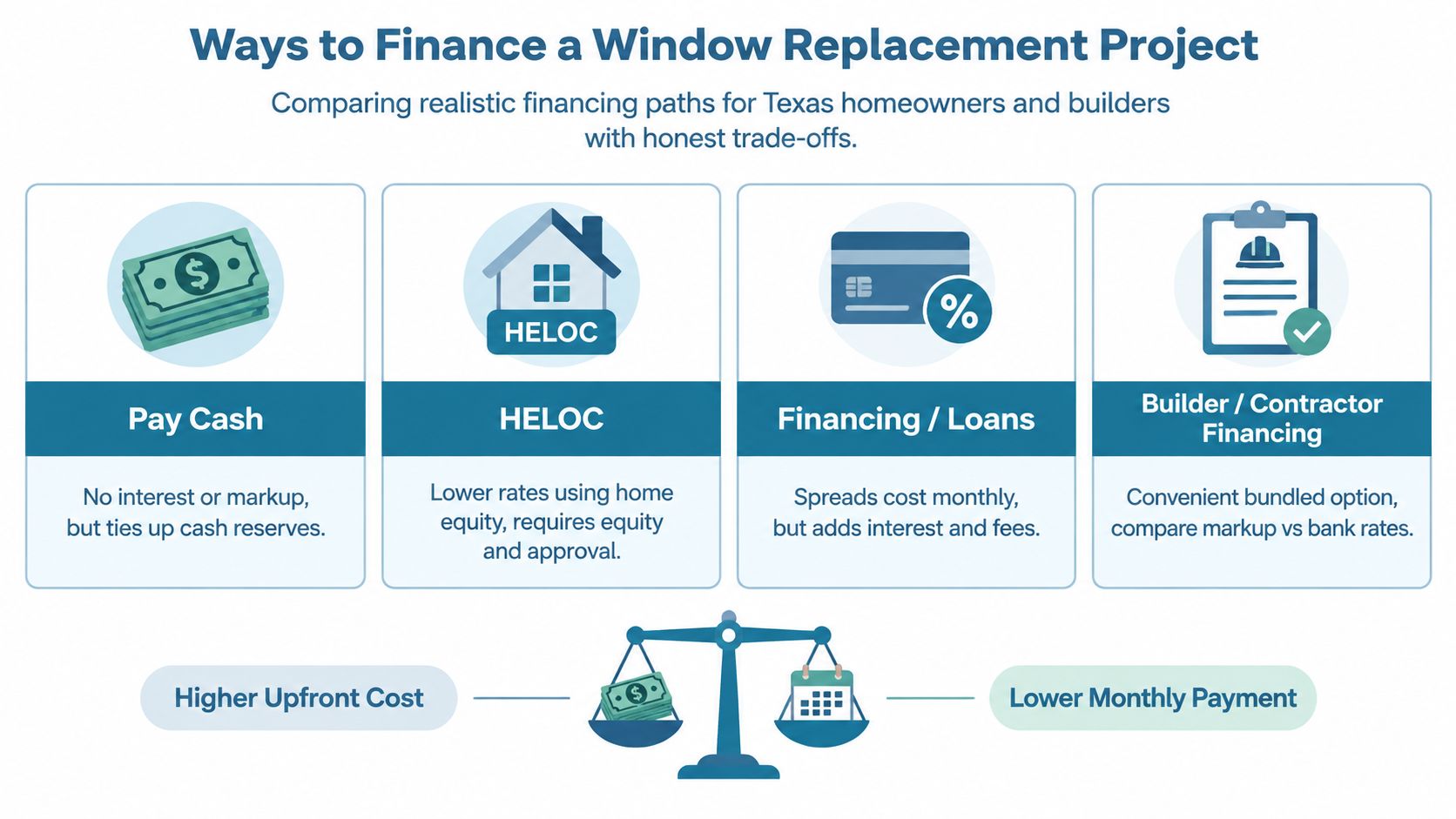
Financing can make a necessary project manageable, but it can also turn a reasonable quote into an expensive one. Start with the installed total, then compare the full repayment cost, fees, promotional period, and consequences of carrying a balance.
Cash is simple, if your reserves can handle it
Paying cash avoids interest and lender fees. It also leaves the homeowner responsible for preserving enough emergency savings for unrelated repairs, insurance deductibles, and normal household expenses. Cash makes the most sense when the project is clearly scoped and paying upfront won't drain the reserve.
A HELOC or home equity loan can spread a larger project over time. The trade-off is approval, equity requirements, variable-rate exposure in some products, and the fact that the home secures the debt. Homeowners should compare the lender's total cost with contractor financing rather than assuming one option is automatically cheaper.
Contractor-arranged financing can be convenient because the application is tied to the quote and project schedule. Read promotional language carefully. A “same as cash” offer may require full payoff within the promotional period, while deferred-interest terms can add accumulated interest if the balance remains.
Match the borrowing method to the project
- Use cash when the project fits comfortably within available reserves and you want the lowest total cost.
- Consider home equity borrowing when the project is substantial, you have sufficient equity, and the repayment terms are clearer than a short promotional offer.
- Review contractor financing when convenience matters, but compare the post-promotion APR, fees, and deferred-interest rules with a bank or credit union.
- Ask a builder or remodeler about loan rollups when the windows are part of a larger construction or renovation package. The window cost may be incorporated into the broader project financing, but it should remain visible in the scope.
Don't choose financing based only on the monthly payment. Ask for the total amount repaid, the first payment date, the promotional expiration date, and the exact interest treatment if you don't pay the balance in full.
For a direct look at available project-payment discussions, review window replacement financing options. Your best choice depends on the size of the project, your available cash, your home-equity position, and how long you expect to keep the property.
Getting a Same-Day Quote From Breaking Glass Co
A useful quote starts before the phone call. Gather the information that lets a window supplier or installer separate a real scope from a guess.
Prepare the opening information
Count the windows, then separate them by style. Note which are single-hung, double-hung, casement, sliding, picture, bay, or another configuration. A contractor can price a project more accurately when you don't describe every opening as “a window.”
Take clear photos from inside and outside. Include the full wall, the frame, the sill, the trim, nearby doors or tubs, and any visible staining or soft wood. Close-up images help identify damaged material, but full-opening photos show access and installation context.
Approximate measurements are useful for an initial conversation, even if they're not a substitute for a professional measure. Record width and height for each opening, identify whether the dimensions are inside or outside measurements, and mark any window that may require a custom shape or structural change.
Also decide what you know about the product:
- Frame preference: Vinyl, fiberglass, composite, wood, or wood-clad.
- Glass preference: Double-pane Low-E, triple-pane, gas fill, or another package.
- Operation: Fixed, single-hung, double-hung, casement, awning, sliding, or tilt-turn.
- Finish expectations: Existing trim reused, new interior casing, exterior trim replacement, drywall repair, or painting.
- Project type: Same-size replacement, full-frame replacement, remodeling, or new construction.
Ask for a line-item bid
During the initial call, expect questions about location, window count, rough dimensions, access, existing frame condition, desired material, and timing. A photo-based review may help establish a preliminary scope, while a site visit or field measurement should confirm dimensions and conditions before ordering.
Request these items in writing:
- Per-unit price for every opening.
- Frame material, glass package, and operating style.
- Removal and installation labor.
- Debris hauling and disposal.
- Interior and exterior trim work.
- Rot repair, drywall patching, paint, and other allowances.
- Permit responsibilities and fees.
- Sales tax and the final project total.
- Product warranty and installation warranty terms.
- Change-order rules if concealed damage appears.
A quote that combines everything into one unexplained allowance is difficult to compare. It may still be fair, but you won't know whether another contractor excluded disposal, trim, or repair work.
Ask this directly: “Does this total include removal, disposal, installation, trim, repairs, permits, tax, and warranty labor?”
Compare bids by scope, not headline price
Put competing proposals side by side and normalize the specifications. One contractor may quote insert replacements while another includes full-frame work. One may include new casing, while another assumes the homeowner will handle drywall and paint.
Use the same checklist for every bidder:
- Same window style and dimensions.
- Same frame material.
- Same pane count and Low-E package.
- Same installation method.
- Same trim and repair responsibility.
- Same disposal and permit treatment.
- Same warranty coverage.
- Same payment schedule and change-order language.
Breaking Glass Co. offers residential and commercial window products, installation coordination, factory-direct pricing, warranty support, and free same-day quote requests for Texas projects. Treat that service as a starting point for a written scope, then confirm every opening and line item before signing.
Turnaround depends on the completeness of your request, product availability, measurement requirements, and project complexity. Ask what can be priced from photos the same day, what requires a site visit, when final measurements happen, and how soon installation can be scheduled after approval.
Before you sign, ask who handles questions after the deposit, who approves substitutions, and what happens if the crew finds rot or a nonstandard opening. A professional quote doesn't eliminate surprises, but it gives you a process for pricing them instead of leaving you with an open-ended invoice.
Visit Breaking Glass Co. with your window count, photos, approximate measurements, and preferred specifications to request a same-day quote. Ask for the installed total broken into unit, labor, removal, disposal, trim, repairs, permits, tax, and warranty terms, so you can compare a real project price instead of another misleading window-only number.