
On-site installation usually takes one day for a full home of standard windows, with crews often finishing 10 to 16 windows in an 8-hour day or 10 to 15 windows per day depending on the job and crew setup. The full project, though, usually takes 4 to 8 weeks for stock units and 8 to 12 weeks for custom orders because manufacturing and delivery take most of the time.
That's the part most homeowners never get told up front. They hear “one-day install” and assume the whole job is basically done by lunch, then they spend weeks waiting on the windows themselves while the rest of the remodel sits in limbo. In Texas, especially on builder schedules, the key question isn't how fast a crew can work once the truck pulls up, it's how long the order sits before it gets there.
Table of Contents
- The Real Window Installation Timeline Most People Miss
- How Many Hours the Crew Actually Works
- What Happens Between Ordering and the Install Date
- Conditions That Slow Window Installation in Texas
- Ways to Speed Up Scheduling and Get Installed Faster
- What to Expect Before You Call for a Quote
The Real Window Installation Timeline Most People Miss
Many homeowners ask how long does window installation take and receive an incomplete answer. The process seems straightforward because the crew's labor can be efficient, but the homeowner's schedule is often complex. A skilled team can work quickly once the windows arrive, but the project still hinges on ordering, manufacturing, delivery, and coordination.

The practical split is between on-site labor and the full project timeline. For standard replacement work, an industry timeline says the install itself usually takes 30 to 60 minutes per window, and professional crews can install 10 to 16 windows in an 8-hour day; the full project commonly runs 4 to 8 weeks, and custom orders can stretch to 8 to 12 weeks because the manufacturing and delivery stages take most of the time. A second guide gives a similar picture, reporting 10 to 15 windows per day on the crew side while the total project still runs 4 to 15 weeks, with 1 to 3 days for installation work and 60 to 75% of the schedule tied up in manufacturing and delivery (Precision DNW timeline, ASP SuperHome scheduling guide).
That's the number that matters when you're planning around drywall, paint, flooring, or a closing date. If the windows aren't built and delivered, the best crew in Texas still can't set a single unit.
Practical rule: If you're comparing bids, separate the labor date from the delivery date. A fast install with a slow order is still a slow project.
Window installation timeline breakdown
| Project Type | On-Site Labor | Total Project Time | Primary Delay Factor |
|---|---|---|---|
| Standard stock replacement | Usually one day for a full home | 4 to 8 weeks | Manufacturing and delivery |
| Custom replacement | Usually one day for a full home | 8 to 12 weeks | Custom manufacturing |
| Straightforward replacement with quick scheduling | Often completed in a single day | 4 to 15 weeks total depending on the source and scope | Supply chain and schedule coordination |
A homeowner standing in the driveway only sees the install day. A builder running a schedule sees the whole chain, and that's the version worth tracking. If you want the fastest path, the key win is not a faster screwdriver, it's getting the right units ordered early and keeping the decision tree short.
How Many Hours the Crew Actually Works
The crew's clock is a different animal from the order clock. Once the windows are on site and the opening is ready, the work itself usually moves faster than people expect. That's why a one-day install is common, even when the overall project has already consumed several weeks.
Insert windows move fast, full-frame work doesn't
An insert or pocket replacement keeps the existing frame in place, so a skilled installer can usually finish about one window per hour (Pella installation overview). A full-frame replacement is a different job entirely, because the old frame comes out and the opening has to be cleaned, prepared, shimmed, insulated, and finished. That commonly takes 4 to 6 hours per ground-level window (Pella installation overview).
On a straightforward home, that difference is the whole story. A two-person crew can knock out a small set of insert replacements in a morning, but the same home with full-frame units, damaged openings, or difficult access can spill into the afternoon or beyond. The method matters as much as the window count.
A clean opening and a square frame save more time than almost any other variable. If the existing structure is sound, the crew spends its energy on installation, not correction.
What a real day looks like in the field
Professional crews often complete 4 to 6 standard windows per day on a full-home basis, and 8 to 10 windows in a day is feasible with a two-person crew using pocket replacement when conditions are straightforward (Home Depot window installation guide). That lines up with what homeowners usually see on site. The truck arrives, the old units come out, the new units get set, and the finish work happens before the crew leaves.
For a typical Texas house, the fastest jobs are the ones with ground-level access, simple openings, and standard replacement sizes. The slower jobs are the ones with second-story access, awkward trim, or openings that need correction before the new unit can be made plumb, level, and square. If you're comparing estimates, ask how the installer is counting the job. A quote for “six windows” means very different things depending on whether those are inserts or full-frame replacements.
On-site labor time by window type
| Replacement Type | Time Per Window | Crew Size | Typical Daily Output |
|---|---|---|---|
| Insert or pocket replacement | About 1 hour | One skilled installer or a two-person crew | 8 to 10 windows in straightforward conditions |
| Full-frame replacement | 4 to 6 hours per ground-level window | Usually two installers | 4 to 6 standard windows per day |
| Mixed-access job | Varies by opening and location | Two-person crew | Often one day, sometimes longer |
This vinyl replacement guide is useful if you want to see how a standard install gets broken down on the product side, but the important point stays the same. The crew's labor is usually measured in hours, not weeks. The weeks are upstream.
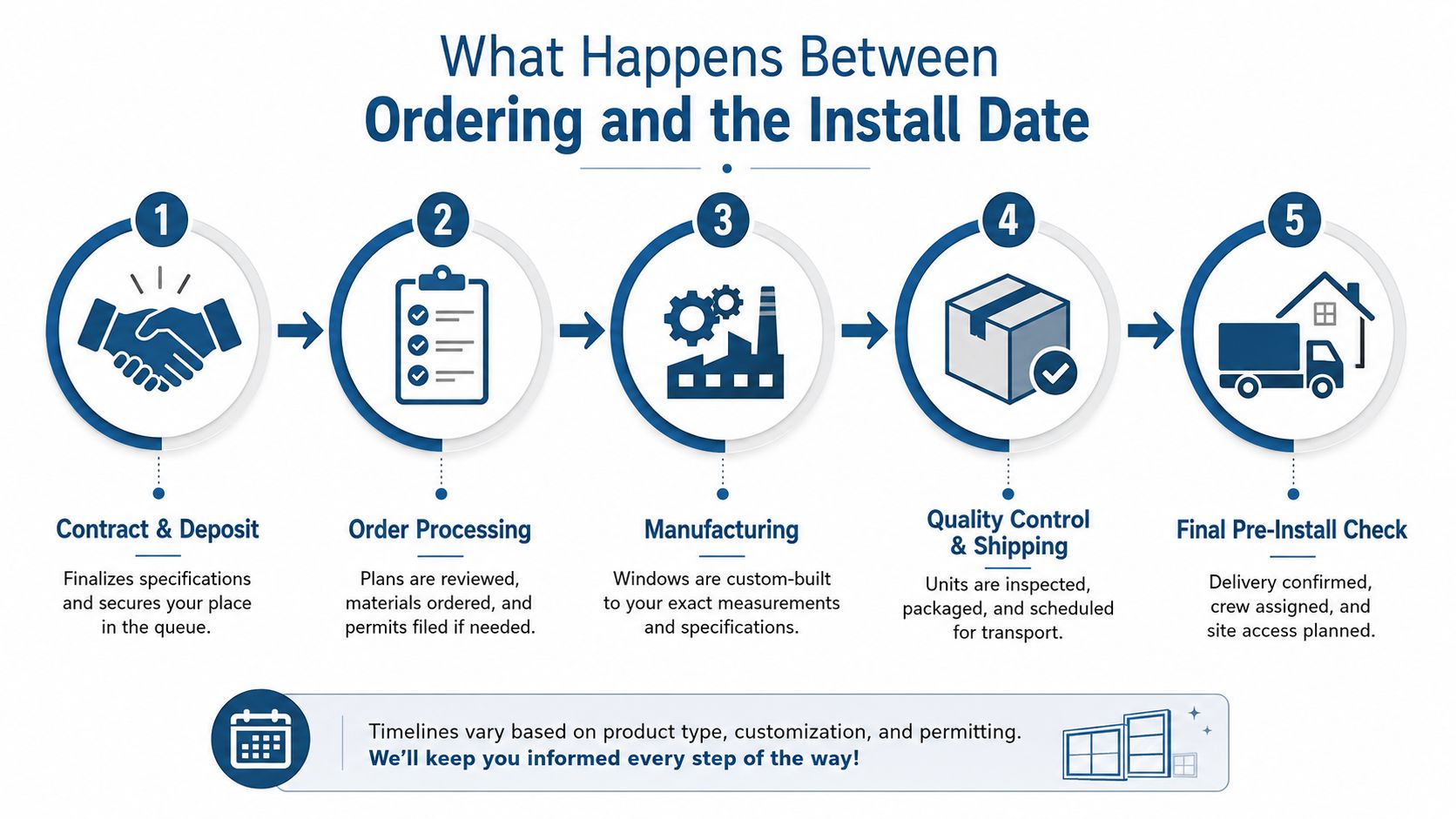
What Happens Between Ordering and the Install Date
The waiting period feels vague to homeowners because nothing visible is happening on the house. That doesn't mean nothing is happening at all. The order is moving through measurement, production, allocation, shipping, and scheduling, and every one of those steps has to line up before the crew rolls in.
The order has to exist before the install can start
After the quote is accepted, the job moves into ordering and production. Stock vinyl windows that match current runs usually move faster because the manufacturer doesn't have to stop and rebuild the whole line for a special size or finish. Custom units take longer because they're built to the exact specification, and the calendar reflects that.
That's why a homeowner can sign off quickly and still wait several weeks for the truck. The delay isn't usually the installer. It's the factory queue, the packaging stage, and the delivery slot. In practical terms, the house is waiting on the window, not the other way around.
The schedule tightens after delivery
Once the units land, the calendar usually gets much more predictable. The crew confirms access, checks the opening sequence, and lines up the install date with the rest of the job. That's the moment when builders start breathing easier, because the invisible part is finally visible.
A Texas remodel often moves faster once the windows are physically in hand. The reason is simple. Installers can control labor, but they can't control the factory lead time. If the job calls for custom colors, non-standard dimensions, or specialty styles like European tilt-turn units, the lead time stretches because the product has to be built to order rather than pulled from stock. If you're dealing with impact-resistant or specialty glass, the ordering process can be even more sensitive to specification accuracy, which is why the plan has to be right before production starts (impact-resistant glass considerations).
The cleanest projects are the ones where measurement, product choice, and install date all line up before demolition starts. Change one of those late, and the whole schedule shifts.
For builders, this phase is where coordination matters most. The windows need to arrive before trim, paint, and finish work lock the opening into place. For homeowners, it means a good quote should include a clear expectation for order time, not just installation labor.
Conditions That Slow Window Installation in Texas
Texas adds its own friction to the timeline. Some of it is weather, some of it is age of the house, and some of it is just the way a building behaves once the old window comes out. None of that is unusual, but it does mean the schedule should always include a little breathing room.
Heat, rain, and access change the day
In East Texas, weather can change the install window without warning. Rain stops exterior flashing and sealing until the opening is dry, and summer heat can force crews to shift their work to safer hours. That's not a marketing point, it's a jobsite reality. If the exterior side of the opening isn't ready, the window shouldn't be set.
Second-story work also takes longer than ground-level replacement because access slows everything down. The same goes for gable-end windows, awkward rooflines, and anything that needs extra safety setup. A pocket replacement on a single-story ranch is a very different day from a full-frame job on a two-story house with tight access.
Old houses hide delays until the frame comes out
Older homes in places like Jacksonville, Athens, and other East Texas towns often look fine from the outside right up until the old frame is removed. Then the installer finds rot, water damage, or settling that has to be corrected before the new unit can sit properly. That's one of the most common ways a job grows longer on site, even when the original schedule looked clean.
The same thing happens with custom orders. Special colors, non-standard sizes, and higher-performance product lines take longer to source than stock vinyl windows. A project built around custom units needs that extra time baked in from the start, not discovered after the old windows are already out. For regional projects that depend on Texas-specific product selection and installation support, this Texas replacement guide is the kind of reference that keeps expectations realistic.
Plain truth: the house decides part of the schedule after the old window comes out. If the opening is solid, the crew moves. If it isn't, the repair comes first.
For homeowners, the right response isn't panic. It's planning. A little contingency time protects the rest of the remodel and keeps one bad opening from wrecking the week.
Ways to Speed Up Scheduling and Get Installed Faster
The fastest jobs usually share one trait, the homeowner and builder made decisions early. The product was chosen before demolition, the delivery path was simple, and the crew didn't have to wait on late changes. That's the lever that matters most.
Start with stock, not custom, when the project allows it
If you want the shortest timeline, choose stock inventory that matches the manufacturer's current run rather than asking for custom colors, grids, or specialty hardware. Standard stock units are easier to order, easier to ship, and easier to schedule around. That's why the lead time is usually shorter than a custom build.
Builders can do the same thing at the plan stage. Lock window sizes early, confirm specs before demolition, and don't leave takeoffs open while other trades are already moving. A late change order doesn't just affect glass. It pushes the install date, which pushes trim, paint, and sometimes final inspection.
Make the job easier before the truck arrives
Homeowners can shave friction off the schedule by clearing furniture away from the openings, removing anything that blocks interior access, and keeping the driveway open for delivery. If the crew can unload and move directly to the openings, the day runs cleaner. If they have to dodge furniture, wait on access, or work around last-minute prep, the job slows down for no good reason.
A same-day quote also helps because it starts the clock sooner. Waiting weeks to approve the order is the easiest way to add weeks to the project. If the estimate is solid and the product is right, moving from quote to order quickly gives the factory a head start.
Use a local supply path when time matters
Local inventory and local coordination usually beat long-distance shipping when the schedule is tight. That doesn't mean every local supplier is better for every project, but it does mean the shortest route is usually the one with fewer handoffs. Factory-direct pricing can still make sense without forcing a custom lead time, and quality doesn't require a longer wait if the right stock line is available.
For homeowners and builders, the practical checklist is simple.
- Pick the right product early: Standard stock units usually move faster than custom specs.
- Lock measurements before demolition: Late changes cause avoidable delays.
- Clear access in advance: A clean driveway and open rooms keep the install day efficient.
- Confirm the delivery window before signing: The project schedule should match the window arrival, not just the crew's labor date.
- Ask about service coverage and support: Clear communication reduces surprises while you wait.
What to Expect Before You Call for a Quote
The clean answer to how long does window installation take has two parts. The crew side is usually measured in hours and often finishes in a single day for standard jobs. The project side is measured in weeks because the windows still have to be measured, built, shipped, and scheduled before anyone can set a unit.
That's why the smartest comparison isn't “How fast can they install?” It's “How fast can they get the right windows to my house and finish the job without reopening the schedule later?” Insert replacements are usually the fastest on-site. Full-frame replacements take more labor. Custom orders take longer before the crew even shows up. Older homes, Texas weather, and access issues can add more time once the work starts.
Before you call for a quote, ask three things. Is this a stock or custom order. What's the delivery window. What happens if the opening reveals damage after the old unit comes out. Those are the questions that keep the project honest.
If you're planning a replacement in Texas and want a straight answer on lead time, product availability, and installation scheduling, reach out to Breaking Glass Co.. They handle quotes, installation, and warranty support with Texas conditions in mind, which makes it easier to get the right windows ordered and installed without guessing at the calendar.