
A west-facing room in a Texas home can feel uncomfortable before the afternoon is over. The air conditioner may be running, yet sunlight still pours through an aging window, the glass feels hot, and the room never quite matches the thermostat. A homeowner replacing that window may ask for a larger opening, a slim black frame, or a cleaner view. Those choices can look excellent, but they also change how much solar heat enters the house.
Custom vinyl replacement windows solve more than an unusual opening size. They combine a measured frame, insulated glass, seals, hardware, and installation details into one assembly. Vinyl became a major replacement-window material as energy-performance requirements tightened, and ENERGY STAR's window methodology illustrates why: in the Southern climate zone, a wood or vinyl frame qualified model is evaluated at a U-factor of 0.517 and a SHGC of 0.57, compared with 0.879 and 0.64 for older single-pane clear windows in the same zones (ENERGY STAR's window savings methodology).

This guide builds the decision from the frame up. You'll learn what “custom” really means, how insulated glass and low-E coatings work, which NFRC-style ratings matter in Texas and the Southwest, how dark finishes and large glass areas affect comfort, and why careful installation protects the performance you paid for. If you're comparing replacement options, start with this Texas window replacement resource before choosing a style based only on appearance.
Table of Contents
- Introduction to Custom Vinyl Replacement Windows in Texas
- How Custom Vinyl Replacement Windows Are Built
- Performance Specs That Matter in Hot Sunny Climates
- Customization Options and When to Choose Them
- Installation Considerations for Lasting Performance
- Factory Direct Pricing Warranty and Service From Breaking Glass Co
- Choosing Your Custom Vinyl Replacement Windows With Confidence
Introduction to Custom Vinyl Replacement Windows in Texas
A stock window is designed to fit a common opening. A custom vinyl replacement window is made around the measured opening, the selected operating style, the glass package, and the finish requirements. That distinction matters in older Texas homes, remodels with unusual openings, and projects where removing the existing frame would create unnecessary structural work.
Think of the window as a boundary between indoors and outdoors. The glass controls much of the sunlight and heat transfer. The vinyl frame supports the glass and limits conductive heat flow. The seals and hardware control air movement. The installation closes the remaining gap between the manufactured unit and the wall opening. A strong glass package can still underperform if the frame leaks or the opening allows movement.
A useful mental model: the material name tells you what the frame is made from. The whole-window rating tells you how the finished assembly behaves.
Vinyl is popular because it offers a practical balance of thermal performance, low routine maintenance, and design flexibility. Current market research valued the global vinyl windows and doors market at US$55,617.8 million in 2025 and projects a 4.6% compound annual growth rate from 2025 to 2033, reflecting continued demand in replacement and new construction (Grand View Research's vinyl windows and doors market data). That market size doesn't guarantee quality in any individual product. It does show that vinyl has moved well beyond a niche choice.
Texas adds a clear design challenge. A larger window can brighten a room and improve the view, while a dark exterior finish can sharpen the home's appearance. But orientation, glass area, frame design, and solar-control glass all influence the heat that reaches the interior. The right project starts by deciding how the window should perform in the room, then choosing the appearance around those requirements.
How Custom Vinyl Replacement Windows Are Built
A custom vinyl window works as a system. Each component has a job, and the final result depends on how those components interact rather than on the vinyl frame alone.

The frame and sash create the structure
Manufacturers begin with extruded PVC profiles. The profile is shaped to form the frame around the opening and the sash that holds a moving pane. Many profiles contain internal chambers. Like the air spaces in a cooler wall, these chambers interrupt direct paths for heat transfer while adding stiffness to the frame.
A custom measurement determines the finished dimensions. That measurement must account for the existing opening, the replacement method, the sill condition, and the clearances required by the manufacturer. A window that fits the rough opening on paper may still need room for controlled movement and adjustment in the field.
Welded corners support an airtight assembly
Vinyl frame and sash corners can be heat-welded, joining the profiles into a fused corner rather than relying only on separate fasteners. This creates a continuous connection at a location where air and water can otherwise find weak points. The quality of the weld, the frame design, and the surrounding installation still matter, but the corner is no longer treated as a simple butt joint.
The sash also needs to operate without forcing the frame out of alignment. Meeting rails, locks, and compression seals work together when a moving sash closes. A reinforced meeting rail may be appropriate where the size or configuration creates extra stress.
The insulated glass unit acts like a thermos
An insulated glass unit, or IGU, places sealed panes around a spacer and an insulating cavity. Argon fill and low-E coatings can improve the way the assembly manages heat. The low-E layer is microscopic, so you won't see it as a dark film in the same way you see a tinted pane. Its purpose is to reflect selected radiant heat while allowing useful daylight into the room.
The spacer separates the panes and helps maintain the sealed cavity. The edge seal protects that cavity from moisture and gas loss. If the frame is excellent but the glass edge, spacer, or seal package is poorly suited to the climate, the whole window won't deliver the expected result.
For a closer explanation of the sealed glass assembly, review this guide to insulated glass construction. The practical lesson is simple: compare the complete window, not a glass-only promise. A unit with low-E glass, argon fill, a capable spacer, welded corners, and tight seals can perform very differently from a similar-looking unit with a basic configuration. Builders comparing product families may also want to review vinyl new-construction window options when replacement and new-build requirements overlap.
Performance Specs That Matter in Hot Sunny Climates

A west-facing Texas living room can feel hot even with the air conditioner running. The window label helps explain why. Start with three whole-unit ratings: U-factor, solar heat gain coefficient, and air leakage. Together, they show how the window resists heat flow, limits sun-driven heat, and blocks outside air.
U-factor measures insulation
U-factor describes how readily heat moves through the complete window. Lower is better for insulation. Per Efficient Windows Collaborative testing data, mid-range vinyl replacement units commonly fall around 0.27 to 0.32, with lower values generally indicating stronger resistance to heat transfer (independent window performance guidance).
Two windows may share a white vinyl frame and double-pane appearance yet carry different U-factors. Frame chambers, sash construction, spacers, low-E selections, and seal quality all affect the result. A glass-center rating is therefore not enough for comparison. Request the whole-unit rating for the exact size and configuration you plan to order.
SHGC controls unwanted sun
SHGC, or solar heat gain coefficient, indicates how much solar heat enters through the window. A lower SHGC generally limits more heat, which matters in bright Texas rooms, especially on south- and west-facing walls. A shaded north-facing opening may call for a different glass strategy in the same house.
Bigger glass and dark finishes can increase solar exposure, so a conservative SHGC may improve comfort and reduce cooling demand in rooms with afternoon heat. The lowest available value is not automatically right for every orientation. Choose it alongside the room's daylight, view, and shading needs rather than accepting a default package designed for another climate.
Air leakage protects comfort
Air leakage measures how much air passes through the assembled window under test conditions. Guidance for window performance recommends selecting units rated at 0.30 cfm/ft² or lower (window performance guidance on air leakage). Lower leakage can reduce drafts and limit hot outdoor air entering around the operating sash.
Buying rule: request the NFRC label for the exact installed configuration. Do not compare one window's center-of-glass claim with another window's whole-unit rating.
The frame, sash, glass coatings, spacer, and seals all affect performance. Specify a custom vinyl window by climate zone and assembly rating, not by the word “vinyl” alone. For a visual explanation of the sealed glass assembly, review this guide to insulated glass construction.
Customization Options and When to Choose Them
Customization changes both the appearance and the way a window behaves. The best choice depends on the room's exposure, the home's architecture, and how much daylight or ventilation you want.
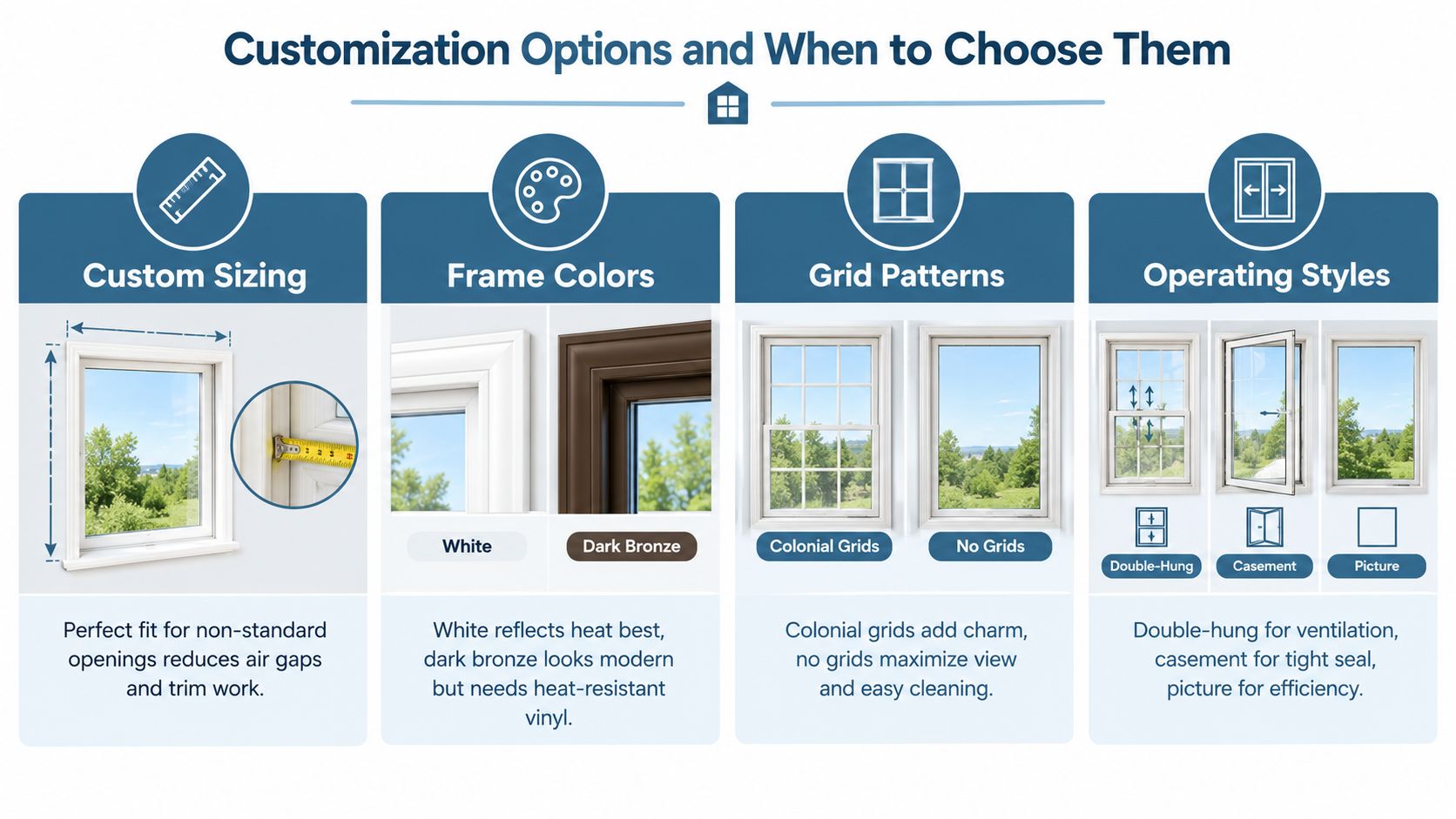
Size and glass area
A larger glass area can make a living room feel open and can preserve a broad outdoor view. It can also expose more interior surface to direct sun. That doesn't make a large window wrong. It means the glass package and SHGC need to support the design, especially on hot western exposures.
A conservative glass ratio can be the better decision in a bedroom, office, or room that already struggles with afternoon heat. In a shaded room, the design may justify more glass for daylight. If changing the opening size, have a professional assess the structure before treating a new configuration as a simple window swap.
Finish and color
White frames generally absorb less heat than dark finishes. Black, bronze, and deep gray can create a modern exterior, but the finish may expose the vinyl frame to more solar heating. Ask how the selected color is designed for sun exposure and whether reinforcement or a specific product line is required.
A dark exterior with a lighter interior can balance curb appeal and indoor visual comfort. Color should be chosen with the roof, siding, trim, and orientation in mind, not from a small sample viewed under showroom lighting.
Grids and operating styles
Grids divide the glass visually. Colonial patterns can support a traditional home, while no grids can maximize the view and simplify cleaning. Casement windows often create a tight closing plane, double-hung windows offer familiar ventilation, and picture windows prioritize a fixed view with no operating hardware.
| Custom Option | Style Benefit | Climate Consideration | Best For |
|---|---|---|---|
| Custom sizing | Fits unusual openings cleanly | Reduces reliance on oversized trim or filler areas | Older homes and remodels |
| Dark exterior finish | Creates a contemporary appearance | Requires careful solar and material selection | Shaded elevations or controlled glass packages |
| No-grid glass | Preserves a wide view | Leaves solar-control choices especially important on large openings | Modern living rooms and view-focused spaces |
| Casement operation | Offers a clean, streamlined look | A tight closing seal can support comfort when properly installed | Rooms needing ventilation and a firm seal |
| Picture configuration | Maximizes fixed glass and daylight | More glass can increase solar exposure | Shaded views or carefully specified sunny rooms |
A good design conversation starts with the room, not the catalog. Identify the hottest windows, decide whether ventilation matters, and then select the style and appearance that fit those conditions.
Installation Considerations for Lasting Performance
Vinyl can handle the Texas climate well, but it moves more with temperature than many buyers realize. Independent technical guidance reports a coefficient of thermal expansion of about 3.33 × 10⁻⁵ in/in/°F for vinyl, and a 10-foot frame can move roughly 1/4 inch across seasonal temperature swings (technical guidance on vinyl expansion and contraction).
That movement isn't a defect. It becomes a problem when the installer traps the frame so tightly that it can't move in a controlled way. An over-constrained frame can transfer stress into corners, joints, fasteners, and seals. Over time, the sash may operate with more friction, and the air seal may lose effectiveness.
Measure the opening before ordering
The installer should measure width, height, square, sill condition, and the existing frame or pocket. Custom sizing only works when the measurements reflect the actual opening. A stable pocket may allow a replacement unit to fit inside the existing frame, while a damaged sill or out-of-square opening may call for additional preparation.
The installation plan should follow the manufacturer's required tolerances. Those clearances provide room for adjustment and thermal movement. Guessing at the gap or ordering from a single rough measurement creates avoidable risk.
Support the sill and preserve movement
A sloped sill support helps direct water outward and gives the replacement unit a stable base. Shims should support the frame at the specified points without distorting it. The installer also needs to seal the perimeter so the assembly blocks air and water while allowing the frame to respond to temperature changes.
The goal isn't to make the frame immovable. The goal is to make it stable, sealed, supported, and able to move as designed.
Check the details that affect operation
Welded corners can strengthen the frame, while reinforced meeting rails may be needed for certain sizes or operating configurations. The installer should check that sashes close evenly, locks engage without force, drainage paths remain open, and the perimeter seal is continuous.
This matters in hot-sun markets because repeated expansion and contraction places the installation under regular stress. A window label can report excellent air leakage performance in testing, but a distorted pocket or incomplete perimeter seal can reduce the effective result in the home. Product selection and field execution must work together.
Factory Direct Pricing Warranty and Service From Breaking Glass Co
The price of a custom vinyl replacement window reflects more than the frame. Size, operating style, glass package, color, grids, hardware, opening condition, trim, and installation all affect the finished project. A useful quote separates the product from the labor and identifies which details could change after the installer exposes the opening.
Factory-direct purchasing can simplify that comparison by connecting the product specification, order, and support process. It doesn't remove the need to compare ratings or warranty terms. Instead, it gives the homeowner a clearer path to ask who measured the opening, who manufactured the unit, who installs it, and who handles service if a component needs attention.
Compare total ownership value
A lower initial bid may not include the same glass package, finish, trim work, or installation preparation as a higher bid. A premium option may deliver a preferred appearance without improving comfort if its SHGC and whole-window rating aren't suited to the room. Conversely, a less dramatic design may provide better everyday comfort in a heavily sun-exposed space.
Use a written comparison that includes:
- Exact configuration: Confirm the size, operating style, glass package, frame color, grid pattern, and hardware.
- Performance label: Request the NFRC label for the configuration being ordered, not a generic product-family claim.
- Installation scope: Check whether measurement, sill preparation, perimeter sealing, trim, disposal, and finishing are included.
- Warranty language: Read coverage for the frame, glass, seals, hardware, finish, labor, and service process.
- Future support: Ask how replacement parts and service requests are handled.
Breaking Glass Co. supplies custom-sized vinyl replacement windows, supports measurement and ordering, and provides professional installation across Texas. Its stated service model also includes factory-direct pricing, bilingual English and Spanish support, coordination with builders and contractors, nationwide product shipping, and lifetime warranty coverage according to the company's guarantee.
For East Texas homeowners, local service availability can matter as much as the product selection. The company identifies service coverage in communities including Tyler, Lindale, Bullard, Jacksonville, Longview, Athens, Whitehouse, and Canton, while its broader Texas installation support serves residential and commercial projects. Out-of-state buyers can evaluate the product and shipping process separately from Texas installation.
The practical standard is accountability. Choose a supplier that can explain the rating, document the order, coordinate the fit, and state what happens if the installed window needs service.
Choosing Your Custom Vinyl Replacement Windows With Confidence
Start with the room, not the color. Note which openings face strong afternoon sun, which rooms feel hot, where ventilation matters, and whether the existing opening has an unusual size or condition. Those observations help determine whether a large picture window, casement, double-hung, slider, or a more conservative glass configuration makes sense.
Then compare the exact performance label. Check U-factor, SHGC, and air leakage, using the climate and orientation to guide the decision. Treat a dark finish or larger glass area as a design choice that needs supporting specifications, not as a free cosmetic upgrade.
Before signing, confirm:
- Measurements: The installer has measured every opening and documented the replacement method.
- Whole-window ratings: The NFRC label matches the ordered size, style, and glass package.
- Installation plan: Clearances, sill support, shimming, perimeter sealing, and drainage are addressed.
- Appearance: Frame color, grids, hardware, and operating style match the home and the room.
- Service terms: Warranty coverage and the process for requesting service are written clearly.
- Project price: Product, installation, trim, preparation, disposal, and possible opening repairs are identified.
A free same-day quote can give you a starting point, but the final decision should follow measured openings and verified specifications. For homeowners, builders, and contractors, that sequence keeps the project focused on comfort, durability, appearance, and long-term ownership rather than a catalog photo alone.
Breaking Glass Co. offers custom vinyl replacement windows, measurement and ordering support, professional Texas installation, nationwide product shipping, and stated lifetime warranty coverage. Visit Breaking Glass Co. to request a quote and discuss a window configuration suited to your Texas or Southwest project.