
A hot Texas afternoon makes a window problem hard to ignore. You're standing in the living room, feeling warm air leak around a warped frame while traffic noise slips through old single-pane glass. Nearby curtains have faded from years of direct sun, and the air conditioner keeps running without making the room feel comfortable.
That situation often leads homeowners to search for custom ordered windows. The term sounds technical, but the idea is straightforward: a manufacturer builds each unit around the actual opening, performance requirements, appearance, and operating style of your home. This guide follows the buying journey, from measuring an uneven opening to choosing Texas-appropriate glass, comparing tilt-turn hardware, understanding factory lead times, and checking the order before installation.
Table of Contents
- Standing in Front of a Window That Does Not Fit
- What Custom Ordered Windows Are
- Why Custom Beats Stock for Most Homes
- How the Ordering Process Works Step by Step
- Specifying for Texas Heat, Sun, and Storms
- Tilt-Turn Designs and Frame Material Choices
- Lead Times and Coordinating With Your Installer
- Your Decision Checklist Before You Order
Standing in Front of a Window That Does Not Fit
A stock window is made to fit a standard opening. Real homes rarely behave so neatly. Framing can settle, masonry openings can vary, trim can reduce available depth, and older houses may have openings that were built long before today's common product sizes existed.
A homeowner may try to solve the problem by choosing the nearest stock size and filling the remaining space with shims, trim, or additional framing. That approach can work in the right opening, but it creates more opportunities for air leakage, water intrusion, uneven sightlines, and visible patches around the frame. A custom ordered unit starts with the opening that exists, not the opening a catalog assumes.

Practical rule: A window is only as good as the measurement, specification, and installation that connect it to the wall.
Custom sizing can address more than an uncomfortable draft. A properly specified insulated unit can reduce the amount of outdoor noise entering the room, limit solar heat gain, and protect furnishings from intense exposure. It can also preserve unusual proportions, such as a narrow opening, an arched top, or a large fixed pane that would be difficult to recreate with stock products.
Measurement should happen before anyone recommends a size. If you're taking preliminary dimensions yourself, use the guidance in this window measuring guide and treat those figures as a starting point for professional verification, not as permission to order blindly.
The rest of the decision is just as practical. You'll need to understand what “custom” includes, decide whether the extra control is worthwhile, review the ordering sequence, select glass for Texas sun, compare frame materials and tilt-turn operation, and coordinate delivery with the installer.
What Custom Ordered Windows Are
A homeowner comparing replacement windows may see a familiar opening, then discover that its measurements, depth, or trim differ from the sizes on a store shelf. A stock window is like an off-the-rack suit: it may look close, yet its proportions can leave the installer adjusting the fit. A custom ordered window follows the opening instead. The manufacturer uses the project's verified measurements to build the unit for that location.
The order can specify rough-opening dimensions, frame depth, frame material, color, finish, glass composition, grille pattern, screen design, hardware, and operating configuration. The factory then fabricates that particular unit and ships it to the project, rather than supplying a product selected from available inventory. That factory-direct process gives the buyer more control, but it also means fabrication and delivery must be planned before installation.

Three reasons homeowners choose custom
The first reason is an opening outside standard dimensions. Older Texas homes may have varied openings, thick walls, unusual trim, or earlier repairs that changed the available space. Industry data describes custom ordering as the dominant replacement-market model, with nearly all replacement windows sold for existing homes custom ordered and 90% of installers reporting that more than 80% of their sales are custom orders. The industry summary provides the underlying figures and context.
The second reason is performance. A buyer may need glass selected for intense Texas sun, lower glare, better insulation, or a specific code requirement. Width and height are only part of that decision. The order may also include the right U-factor, which indicates how readily heat passes through the assembly, and SHGC, which indicates how much solar heat the glass admits. Spacer, gas fill, frame, and certification also affect the specified package.
The third reason is design. Arched heads, round tops, oversized fixed units, narrow picture windows, unusual mullion layouts, and coordinated finishes can exceed a basic stock selection. Custom ordering lets the window suit the architecture and climate priorities together.
Custom is not automatically right for every opening. It makes sense when fit, performance, shape, or coordination justify the made-to-order process.
Why Custom Beats Stock for Most Homes
A stock window is like buying shoes in the nearest available size. It may work, but the opening, climate, and room use can force compromises. Custom ordering gives you more control when those details matter. The added specification work is justified when a verified opening, Texas exposure, or project requirement calls for something beyond an inventory size.
| Factor | Custom Ordered | Stock Windows |
|---|---|---|
| Opening fit | Built around verified dimensions and conditions | Chosen from preset sizes |
| Performance | Glass and frame can suit climate and exposure | Available packages may be limited |
| Shape | Supports unusual proportions and specialty configurations | Usually limited to common profiles |
| Appearance | Color, finish, grille, and hardware can coordinate | Choices depend on inventory |
| Operation | Each room can receive a suitable operating style | Options may depend on available units |
| Schedule | Requires measurement, approval, fabrication, and delivery coordination | Can be faster when the exact unit is in stock |
| Installation | Reduces reliance on filling a size mismatch | May require more framing or trim adjustment |
| Cost | Usually requires a higher upfront commitment | Often has a lower initial purchase price |
Fit is the first advantage
A unit made for the opening gives the installer a more predictable perimeter condition. It does not replace careful installation, but it reduces the temptation to force a near-match into place. Better alignment can produce cleaner trim, more even reveals, and a tighter connection between the window and the surrounding air and water control layers.
That fit matters especially in older Texas homes, where openings may have shifted, been repaired, or been built with unusual wall thicknesses. A factory-direct custom order uses the approved dimensions rather than asking the installer to adapt the house to a standard product. The result is a clearer relationship between the window, the opening, and the installation details.
Performance and project control come together
Custom ordering lets you match the frame and glass package to each room's exposure. A west-facing room may need stronger solar control than a shaded north-facing room. Homeowners comparing insulated windows for homes should also ask how the glazing layers, spacer, gas fill, frame, and coatings work as one assembly.
U-factor describes how readily heat passes through the window. A lower value generally means less heat moves through it. SHGC describes how much solar heat the glass admits, so a lower value can help limit unwanted sun in a hot, bright exposure. Insulated glazing works like a layered barrier: multiple panes separated by a sealed space slow heat transfer more effectively than a single pane.
The performance upgrade may also include privacy glass for a bathroom, a large fixed pane for a living room, or coatings selected to manage glare without treating every elevation the same way.
An industry summary reports that 63% of homeowners replace windows for energy efficiency. It also reports a global replacement market valued at $189.7 billion in 2022, projected to grow at 6.2% annually from 2023 to 2030, a U.S. replacement market of $15.2 billion in 2023, and replacement representing 62% of North American fenestration sales in 2022. Those market figures are reported in this industry summary.
Custom windows can cost more initially and take longer than an available stock unit. In exchange, you gain control over fit, energy characteristics, finish consistency, hardware, and room-by-room operation. The value depends on whether those choices solve a real problem.
The expensive mistake may be ordering before the opening, glass package, and installation conditions are fully defined.
How the Ordering Process Works Step by Step
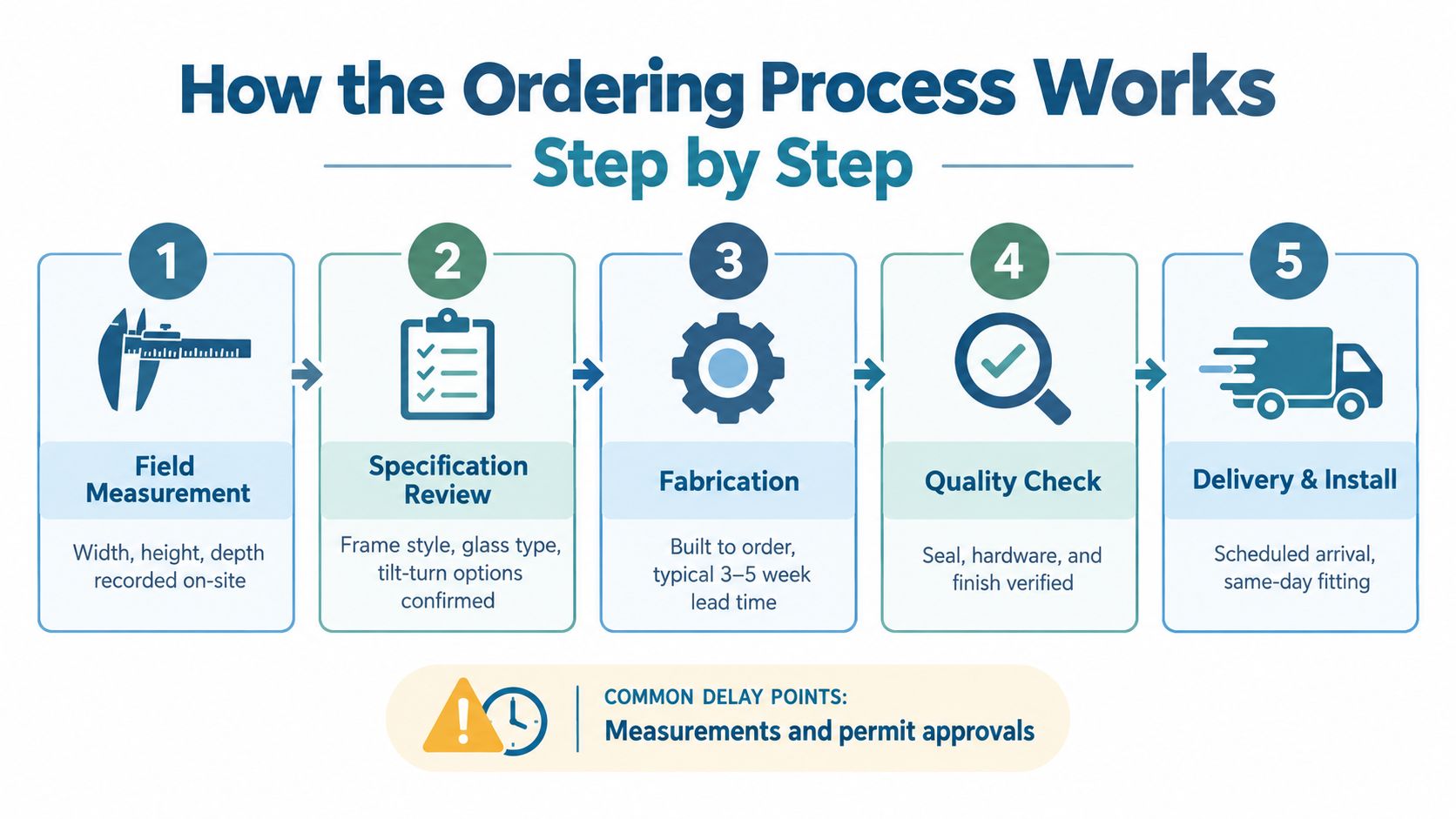
A custom window order passes through several handoffs, from field measurement to delivery. Each stage addresses a different risk. A low quote offers little protection if the dimensions, glass package, or site conditions remain unclear.
Step one starts in the field
An experienced measurer records the width, height, and depth at several points in every opening. The top, middle, and bottom may differ, and the opening may be out of square. The record should identify the room, opening number, existing frame condition, sill details, trim, wall thickness, and any signs of moisture or movement.
These measurements become a written specification shared by the installer and supplier. It should list the frame material and color, glazing layers, coatings, gas fill, hardware, screens, grilles, operating style, and any tilt-turn configuration. If the unit must meet a local requirement or project-specific rating, record that before approval. Factory-direct ordering works well only when the factory receives a complete, accurate description of the opening and the performance package.
The drawing approval is a decision point
The shop drawing or order confirmation turns the discussion into specific dimensions and visible features. Check the width, height, handing, swing direction, mullions, frame depth, color, glass description, and hardware before signing. For a tilt-turn unit, verify the hinge side, handle position, and sash movement in both modes.
Approval starts production based on those details. The factory may assemble the unit, install glazing and hardware, check seals, inspect the finish, and package the window. Exact checks vary by manufacturer, but the approved order remains the reference. The factory can verify only what that document identifies.
Delivery requires its own inspection. The installer should examine crates and units for shipping damage, match labels with the order sheet, confirm quantities and handing, and record visible problems before accepting the shipment. Store the units on a suitable surface and shield them from weather until the openings are ready.
For a visual explanation of the five stages, watch this custom window ordering overview.
A missing measurement, unsigned drawing, or unclear responsibility can delay the chain. Written records give the homeowner, installer, and supplier one shared account of what was requested and approved.
Specifying for Texas Heat, Sun, and Storms
Texas window selection starts with exposure, not with the label “double” or “triple.” A south- or west-facing room can feel overheated even when the air conditioner is working properly, while a shaded elevation may place greater emphasis on insulation and visible light.
Read the two numbers that matter most
U-factor describes how readily heat moves through the window assembly. Think of it as the window's resistance to heat flow. A lower U-factor generally means better insulation. ENERGY STAR explains that lower U-factor improves insulation, while lower SHGC is preferred in hot, sunny climates because it reduces solar heat gain and cooling demand. The ENERGY STAR window guidance explains how to use both ratings.
SHGC, or solar heat gain coefficient, works like a window's sunglasses rating. Lower SHGC blocks more of the sun's direct heat, which can help in a bright west-facing room. The goal isn't to make every room dark. It's to balance solar control, daylight, views, and the cooling load for that particular side of the house.
ENERGY STAR also states that qualifying windows can save about 6% to 13% on utility bills compared with standard windows, with the exact result depending on the home, existing windows, climate, and installation. Use the ENERGY STAR guidance to interpret that estimate in context. Select the rating from the performance label, not from a salesperson's shorthand description.
Choose the glazing package around the room
Double-pane insulated glazing remains a practical choice for many projects. Triple-pane glass can make sense where added insulation, interior comfort, or sound control justify its added weight and cost. More layers aren't automatically better for every Texas exposure, especially if solar control and frame design are neglected.
| Spec option | Best for | Trade-off |
|---|---|---|
| Low U-factor | Rooms where insulation and interior surface temperature matter | May come with a more specialized glass package |
| Controlled SHGC | Bright south- and west-facing rooms | Very low solar gain can reduce useful winter warmth and daylight |
| Double-pane IGU | Broad replacement use with a balance of weight and performance | Provides less insulating resistance than higher-performing assemblies |
| Triple-pane IGU | Projects prioritizing greater insulation or sound reduction | Heavier sash and higher specification complexity |
| Laminated glass | Added safety, sound control, and protection goals | Adds weight and can affect hardware requirements |
| Argon-filled low-E glass | A common insulated configuration for better thermal behavior | The unit still depends on sound seals and correct installation |
Modern insulated glazing has progressed from dual-pane assemblies below R-2 to above R-4, while triple-pane assemblies can exceed R-9 and advanced vacuum-insulated glazing can reach roughly R-14. The Lawrence Berkeley National Laboratory summarizes these glazing developments and the importance of long-term seal durability. If a seal or gas fill becomes compromised, field performance can decline, so product quality and installation remain part of the specification.
For severe-weather or security concerns, ask whether laminated or impact-rated glass is appropriate for the location. The right choice depends on local requirements, exposure, frame capacity, and the rest of the wall assembly. For Texas replacement options, compare measured-opening products such as custom vinyl replacement windows against the performance needs of each elevation.
Tilt-Turn Designs and Frame Material Choices
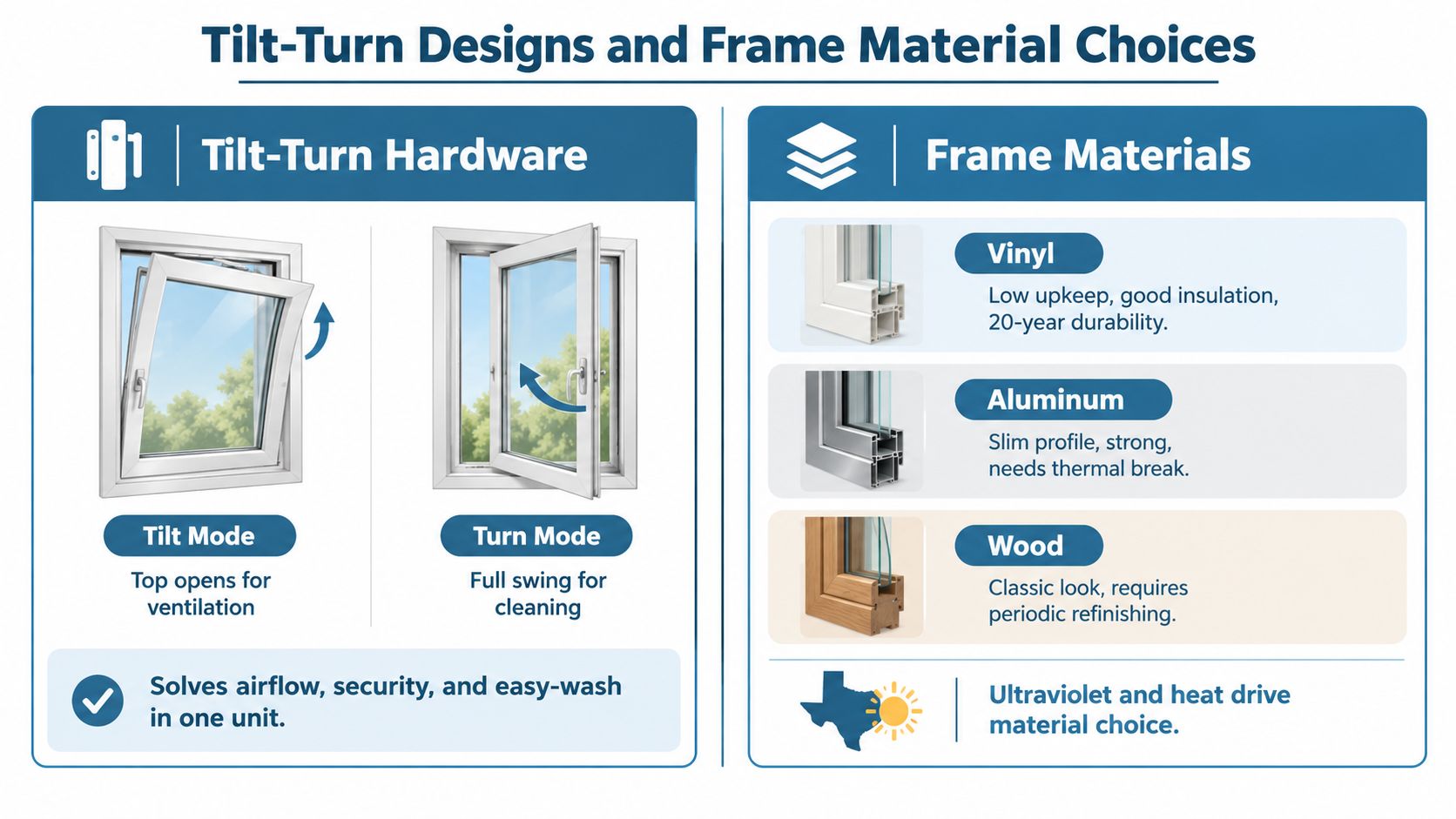
A tilt-turn window uses one sash with two operating actions. In tilt mode, the top edge moves inward for controlled ventilation. In turn mode, the sash swings inward like a door, creating a wide opening for cleaning and airflow.
That combination is useful in a second-story room where exterior cleaning is awkward. It also suits spaces near patios or walkways, where a fully open window could interfere with people outside. Tilt ventilation can provide airflow while keeping the opening more controlled than a fully swung sash, although the exact security and weather behavior depends on the hardware and installation.
Match the frame to the conditions
Frame material dictates how the window handles heat, movement, moisture, upkeep, and sash weight.
- Vinyl is a low-maintenance choice with useful insulating properties. It works well when the homeowner wants practical performance without periodic refinishing.
- Fiberglass provides a stiff, dimensionally stable option for demanding exposures and larger units. Its resistance to heat-related movement can be valuable in strong Texas sun.
- Aluminum-clad wood combines a traditional interior appearance with an exterior layer designed to protect the wood from weather. It suits projects where interior character matters, but the exterior still needs durable protection.
- Thermally broken aluminum separates interior and exterior aluminum paths with an insulating material. That approach supports slim modern profiles and larger openings while reducing the thermal penalty of an unbroken metal frame.
Frame selection should follow the glass weight, sash size, exposure, and desired maintenance routine. A large triple-pane tilt-turn sash needs hardware and a frame capable of carrying it without sagging or becoming difficult to operate. The point of custom ordering is not merely to select an attractive frame. It's to make the frame, hardware, glass, and opening work as one system.
Read more about tilt-and-turn windows before choosing this operating style, especially if you're replacing several rooms with different ventilation and cleaning needs.
Lead Times and Coordinating With Your Installer
Custom window timing is a coordination problem involving the homeowner or builder, the supplier, and the installation crew. A deposit may begin the commercial process, but fabrication shouldn't begin until field dimensions, specifications, approvals, and any required permits are settled.
A straightforward custom order can move smoothly when every decision is final. Specialty shapes, unusual finishes, tilt-turn hardware, high-performance glass, and color-matched frames can add review and production complexity. Independent industry coverage describes growing attention to triple glazing, low-E coatings, thermal-break frames, and smart glazing, all of which can make the specification more involved than a basic replacement unit. This overview discusses the design and technology factors affecting modern window decisions.
What each party must confirm
The person measuring must provide accurate dimensions and document conditions that could affect installation. The supplier must return a complete order confirmation, identify unresolved details, and communicate when the units are ready. The installer must confirm access, staging space, crew availability, removal requirements, and the condition of the openings.
A homeowner should ask for the expected manufacturing window in writing, then distinguish that period from transit, site receiving, inspection, permit approval, and installation scheduling. Generic promises such as “a few weeks” aren't enough when a project has multiple units or a strict closing date.
Common delay points include:
- Specification changes: A revised color, glass package, handing, or size can require a new approval.
- Approval holds: Permits or shop-drawing questions can prevent fabrication or installation.
- Material availability: Specialty glass, hardware, or finish components may not be ready with the main order.
- Delivery conditions: A damaged crate or incomplete shipment can require rescheduling.
- Weather and site readiness: Rain, unsafe access, unfinished framing, or missing trim can stop installation even when the windows are on site.
Don't remove sound existing windows until replacement units have arrived, been inspected, and been matched to the order. A modest schedule buffer is easier to manage than an open wall or an unprotected room waiting for a missing component.
Your Decision Checklist Before You Order
Use this checklist before money changes hands or the first opening is disturbed. A “no” answer doesn't always stop the project, but it identifies a question that needs resolution.
Verify the opening
- Measurements: Has someone recorded width, height, depth, square, sill, trim, and condition at every opening?
- Identification: Is each unit labeled by room and location so the correct window reaches the correct opening?
Confirm Texas performance
- Glass ratings: Does the order show the U-factor and SHGC rather than only saying “energy efficient”?
- Exposure: Does the glass package suit the room's sun direction, glare, cooling needs, and desired daylight?
- Severe weather: Have you checked whether laminated, impact-rated, or other tested glass is needed for the location?
Select the complete unit
- Operation: Does each room have the right opening style, screen, handle position, and cleaning method?
- Frame: Does the material match the window size, glass weight, appearance, heat exposure, and maintenance expectations?
Lock in the schedule
- Documentation: Have you approved the final dimensions, shop drawing, finish, glass, hardware, and handing in writing?
- Delivery: Are the installer, supplier, and homeowner aligned on arrival, inspection, staging, permits, and the installation date?
Custom ordered windows make the most sense when the project needs control that a stock unit can't provide. If you have verified the opening, selected climate-appropriate performance, and confirmed the installation sequence, you're no longer guessing at a catalog size. You're ordering a window designed for the wall it must serve.
Breaking Glass Co. supplies and installs residential and commercial windows and doors, including factory-direct products for Texas and Southwest climates, custom measurement and ordering support, tilt-turn options, and statewide installation. Visit Breaking Glass Co. to request a quote and discuss the right specification for your openings.