
You're standing at a storefront door, a utility-room exit, or a back-of-house opening that needs to swing out for clearance, and the hinge detail suddenly matters more than the lockset. That's the moment a lot of jobs go sideways. The slab may be right, the frame may be right, but if the outswing door hinge isn't specified for load, exposure, and tamper resistance, the opening fails in service even when it looks fine on day one.
Table of Contents
- What an Outswing Door Hinge Does
- Hinge Types Used on Outswing Doors
- Handing and Swing Direction on Outswing Openings
- Load Ratings and Sizing the Hinge Set
- Security Features for Outswing Hardware
- Materials and Corrosion Resistance
- Installation Clearances and Fasteners
- Compatibility with Fiberglass and Metal Doors
- Contractor Specification Checklist
- Common Outswing Hinge Mistakes to Avoid
- Quick Reference Glossary and FAQ
What an Outswing Door Hinge Does
A contractor can treat a hinge like a simple pivot on an interior door. On an outswing opening, that idea fails fast. The hinge is part of a load-and-exposure system that has to carry the door's weight, stand up to weather, and keep the exposed pin side from being lifted or tampered with.
Gravity, wind, and force all work against the frame
On an outswing door, the hinge leaf sits where wind, rain, and public access can reach it. That changes the failure mode completely. A standard loose-pin hinge is a weak choice on an exterior outswing because the pin is reachable from outside, and the door can be lifted off once the pin is driven out. Industry guidance treats non-removable pin, or NRP, hinges as the baseline for outswing exterior doors, because the hinge side is no longer hidden inside the room. The same opening may also need a security stud or safety-stud feature if the spec calls for extra anti-lift protection, as noted in commercial and university standards in the provided reference material.
An outswing leaf also behaves differently under load. When a door swings outward, the hinge assembly takes force from wind pressure and from the user pulling the door open against the closer. The first problems usually show up as sag, loose screws, or a pin that wears faster than expected, not as a sudden break. Practical commercial guidance ties hinge quantity to door height, with a standard rule of one hinge per 30 inches of door height, so a typical 7-foot commercial door lands at 3 hinges under that sizing logic (commercial hinge guidance).
A light-duty hinge on a heavier leaf will show its limits quickly.
Practical rule: if the door swings out, the hinge choice has to answer three questions at once, can it carry the weight, can it survive the climate, and can someone outside defeat it?
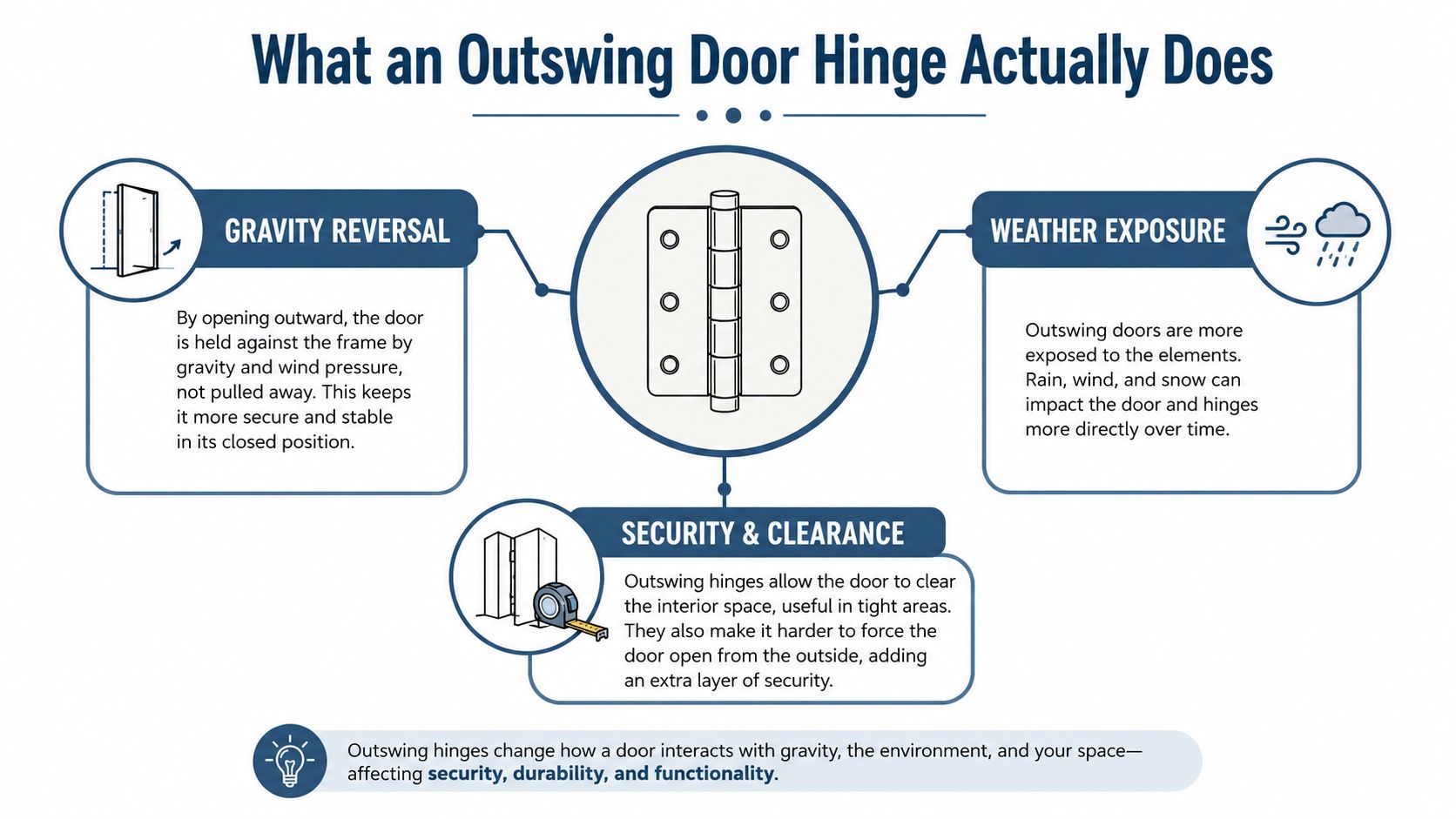
A cheap finish on an exterior door starts to oxidize. A standard pin leaves a security hole in an otherwise solid opening. Once you treat the hinge as a load-and-exposure system, the spec stops being guesswork and becomes a match between door height, door mass, closer use, and the environment around the opening.
Hinge Types Used on Outswing Doors
The hinge family matters more than most cut sheets admit. A door can be outswing and still need a very different hinge depending on whether it's a residential entry, a school exit, or an industrial metal door. The wrong family usually doesn't fail on the bench, it fails after traffic and weather start working on it.
Standard butt hinges still do a lot of the work
Full-mortise butt hinges are the default for standard residential and light commercial outswing doors. They're straightforward, familiar, and easy to replace, which is why they show up everywhere. For a normal entry with moderate traffic, they're usually the first stop, provided the door isn't overbuilt, oversized, or closer-equipped.
Continuous hinges belong on long or heavy panels where load distribution matters. A continuous hinge spreads the stress over the full height of the opening, which helps when the slab is heavy, wide, or likely to rack. Geared continuous hinges push that idea further for high-cycle commercial openings, especially in education and healthcare where the door gets used hard all day.
Match the hinge family to the opening, not the catalog
Strap-and-tee hinges make sense on industrial or oversized metal doors, where the geometry and exposed hardware are part of the design. They're not the answer for a standard storefront entry, and they're overkill on most residential outswing doors. Ball-bearing construction matters too, especially on doors with closers, because the bearing surface reduces wear and supports repeated cycle loading in a way plain-bearing hinges can't.
| Hinge Family | Typical Door Weight | Cycle Rating | Best Outswing Application |
|---|---|---|---|
| Full-mortise butt hinge | Light to moderate | Low to moderate | Residential entries, light commercial doors |
| Continuous hinge | Moderate to heavy | Moderate to high | Fiberglass entries, long panels, load-spreading use cases |
| Geared continuous hinge | Moderate to heavy | High | Healthcare, education, frequent-use commercial openings |
| Strap-and-tee hinge | Heavy to very heavy | Depends on build | Industrial doors, oversized metal leaves |
A plain-bearing hinge can survive a low-use opening. Put a closer on the door, and the bearing choice stops being optional.
For contractors comparing hardware lines, a supplier page such as durable hinges for professional contractors can be useful for sorting heavy-duty options by general application, as long as the final spec still matches door weight, exposure, and security needs.
Handing and Swing Direction on Outswing Openings
Handing errors on outswing doors happen because installers still think from the inside out. That works on inswing doors. It gets inverted the second the door opens away from you. If the order form says the wrong hand, the hinge prep, lock prep, and closer geometry can all go sideways before the door ever gets hung.
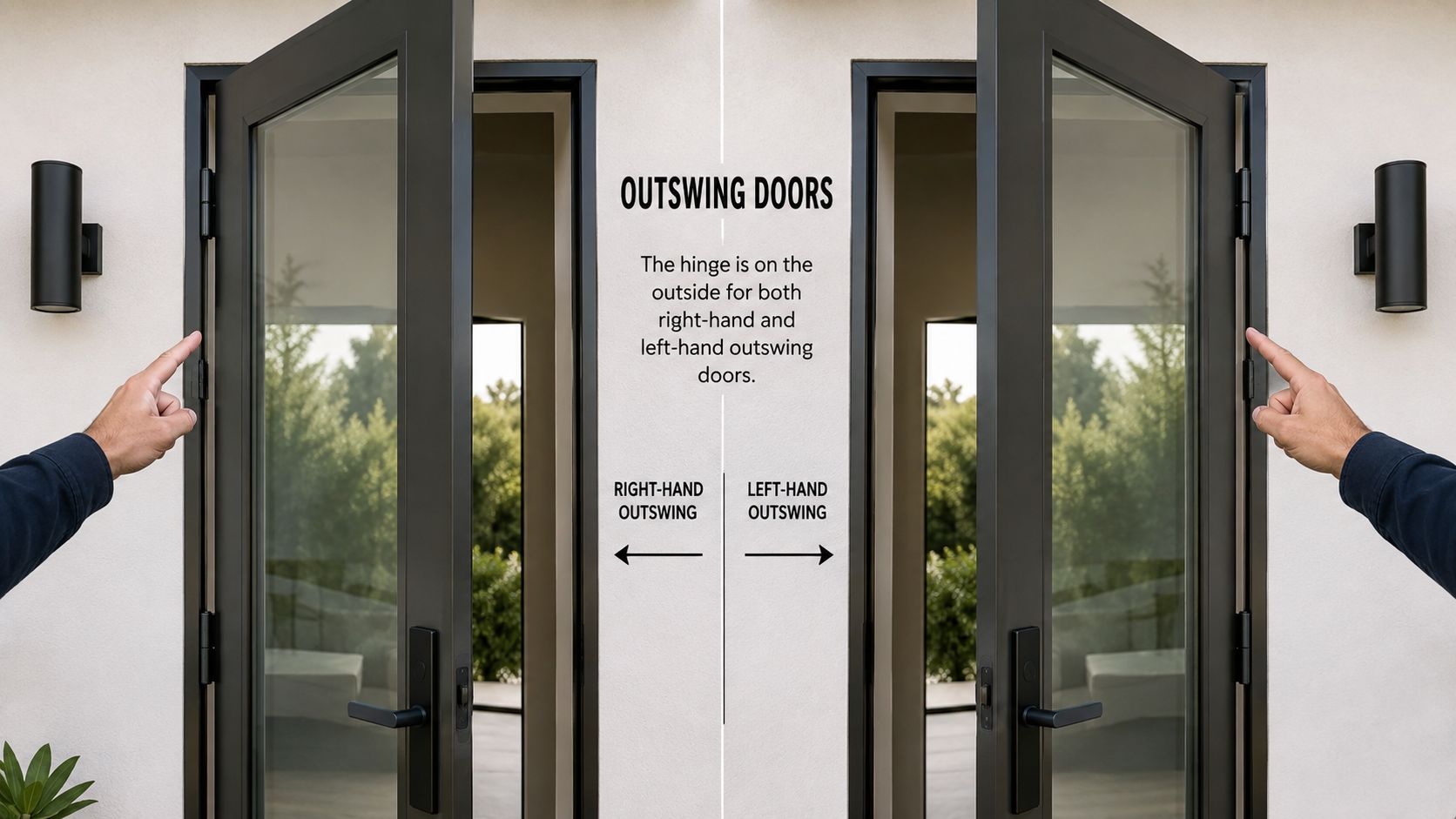
Read the hand from the exterior side
Stand outside the opening and look at the hinge side. That's the clean field test. If the hinges are on the right and the door swings outward, you're dealing with right-hand outswing. If the hinges are on the left, it's left-hand outswing. The confusion comes from carrying inswing logic onto an opening where the visible hinge side is now on the public side.
The frame decides the order
The important thing to confirm isn't just the slab, it's the hinge jamb on the frame. That's where the load lands, and that's the side that determines which leaf carries the stress. A contractor who verifies handing on the door slab alone can easily miss a frame that was prepped opposite to the required swing.
Common ordering mistakes show up in the same three ways:
- Right hand versus left hand confusion, especially when the door swings the opposite direction from the person placing the order.
- Standard pin instead of NRP, which leaves an exterior hinge vulnerable to tampering.
- Mixed prep between inswing and outswing templates, which forces field fixes that weaken alignment.
If the opening is a pair, the logic gets stricter. Both leaves have to be confirmed independently, especially if the center meeting stile carries an astragal or a panic device. Outswing handing should be verified at the frame before hardware is ordered, because fixing a wrong-hand prep after fabrication usually costs more than the hinge set ever did.
Load Ratings and Sizing the Hinge Set
An outswing door lives in a harsher loading setup than an interior leaf. The hinge set has to carry the slab, resist repeated closer action, and stay aligned while wind, traffic, and security hardware keep working against it. Start with height, then test that choice against weight and use.
Commercial hinge guidance commonly uses one hinge for every 30 inches of door height. That puts doors up to 60 inches at 2 hinges, 61 to 90 inches at 3, 91 to 120 inches at 4, and each additional 30 inches adds another hinge (commercial hinge sizing guidance).
Height gives you the count, weight tells you whether the count is enough
That rule is a starting point, not a final spec. A typical 7-foot commercial door lands in the 3-hinge pattern by height alone, but a heavier fiberglass, steel, or metal-clad leaf can call for larger leaves, stronger screws, and sometimes a fourth hinge if the door mass exceeds what the standard count can carry. In practice, height sets the baseline and load decides whether the baseline holds.
Closers change the load profile
Once a closer is on the door, the hinges are no longer handling static weight only. They take repeated cycle load, closing force, and the added stress from the arm pulling the leaf shut. That is why ball-bearing hinges are typically the right call on outswing doors with closers, since the bearing surface handles wear and repeated movement better than plain bearing construction (outswing hinge and closer guidance).
| Door Weight | Door Height | Hinges Required | Leaf Gauge / Length |
|---|---|---|---|
| Light residential leaf | Up to 60 in. | 2 | Standard butt hinge leaf size |
| Moderate commercial leaf | 61 to 90 in. | 3 | Commercial full-mortise size, often ball-bearing |
| Heavy commercial leaf | 91 to 120 in. | 4 | Larger leaf size, stronger frame attachment |
| Oversized or high-use leaf | Each additional 30 in. | +1 hinge | Match load rating and cycle demand |
For specs that need both load ratings and security hardware in a controlled-entry package, a source like Amax Fire & Security entry systems can help align the hinge choice with closer, lock, and access-control requirements. For source-matched hardware sourcing, durable hinges for professional contractors is a useful place to compare heavier-duty options.
Security Features for Outswing Hardware
Security on an outswing opening isn't one feature, it's a stack. The hinge pin matters. The leaf interlock matters. The bearing style matters because sag creates a gap that people can pry on later. If you only solve one of those problems, the door still leaves a path open.
Start with the non-removable pin
The NRP hinge is the starting point for any exterior outswing opening. The pin locks into the barrel from the protected side, so it can't be driven out from the outside when the door is closed. That blocks the most obvious lift-off attack, which is why commercial and university standards call for NRP on outswing lockable doors in the verified data.
A security stud or safety stud is the next layer. It doesn't replace NRP, it supplements it. If someone somehow defeats the pin, the stud helps keep the leaves engaged so the door can't be pried apart as easily. On schools, healthcare entries, multifamily doors, and outswing openings that carry a panic device or closer, that extra layer makes sense because the hinge side is visible and reachable.
The cheapest mistake on an exterior outswing door is a hinge that looks secure from the inside and is fully defeatable from the parking lot.
Use bearing style to protect alignment
Ball-bearing and oil-impregnated bearing hinges keep the leaf moving cleanly under repeated use. That matters because a sagging hinge does more than annoy the installer. It opens a seam, drags the latch, and makes the hinge side easier to work on. If the door is heavy or busy, a bearing hinge is part of the security spec, not just a durability upgrade.
For opening types that already have controlled-entry hardware, consult a system-level layout such as Breaking Glass Co.’s hurricane-proof doors before finalizing hinge hardware. The hinge has to work with the door package, not against it, especially where weather and security pressures hit the same opening.
Materials and Corrosion Resistance
Material choice on an outswing hinge is really exposure management. The door is already swinging into weather, dust, humidity, salt, or pool chemicals, so the finish has to survive the actual site conditions, not the showroom. That's where a cheap plated hinge usually starts losing the argument.
Stainless steel usually wins on exposed sites
European hinge classifications give a useful benchmark here. BS EN 1935 uses a corrosion-resistance digit that maps to five grades defined by BS EN 1670, from Grade 0 up through Grade 4, with the higher grades intended for harsher exposure conditions (BS EN 1935 guidance). For exterior and coastal use, industry guidance commonly points to Grade 3 or Grade 4 as the practical target. That's why stainless-steel hardware is usually the first call for exposed outswing openings.
304 stainless is the inland workhorse. 316 stainless is the better pick for coastal, pool-deck, and chlorinated environments because it's the more resistant alloy choice for harsher exposure. Brass and bronze are often selected as much for appearance and finish matching as for corrosion behavior, especially on higher-end entries. Plated steel is the budget route, but once exposure gets aggressive, it stops being cheap and starts becoming a maintenance line item.
Match the material to Texas and Southwest conditions
Texas and Southwest projects add their own abuse. High sun, alkaline dust, and irrigation overspray can strip weaker finishes faster than a contractor expects. In those conditions, stainless or bronze often costs less over time than replacing or reworking a plated hinge that wasn't built for the site.
| Material | EN 1935 Grade | EN 1670 Rating | Recommended Exposure |
|---|---|---|---|
| 316 stainless steel | High mechanical grade options available | Higher corrosion resistance grades | Coastal, pool, chlorinated, severe exterior exposure |
| 304 stainless steel | Common commercial grades | Moderate to high corrosion resistance | Inland exterior, general weather exposure |
| Brass | Decorative and architectural grades | Comparable when properly alloyed | High-end entries, finish-matched openings |
| Bronze | Architectural grades | Comparable when properly alloyed | Exterior entries, long-life finish requirements |
| Plated steel | Common light-duty grades | Realistic ceiling around Grade 3 | Protected or low-exposure openings |
Installation Clearances and Fasteners
Outswing installation problems usually start with the installer trying to use inswing habits on an opening that moves differently. The hinges load the frame in a different direction, the weather seal behaves differently, and the fastener pull-out risk is higher if the jamb isn't reinforced correctly. That's why gap control matters before the first screw is fully driven.
Set the gap before you chase the screws
A 1/8-inch uniform hinge jamb gap is the practical target with the door closed. Check the head and latch-side reveals before final tightening so the door doesn't go plumb at the hinges and binding at the latch. If the frame is out of plane, shimming behind the leaf is what keeps the barrel aligned instead of twisting the leaves into a permanent bind.
Fasteners should match the hinge base metal. On coastal or wet sites, stainless hinges with zinc screws are asking for galvanic trouble inside the jamb. Frame-side screws need to bite into a structural stud or a reinforced jamb block, not just brick mould, because the hinge load belongs in the structure. On door slabs, use the manufacturer's reinforced locations, and on hollow metal doors, make sure the thread engagement is appropriate for the assembly.
Use the right fastener path for the frame type
Residential wood and composite doors usually accept full-thread wood screws into a reinforced stile zone. Hollow metal doors need a self-tapping thread pattern that's sized for the door prep, not generic drywall-fastener thinking. The hinge leaf should be snug, not crushed, because overtightening can distort alignment as fast as an undersized screw can pull out.

For installers who want a visual reference for exterior alignment details, the exterior door installation diagram can help keep hinge jamb, shim stack, and swing geometry in the same conversation instead of treating them as separate tasks.
Compatibility with Fiberglass and Metal Doors
The slab material drives the hinge spec as much as the swing direction does. Outswing only makes the attachment side more sensitive, because the hinge leaf is being pulled away from the frame under load instead of sitting into it. That means reinforcement and fastener choice have to be matched to the door construction, not just to the opening size.
Fiberglass, steel, aluminum-clad, and wood-edge doors all ask for different prep
Fiberglass-skinned doors usually depend on a composite or LVL reinforcement zone inside the stile. That's the place for the hinge fasteners, not the skin itself. Face-mounting into the skin crushes the panel and gives you a hinge that feels tight at install and loose a few cycles later.
Insulated steel doors need a 12-24 self-tapping thread or a specified through-bolt pattern, depending on the manufacturer's prep. Aluminum-clad and wood-edge doors sit between those two extremes. Hollow metal commercial slabs need a welded or mortised reinforcement at the hinge prep, and the template has to match the corner radii exactly, or the installer ends up hogging out material and weakening pull-out resistance.
Match the hinge pattern to the actual prep
The door prep template is not a suggestion. If the hinge corner radius, leaf size, or knuckle geometry doesn't line up with the slab prep, the job turns into field modification, and field modification usually weakens the opening. That's why a contractor should check the template before shipment, not after the slab is on the horses.
For fiberglass entries that are already engineered for exterior performance, high-quality fiberglass entry doors are a practical reference point when you're matching hinge type to the reinforcement embedded in the door. The hinge spec has to respect that reinforcement, or the load path is wrong from the start.
| Door Material | Hinge Prep | Fastener Type | Reinforcement Required |
|---|---|---|---|
| Fiberglass | Reinforced stile prep | Full-thread wood screws | Composite or LVL reinforcement zone |
| Insulated steel | Factory hinge prep | 12-24 self-tapping or through-bolt pattern | Manufacturer-specified internal support |
| Aluminum-clad | Manufacturer prep | Material-matched fasteners | Edge reinforcement and template match |
| Wood-edge | Mortised or full-mortise prep | Wood screws into solid reinforcement | Reinforced edge or stile block |
| Hollow metal | Welded or mortised prep | Machine or self-tapping per schedule | Metal reinforcement at hinge point |
Contractor Specification Checklist
A clean spec sheet beats a long conversation on the jobsite. For outswing openings, the contractor needs a list that can be checked line by line without interpreting anyone's memory from the plan review. That's especially true on projects where security, weather, and traffic all hit the same door.
The spec should verify the whole assembly
A hinge alone doesn't solve an outswing opening. The hand, the grade, the finish, the fastener schedule, and the jamb reinforcement all have to agree before the door goes up. If one item is wrong, the field fix usually costs more than the original hardware delta.
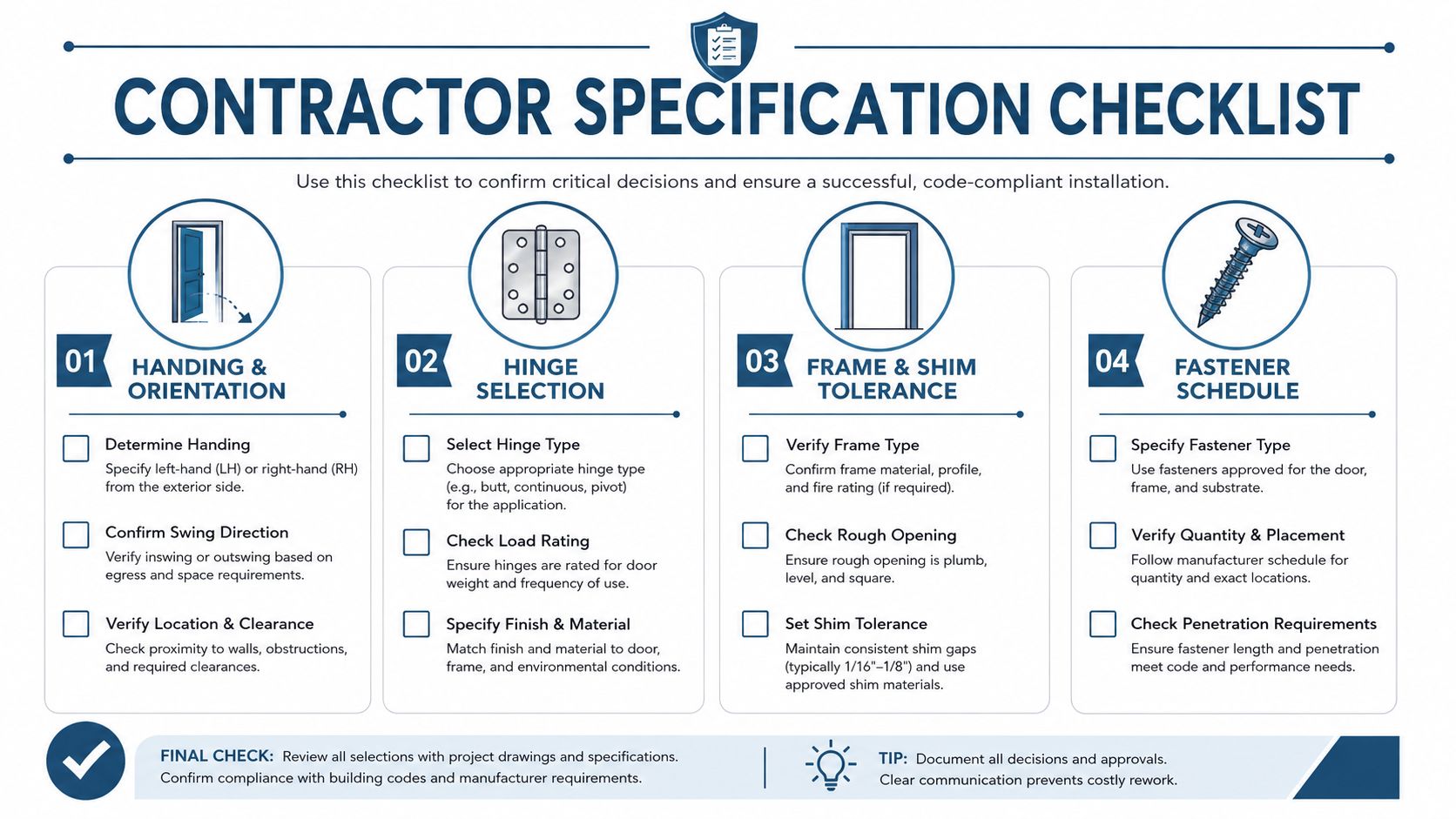
| Decision Point | Pass / Fail | Notes |
|---|---|---|
| Handing and swing direction | Confirm from exterior side | |
| Hinge family and grade | Match to traffic and load | |
| Leaf size and quantity | Verify by height and weight | |
| Load rating or EN 1935 equivalent | Include closer-equipped doors | |
| Security features, NRP and studs | Required on exterior outswing | |
| Base material and corrosion grade | Match exposure level | |
| Fastener specification | Match hinge metal and frame type | |
| Jamb-side reinforcement | Structural bite, not trim only | |
| Door-slab prep pattern | Template must match exactly | |
| Shim and gap tolerances | Check plumb and reveal before final torque |
The practical use of a checklist like this is simple. It keeps the supplier, the inspector, and the installer looking at the same details. That's how you prevent the common outswing failures, wrong handing, underbuilt hinge sets for closer-equipped doors, and mixed-metal fasteners that start corroding before the warranty period ends.
Common Outswing Hinge Mistakes to Avoid
Most outswing mistakes come from treating the opening like a normal inswing door with the leaf flipped to the other side. That shortcut looks harmless on paper and expensive in the field. It's the reason a lot of exterior doors get hung, then rehung.
The failures are mechanical, not theoretical
Ordering standard residential hinges for an exterior outswing door leaves the pin side exposed and defeats the security intent. Using zinc-plated interior hardware on a coastal or pool-area frame gives you the wrong finish life from day one. Ignoring the closer load means the two-hinge or light three-hinge setup gets worked harder than it was meant to be, and the top leaf starts carrying the punishment.
Other mistakes are just as common:
- Mixed handing on paired doors creates a binding middle point that looks like a measurement error but is really a layout error.
- Fastening into hollow metal without the right anchorage leaves the hinge attached to the skin instead of the structure.
- Skipping hinge jamb shims lets the racking load pull the top leaf out of plane, which shows up later as drag and latch misalignment.
The pattern is always the same. The cheap shortcut survives the install, then the opening starts telling the truth after a few weeks of traffic and weather.
Quick Reference Glossary and FAQ
The language around outswing hinges gets messy fast, especially on commercial jobs where different trades use different shorthand. A clean glossary keeps the order moving and keeps the wrong hardware from getting substituted in the middle of procurement.
Terms worth locking down before submittal
| Term | Definition | Typical Question It Answers |
|---|---|---|
| Handing | Left or right based on the exterior view | Which way do I order the hinge set |
| NRP | Non-removable pin | Can the pin be driven out from outside |
| Security stud | Interlocking anti-pry feature | Do I need extra anti-lift protection |
| Ball bearing | Bearing that reduces wear under cycling | Will this hinge survive a closer |
| Plain bearing | Basic hinge bearing surface | Is this only for low-use openings |
| Knuckle length | The barrel length of the hinge | Does the hinge fit the prep and load |
| Throw | How far the door projects as it swings | Will it clear trim and adjacent hardware |
| Backcheck | Closer control that resists forceful opening | Will the hinge set see extra dynamic load |
| Full mortise | Both leaves recessed into door and frame | Does the prep match commercial hardware |
| Half mortise | One leaf recessed, one surface mounted | Is this the right style for this frame |
Quick answers contractors actually need
How do I tell if a hinge is outswing-compatible? Check the leaf geometry, the pin location, and whether the pin is locked from the exposed side. If the hardware schedule doesn't call out NRP for an exterior outswing door, that's a red flag.
Is one security hinge enough? Usually not if the opening is a standard commercial outswing set. The full hinge count still has to carry the load, and every hinge in the set needs the same security logic.
Can stainless hinges be painted? Yes, but that's a finish decision, not a substitute for corrosion resistance.
Does a wood-edge residential outswing door use the same hinge spec as hollow metal? No. The reinforcement and fastener path are different, so the hinge prep has to match the slab type.
Breaking Glass Co. works with residential and commercial doors across Texas, including fiberglass entry doors and exterior hardware packages that have to hold up in heat, wind, and weather. If you're pricing an outswing opening or fixing one that keeps sagging, visit Breaking Glass Co. to review door and installation options that fit the project instead of forcing the project to fit the hardware.