
You're standing in front of a window with the handle in your hand, and the thing still won't behave like a normal American sash. It doesn't slide up. It doesn't crank out the way a casement does. That's the first moment many realize tilt and turn windows are built around hardware logic, not habit.
If you're pricing windows for a Texas house, that matters. These units can solve real problems, but they also bring real tradeoffs, like inward swing clearance, a higher purchase price, and a more exacting install. I've specified them on Texas projects, and my advice is simple: don't buy them because they sound European. Buy them only where the performance, security, and serviceability fit the room.
Table of Contents
- What Tilt and Turn Windows Actually Are
- How the Tilt and Turn Mechanism Works
- Why Homeowners Choose Tilt and Turn Windows
- Tilt and Turn Windows Versus Common Texas Alternatives
- Fitting Tilt and Turn Windows Into U.S. Homes and Texas Projects
- Cost, Maintenance, and the Long-Term Cost of Ownership
- How to Specify and Maintain Tilt and Turn Windows
What Tilt and Turn Windows Actually Are
The first time a homeowner sees one, the question is usually the same, “Which way am I supposed to open this?” That reaction makes sense, because tilt and turn windows don't behave like the windows most Americans grew up with. The same sash can tilt inward from the top or swing inward like a door, all from one frame, and that dual action is the whole point.
A European hardware idea, not a brand
This isn't a brand name. It's a hardware geometry that became standard across Europe because it solved several day-to-day problems at once. By the end of 1964, Frank's company had sold 40 million tilt-turn fittings, and by 1970 that total had nearly doubled, which shows how quickly the system moved from niche hardware to mass-market use in Europe. That long adoption history helps explain why Europe is still the largest regional market today, with an estimate of USD 1.2 billion in 2024 projected to reach USD 1.75 billion by 2033 in one industry report, while residential applications account for more than 65% of the global market in that same source (history and market context).
The appeal is practical, not decorative. The inward tilt gives you controlled ventilation, the full inward swing gives you easy cleaning, and the closed position gives you a tight seal without removing the sash. That combination is why architects keep specifying them in places where airflow, security, and maintenance all matter.
Practical rule: if a window has to do more than one job, tilt-and-turn hardware is worth looking at. If the opening is simple and clearance is tight, a standard unit may still be the smarter choice.
For Texas homeowners, the question isn't whether the mechanism is clever. It's whether the room can tolerate the inward swing, whether the home needs better air sealing, and whether the premium makes sense after installation and upkeep.
How the Tilt and Turn Mechanism Works
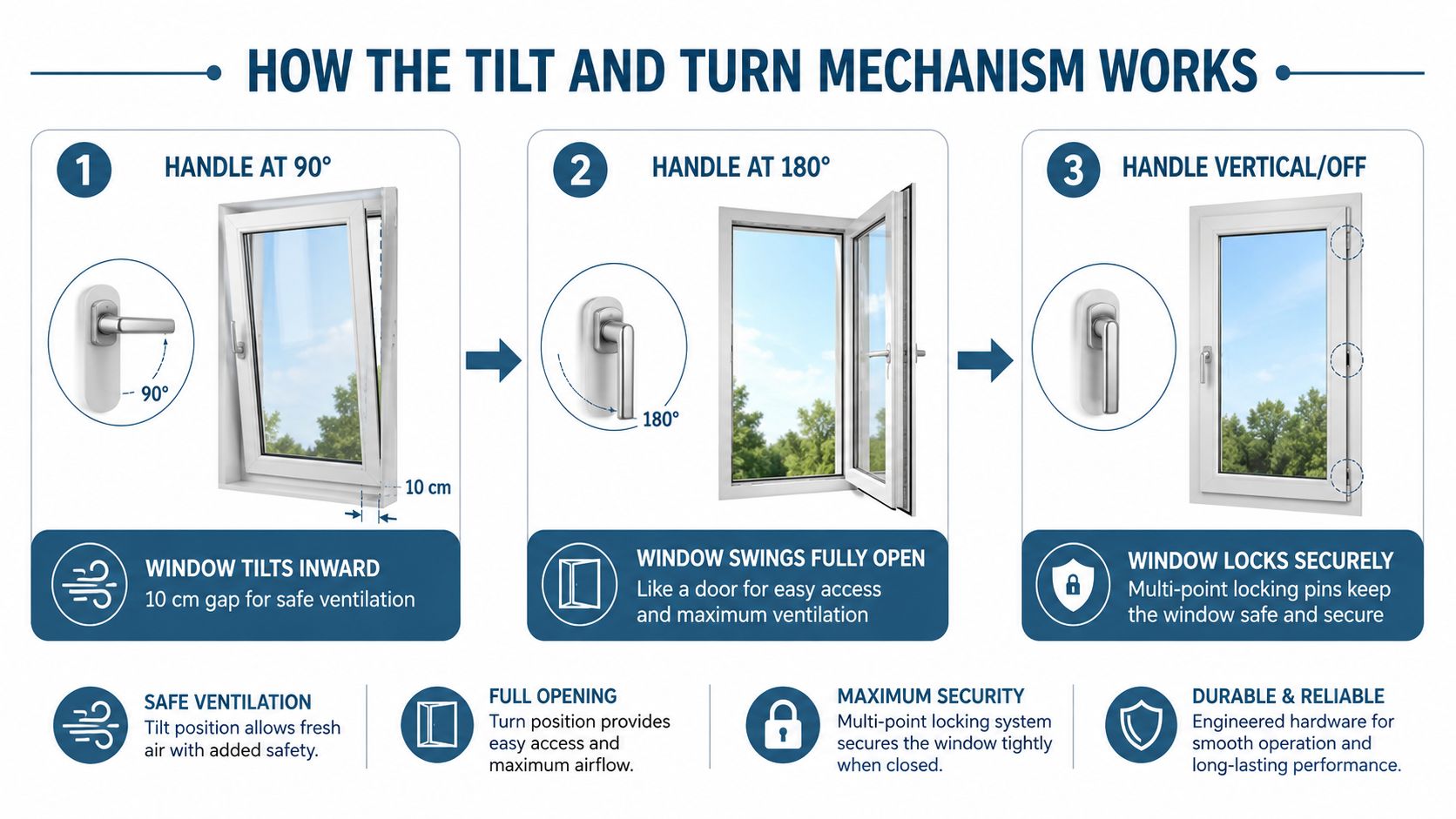
The handle does all the work, but only if the sash and frame are built correctly. In the closed position, the handle sits vertical or down depending on the hardware set, and the lock engages around the perimeter. Turn the handle to the tilt position, and the top of the sash opens inward while the bottom edge stays anchored. Turn it again, and the sash swings fully inward for access to both sides of the glass.
Three positions, three different uses
The tilt position is the one homeowners use most often when they want safe, partial ventilation. It's the right move for a bedroom at night, a bathroom that needs continuous airflow, or a day when the weather is unsettled and you don't want a wide-open sash catching rain. The opening is narrow enough that it's not functioning like a standard entry point, which is why people often prefer it in upstairs rooms and around children.
The turn position is for full access. You open the sash inward like a door, which makes exterior cleaning from inside the room straightforward. On a second-story wall, that's not a luxury. It's the difference between cleaning the glass yourself and relying on ladders or professional service.
The locked-closed position is where the engineering shows up. Quality tilt-and-turn systems use multi-point peripheral locking and compression seals on all four sides, which is why airtightness is usually better than a single-latch window. One commercial specification in the verified data showed air leakage of ≤ 0.5 L/s·m², water tightness ≥ 600 Pa, and wind load resistance ≥ 4000 Pa, with the compression seal geometry cited as the reason for those results (commercial performance specification).
That's a key advantage. The handle is just the interface. The value comes from how the frame, seals, and locks work together under pressure.
Why Homeowners Choose Tilt and Turn Windows

A homeowner in Texas usually starts with a practical question. Will the window let air move without turning the room into a security or weather problem, will it seal hard enough to hold conditioned air, and will it still be easy to live with after the first season of dust, heat, and storms? Tilt-and-turn windows get attention because one unit answers those questions with one hardware system.
The appeal starts with ventilation. In the tilt position, the sash opens just enough to bring in fresh air without exposing the room the way a full-open window does. That is useful in a bedroom, a nursery, or any room where you want air movement but do not want a wide opening that invites rain, debris, or unwanted access. The opening also stays controlled, so you are not depending on a screen to do a job it was never meant to do.
Security and weather control come from the same built-in logic. Quality tilt-and-turn units use multi-point locking and compression seals that pull the sash tight around the perimeter, which is a very different setup from a basic single-latch window. That hardware matters in Texas, where wind-driven rain and sudden weather swings punish weak closures. In the verified data, tilt-and-turn products are shown with tighter air leakage values than typical sliders, which is one reason they are specified where air sealing is part of the job (market and performance data).
Thermal performance is the other half of the argument. Published product data show strong thermal performance when the frame and glazing package are specified correctly, including systems with low U-values in triple-glazed builds and other datasheets showing higher, but still competitive, ranges depending on the glass package (thermal performance data). For homeowners comparing options, a clearer U-factor vs R-value guide helps explain why a tighter window assembly matters as much as the wall insulation around it. In plain terms, a window that seals well helps keep conditioned air where it belongs, and that is a significant issue in hot climates.
The cleaning benefit is not a marketing gimmick. When the sash turns inward, you can reach the exterior glass from inside the room, which makes a big difference on upper floors and on walls that are hard to access from outside. Homeowners notice that fast, usually after the first time they skip a ladder or service call.
The cost case is simpler than most sales brochures make it sound. You pay more upfront than you usually do for basic double-hung or sliding windows, but you are buying a heavier operating system, stronger sealing, and better day-to-day function. For the right opening, that premium makes sense because it reduces compromise. For a room where clearance is tight or the frame is poorly detailed, the premium is wasted, which is why specification and installation matter as much as the unit itself.
Homeowners choose them not for style, but for control. They want a window that ventilates safely, locks down tightly, cleans easily, and performs like a serious building component instead of a lightweight compromise.
Tilt and Turn Windows Versus Common Texas Alternatives
Here's the comparison buyers need. If you are choosing between tilt and turn windows, double-hung, casement, and sliding units, the right choice depends on the opening, the room layout, and what problem you are trying to solve.
| Criterion | Tilt and Turn | Double-Hung | Casement | Sliding |
|---|---|---|---|---|
| Airtightness | Strong when properly specified | Usually moderate | Often strong | Typically weaker than tilt-and-turn |
| Wind-driven rain resistance | Strong because of compression seals | Depends on product and install | Strong when shut tightly | Often less favorable in rough weather |
| Interior clearance | Needs inward swing space | Minimal | Needs outward swing space | Minimal |
| Cleaning | Easy from inside | Can be awkward upstairs | Usually easier than sliders, but still limited | Easier than double-hung, but not as cleanly as turn-open units |
| Upfront cost | Higher | Usually lower | Often lower than tilt-and-turn | Usually lower |
Where each style wins
A double-hung window still makes sense when a homeowner wants familiar operation and little interference inside the room. A sliding window fits spaces where inward or outward swing is a problem. A casement is a solid middle ground when outward projection is acceptable and the opening needs good ventilation.
Tilt-and-turn wins when you want tight sealing, safe partial ventilation, and easy cleaning from inside the house. It also fits rooms where an outward-opening sash would be a problem, because the movement stays inward. It loses when furniture, blinds, or curtains sit too close to the opening, or when the room layout leaves no room for the sash arc.
The price tradeoff is real. A comparable tilt-and-turn unit can cost 30% to 40% more than a similar slider according to the verified data, and another independent guide puts the premium over standard windows in the 20% to 40% range in the UK, while a U.S.-oriented source says homeowners should expect 40% to 60% more than mid-range American windows (price tradeoff discussion). That is the hardware and sealing system you are buying, not a cosmetic upgrade.
Use the premium where it solves a real problem. Do not spend it on an opening that could be served just as well by a simpler window.
If you are comparing styles across a whole house, This Texas window replacement guide helps you weigh the options room by room.
Fitting Tilt and Turn Windows Into U.S. Homes and Texas Projects
The biggest mistake on U.S. jobs is treating these like a direct swap for a typical American replacement window. They aren't. A U.S.-focused guide notes that tilt-and-turn units are heavier than typical replacements, are often installed into rough openings more like doors, and need careful measurement plus perimeter weatherproofing, while another discussion points out the clearance conflicts with blinds and curtains and the need for interior swing room (U.S. homeowner guide).
The fit check I'd run before ordering
Start with the room, not the catalog. If a sofa, desk, or dining chair sits within the swing path, the inward-open sash is going to annoy the homeowner every single day. If blinds are mounted tight to the casing, they may interfere with the operation unless the layout is planned around the hardware.
Texas weather raises a second issue, the install has to be tight and disciplined. Heat, sun exposure, and severe storms punish sloppy perimeter sealing, so the rough opening, flashing, and insulation details matter as much as the window itself. That's especially true on retrofit work, where the existing frame condition can make a good product perform badly if the opening isn't corrected first.
Practical rule: if the sash can't swing fully without touching furniture, shade hardware, or trim, don't force the spec.
New-construction installs give you more freedom because the framing can be laid out around the unit from the start. Retrofit jobs demand more compromise, and in many older Texas homes, that means some openings are better candidates than others. Bedrooms, upstairs baths, and second-story walls usually make more sense than tight living room elevations packed with furniture and window treatments.
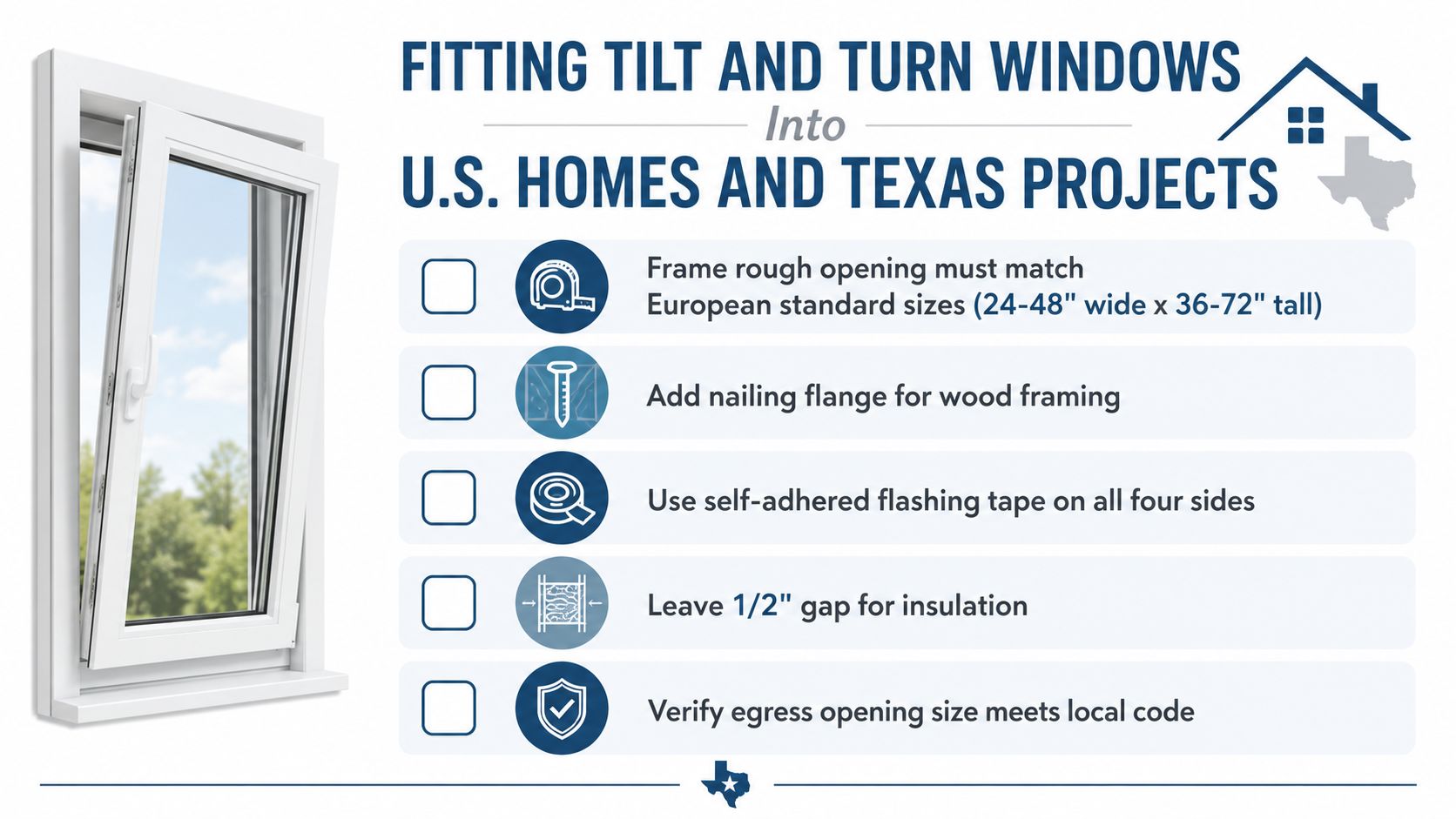
If you're ordering for a project, I'd use tilt-and-turn where the room benefits from secure ventilation and inside-the-room cleaning, then leave the simpler openings to simpler window types. That's the cleanest way to keep the budget under control without giving up the performance where it matters.
Cost, Maintenance, and the Long-Term Cost of Ownership
A lot of marketing copy makes tilt-and-turn windows sound like a permanent upgrade with no downside. That is not how ownership works. The upfront price is higher, the hardware is more complex, and the long-term cost conversation has to be honest from the start.
What the Premium Buys
A comparable tilt-and-turn window can cost 30% to 40% more than a similar slider because of the added hardware and sealing system (market and performance data). Another independent guide says the premium is roughly 20% to 40% in the UK, while a U.S.-oriented source puts it at 40% to 60% more than mid-range American windows (disadvantages and cost discussion). That spread tells you what you already know if you have priced them on real jobs, these are not budget units.
You are paying for better hardware, better sealing, and usually better thermal and air-leakage performance when the system is specified correctly. You are also paying for more complexity. A dual-function mechanism has more moving parts than a simple latch window, which means repair work is more specialized when something goes out of adjustment.
Maintenance is Manageable, but Do Not Ignore It
Most opening and locking issues on these windows are not catastrophic. They often come down to alignment, lubrication, or a mechanism that needs to be reset rather than replaced. Still, the hardware needs attention, especially if the home sits in heat, dust, and storm exposure, which is most of Texas.
Check the sash, not just the glass. If the hardware starts dragging, the window is telling you before it fails.
The practical ownership question is simple, can you get service and parts when you need them? If you cannot, the premium becomes harder to justify. I would rather see a homeowner spend more on a well-supported system than save upfront on a design nobody can service later.
If drafts are already a problem in your house, this guide to stopping window drafts will help you judge whether replacement is necessary or whether the issue is mainly sealing and adjustment.
How to Specify and Maintain Tilt and Turn Windows
Order these windows like a specifier, not like a shopper. Ask for the frame profile depth, the glazing package, the hardware brand, the multi-point lock count, and the published air and water test results. If the supplier can't answer those questions clearly, keep looking.
What to confirm before you sign
Measure the rough opening carefully, then check the interior swing path, trim depth, blind clearance, and furniture placement. If the room can't absorb the inward arc, the window isn't right for that opening, no matter how good the thermal numbers look. For Texas projects, also ask how the unit will be flashed and sealed at the perimeter, because the best sash in the world won't save a sloppy install.
If you're comparing suppliers, ask whether they support both product supply and installation. Breaking Glass Co. does that, and it offers European tilt-turn windows as part of its window and door lineup for Texas projects and nationwide shipping. That matters because accountability is cleaner when the seller and installer are aligned on the same order.
Keep the hardware alive
Use a simple routine, not a complicated one. Clean the frame and glass with mild soap, inspect the weatherstripping before winter, and lubricate hinges and locks with silicone spray on a regular schedule. If the handle feels stiff or the sash no longer pulls in evenly, don't force it.
A short homeowner checklist
- Confirm fit first. Make sure the sash can swing without hitting trim, blinds, or furniture.
- Verify the seal package. Ask how the frame compresses on all four sides.
- Keep the hardware clean. Dust and grit shorten the life of moving parts.
- Inspect before cold weather. Cracked or flattened seals should be replaced early.
- Document the supplier response. If they can't explain the lock and seal system, move on.
When you get the specification right, tilt-and-turn windows are easy to live with. When you skip the fit check or the service plan, they turn into an expensive lesson.
If you want a straight answer on whether tilt and turn windows make sense for your Texas home or project, Breaking Glass Co. can help you compare the opening, the hardware, and the install before you order. Visit Breaking Glass Co. to request a quote and get a spec that fits the room, the climate, and the long-term maintenance plan.