
Most homeowners compare window installation quotes by circling the lowest total. That's the wrong starting point. A cheap number often reflects a smaller scope, not a better deal, and the missing work appears later as disposal charges, trim repairs, weatherproofing, permit fees, or change orders.
A reliable quote tells you what the contractor will install, how the opening will be prepared, who performs the work, and what the price excludes. That matters especially in Texas, where heat, sun exposure, storms, and air leakage put real demands on the window package and the installation itself. Judge the estimate by its scope and risk, not by the headline price.
Table of Contents
- Why the Lowest Bottom Line Is Often a Trap
- Anatomy of a Professional Window Estimate
- How Field Measurements Shape the Final Price
- Insert Versus Full-Frame Replacement Costs
- Factoring Energy Performance Into the Quote
- Critical Questions to Ask Before Signing
- The Breaking Glass Co Same-Day Quote Process
Why the Lowest Bottom Line Is Often a Trap
A low window installation quote can be perfectly legitimate, but it can also be incomplete. The number may cover only the replacement unit and basic labor while leaving removal, disposal, interior trim, exterior trim, sealants, insulation, flashing, permits, and cleanup outside the contract. Homeowner guidance identifies water damage, structural damage, pest damage, disposal, trim work, permits, cleanup, and weatherproofing as potential additions ranging from hundreds to several thousand dollars, depending on site conditions. Renewal by Andersen's guide to unexpected window replacement costs also recommends budgeting 15% to 20% above the initial quote as protection against surprises.
That doesn't mean you should automatically approve the most expensive proposal. It means you should stop comparing totals until each contractor has defined the same work. A quote for insert replacements isn't directly comparable with one for full-frame tear-outs, even if both proposals list the same number of windows.
Practical rule: Treat every blank line in an estimate as a possible future charge.
Read exclusions before inclusions
The exclusions section deserves as much attention as the product description. Ask whether the quoted amount includes:
- Old window removal: Confirm who removes the existing units, screens, fasteners, and debris.
- Disposal: Some contractors remove the windows but charge separately to haul them away.
- Opening repairs: Rot, deteriorated framing, pest damage, or structural movement may require carpentry.
- Interior and exterior finishes: Casing, drywall repair, sill extensions, siding, stucco, and paint can sit outside the base installation.
- Weatherproofing materials: Look for flashing, backer materials, sealants, insulation, and other installation components.
- Permits and compliance: Establish whether permit fees, inspections, and code-related adjustments are included.
- Cleanup: Written scope should identify who removes packaging, glass fragments, and construction debris.
A contractor who identifies these items before work begins is giving you useful risk information, even if the initial total is higher. The contractor who omits them may appear cheaper while shifting the uncertainty onto you.
Compare scope, not sales language
The best quote is usually the one you can explain line by line. You should know the window type, frame material, glass package, installation method, labor, finishing work, taxes, warranty, payment terms, and contingencies. If two estimates use different terminology, ask each installer to rewrite the proposal in comparable categories.
A low price with vague exclusions is not value. It's an unfinished budget.
Anatomy of a Professional Window Estimate
A professional estimate separates the window unit, installation labor, and site-specific additions. That structure lets you identify whether the price difference comes from a better product, a more demanding installation, or work that another contractor left out.
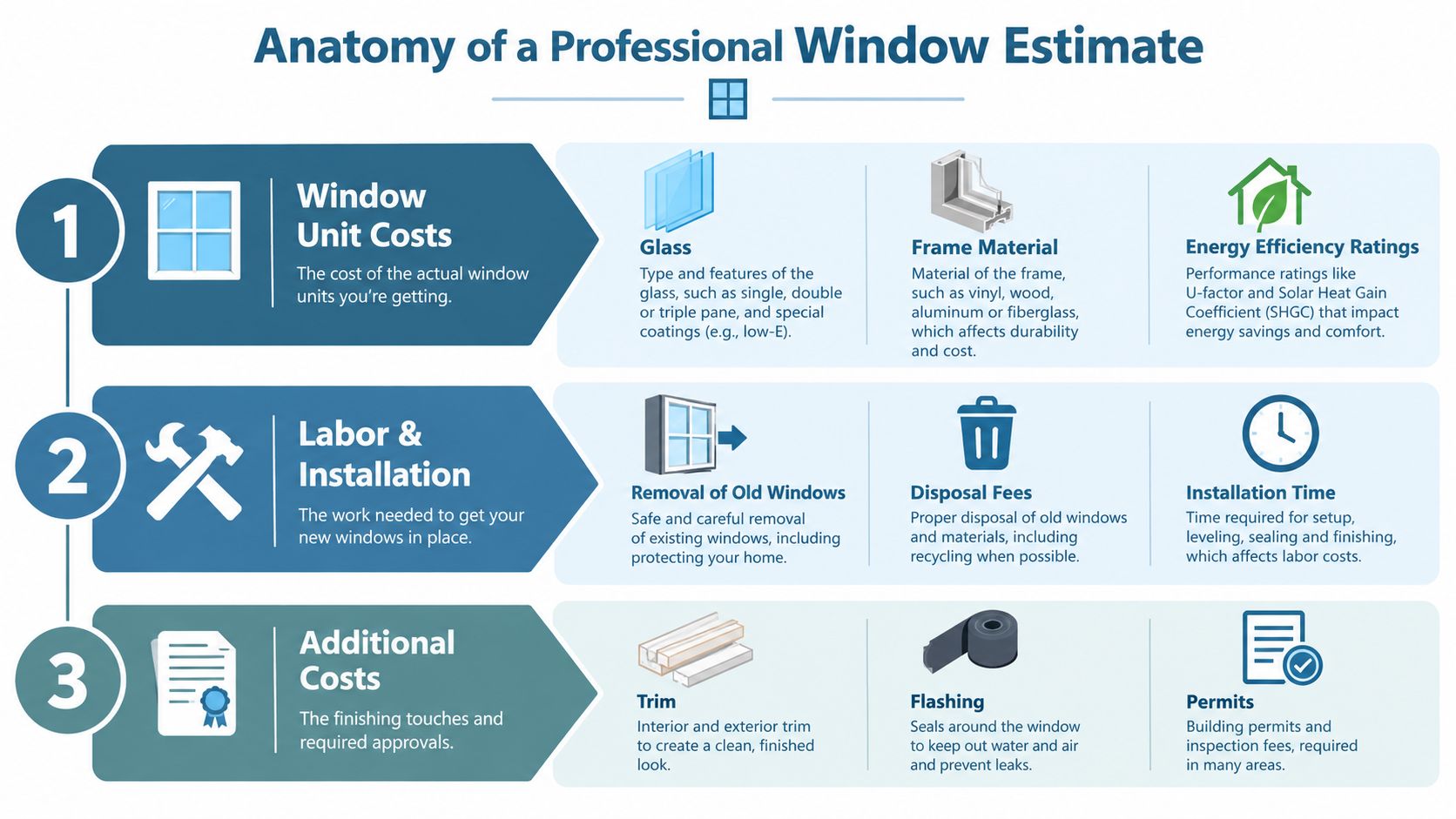
Window unit costs
Start with the actual product specification. The estimate should name the window style, operating configuration, frame material, glass package, color, hardware, screens, grids, and performance data. “Energy-efficient window” is sales language, not a complete specification. Ask for the manufacturer, series, glass construction, and applicable NFRC performance information.
Historical consumer guidance has placed professional replacement of one window around $800, with a broad range of approximately $300 to $3,000, depending on size and type. Consumer Reports also cited installation costs of $100 to $300 per window in one marketplace estimate, while a full-home project for an average one-story house could reach roughly $8,000. More recent consumer-market estimates cited in the same verified guidance place the national average closer to $850 to $1,047 per window installed. These figures are useful benchmarks, not substitutes for a site-specific estimate. Consumer Reports' replacement-window buying guide explains why product mix and installation scope can move the price sharply.
Labor and installation
Labor should identify whether the installer is removing the existing unit, preparing the opening, setting the new frame, insulating, sealing, flashing, adjusting hardware, and completing finish work. Ask whether the quoted labor covers standard conditions only, and how the contractor handles concealed damage.
The estimate should also state whether the work is performed by the quoting company, an employee installation team, or a subcontractor. Responsibility matters because a product warranty may not cover installation errors, while an installation warranty may depend on who completed the work.
Additional costs
The third category includes items that vary by house rather than by window model. Common examples include difficult access, unusual opening geometry, structural repair, trim replacement, siding or masonry work, permit administration, and disposal. A detailed window and door schedule can help builders and remodelers coordinate sizes, types, locations, and specifications before ordering. Use a window and door schedule to organize project information rather than relying on scattered notes or verbal assumptions.
A good estimate makes these variables visible. It doesn't hide them inside a single per-window figure.
How Field Measurements Shape the Final Price
A contractor shouldn't finalize a window installation quote from rough dimensions copied from an old plan or supplied by a homeowner. Existing openings rarely behave like perfect rectangles, and the replacement frame must fit the actual opening while leaving room for adjustment, insulation, and weather management.
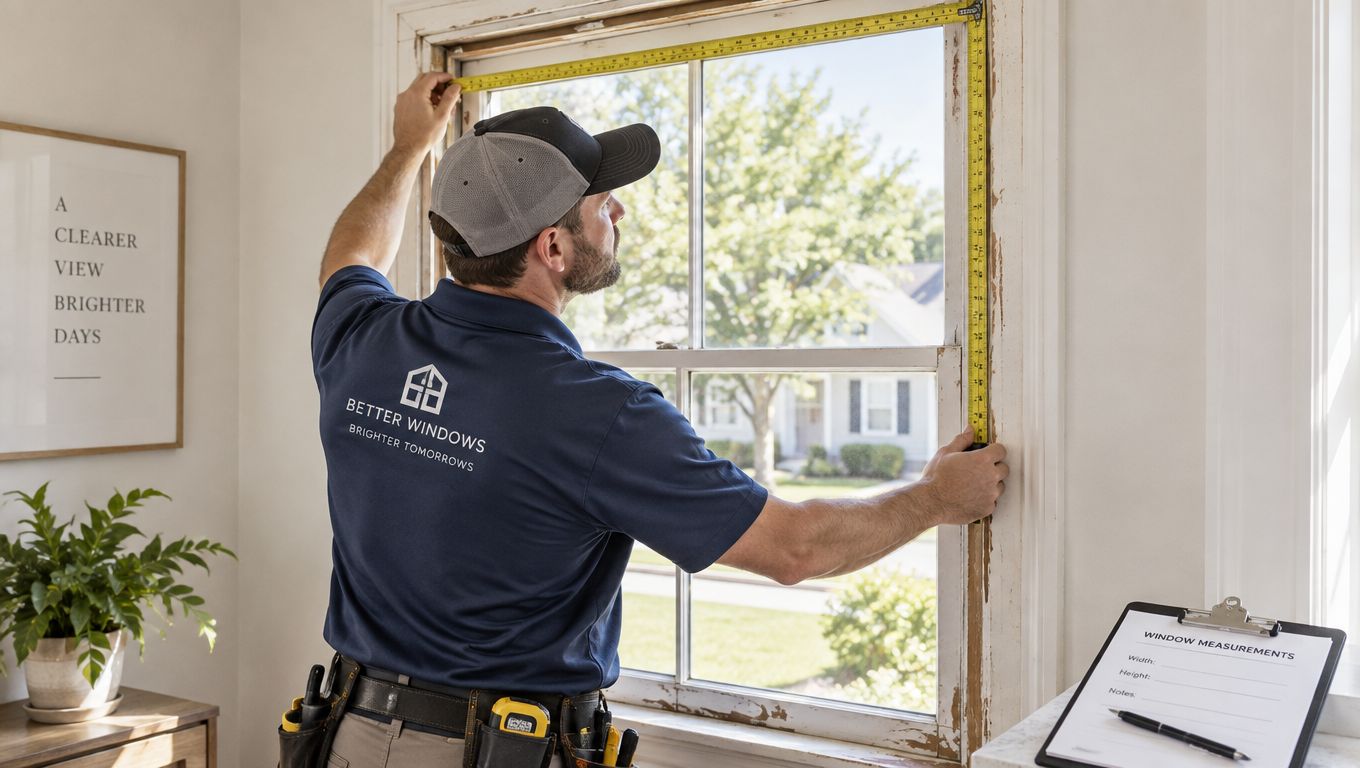
What the installer should measure
A disciplined field survey starts with the opening, not the preferred product. Installers commonly measure width and height at three points, then use the smallest measurement. They also check the diagonals to identify an opening that isn't square. Cloudy2Clear Windows' survey guidance describes this approach and explains why the smallest dimensions protect the fit.
The technician should inspect the sill, jambs, head, exterior cladding, interior trim, drainage path, and surrounding finishes. They should also record access conditions, floor height, nearby landscaping, roof extensions, security restrictions, and any obstacle that changes installation time.
The installation gap is part of the design
The replacement frame does not fill every millimeter of the opening. Installers need an installation gap so they can plumb and level the frame, accommodate thermal movement, insulate around the perimeter, and complete flashing and sealant work. Industry guidance commonly places perimeter gaps around 8 to 20 millimeters, depending on frame material and movement requirements. ROPO Windows' opening and installation-gap guidance explains why the gap affects fit and installation performance.
An estimator who ignores that allowance may order a unit that's too large, then discover the problem at delivery. The resulting correction can involve reordering, additional labor, damaged finishes, or a rushed field modification. None of those outcomes represent a real saving.
For a practical reference, review this guide to measuring window size before requesting proposals, but don't treat homeowner measurements as a substitute for a professional survey. Your measurements help start the conversation. The contractor's field verification should control the final order.
The measurement process also determines whether an insert replacement remains viable or whether the opening needs more extensive preparation. Watch the installation sequence below, then ask the estimator to connect each observed condition to a specific line item in the proposal.
If the technician finds an out-of-square frame, deteriorated substrate, or inaccessible exterior, the quote should explain the effect on labor and materials. A careful survey doesn't merely improve ordering accuracy. It makes the price defensible.
Insert Versus Full-Frame Replacement Costs
Insert and full-frame replacement are different construction methods, not two labels for the same job. An insert, sometimes called a pocket replacement, fits a new window inside the existing frame. A full-frame replacement removes the window and the surrounding frame so the contractor can inspect and rebuild the opening more completely.
The installation method changes labor, finish work, insulation access, and the amount of uncertainty in the estimate. That's why two contractors can quote different totals for the same glass package without either one making a mathematical mistake.
| Feature | Insert Replacement | Full-Frame Replacement |
|---|---|---|
| Existing frame | Retained if it's sound, square, and suitable | Removed so the opening and surrounding components can be inspected |
| Typical scope | New window fitted into the existing frame | New unit, frame, and related opening preparation |
| Interior finish | Often preserves existing trim and finishes | May require new casing, extensions, drywall, or paint |
| Exterior finish | Usually limited disruption around the existing frame | May involve siding, stucco, brickmould, flashing, or cladding repairs |
| Insulation access | More limited because the existing frame remains | Greater access around the rough opening |
| Best fit | Sound openings where preserving finishes matters | Rot, water intrusion, structural concerns, remodeling, or size changes |
| Quote risk | Lower when existing conditions are predictable | Higher because concealed conditions and finish work may be exposed |
When an insert makes sense
An insert can be an efficient choice when the existing frame is structurally sound, the opening dimensions work, and the homeowner wants to preserve interior and exterior finishes. It can reduce demolition and shorten the finishing scope. That doesn't make it automatically superior. The retained frame may limit glass area, affect the final appearance, or leave unresolved problems around the original opening.
The estimator should inspect the existing frame rather than assume it's reusable. If water has entered behind the frame, the insert can cover the symptom while leaving the cause in place.
When full-frame work earns its cost
Full-frame replacement is the better fit when the opening contains rot, water damage, movement, pest damage, inadequate insulation, or outdated construction details. It also makes sense when the project changes the window size, exterior profile, or interior finish. Removing the existing frame gives the installer a chance to verify the substrate and build a more complete weather-management assembly.
The tradeoff is a broader labor and finishing scope. Exterior cladding may need repair, interior trim may need replacement, and the project may require more coordination with siding, masonry, drywall, or paint trades.
How to compare the proposals
Ask each contractor to state the method in plain language and identify what remains in place. Then ask which conditions trigger a change order. A credible estimate should explain whether repairs are included as allowances, priced after discovery, or excluded entirely.
Don't ask only, “Which quote is cheaper?” Ask, “Which quote solves the same opening problem?”
Factoring Energy Performance Into the Quote
A Texas window quote should be judged partly by how the assembly handles heat gain, air leakage, solar exposure, and interior comfort. The cheapest glass package may reduce the initial price while doing little to address the reason you're replacing the windows.
Energy performance isn't a single feature. It depends on the glass, coatings, spacer, frame, weather seals, installation gap, perimeter insulation, flashing, and final adjustment. A high-performing unit installed poorly can still leak air or water, while a competent installation helps the specified product deliver its intended performance.
Read the performance information
Ask for NFRC-rated data rather than accepting broad phrases such as “low energy” or “maximum efficiency.” The relevant values depend on the building and climate, but the estimator should be able to explain how the selected package addresses solar exposure and comfort on your elevations.
ENERGY STAR-rated windows are estimated to save homeowners about 6% to 13% on utility bills while improving thermal comfort, according to the verified guidance and its ConsumerAffairs window cost and efficiency resource. The same source cites University of Massachusetts guidance that energy-efficient units can have a payback period ranging from 2 to 10 years. Those figures are general context, not a promise for a particular Texas house.
Texas conditions make the installation details especially important. Strong sun can raise interior surface temperatures, poorly sealed openings can increase cooling demand, and storm exposure can punish weak exterior sealing. A quote should therefore identify the glass package and the installation materials, not merely list a frame color and window count.
Spend where the building needs it
Don't pay for a premium option without understanding its purpose. A high-performance glass package may make sense on heavily exposed elevations, rooms with persistent afternoon heat, or spaces where occupants complain about radiant discomfort. Other openings may benefit more from improved air sealing, better installation, or correcting a damaged sill.
The right question is not, “What is the most expensive window available?” It's, “Which combination of product and installation addresses this opening's actual thermal and weather conditions?”
That approach also protects the project from a common mistake: treating energy performance as a product-only purchase. The quote should connect the selected window to the installation method, perimeter treatment, and site exposure. Comfort savings disappear quickly if the installer leaves gaps around the frame or fails to manage water at the sill.
Critical Questions to Ask Before Signing
A quote becomes useful only when its terms are clear. Before signing, make the contractor turn assumptions into written answers. You're not being difficult. You're defining the work that controls your budget.
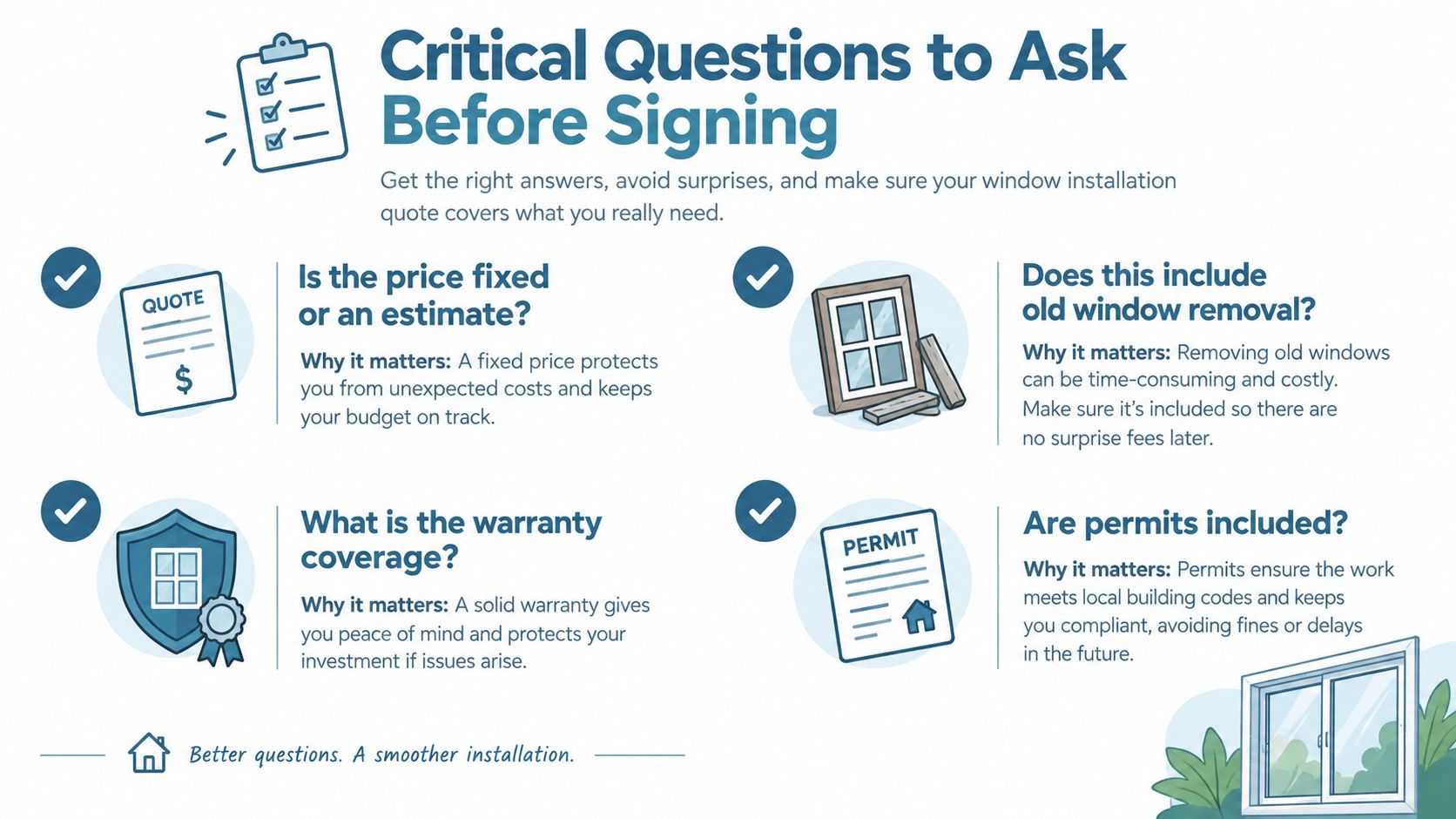
Confirm whether the price is firm
Start with the status of the number. Ask whether the quote is fixed, an estimate, or subject to final measurement, product selection, permit review, or concealed-condition discovery. A proposal can't be treated as firm if the contractor still hasn't verified the openings or selected the final glass package.
Request an itemized document that separates product, labor, removal, disposal, finishing, permits, taxes, and any allowances. Recent quote guidance emphasizes asking about fixed pricing, field measurements, installer identity, NFRC data, warranty support, taxes, payment terms, and permit or compliance costs. Bradley James Windows' installer-question checklist provides a useful model for that conversation.
Confirm the installation scope
Use these questions to expose missing work:
- Who removes the old windows? Confirm whether removal includes frames, screens, fasteners, and protection of nearby finishes.
- Who pays for disposal? A contractor may remove debris without including hauling or disposal.
- What happens if the opening is damaged? Ask for the repair rate, allowance, or approval process for rot, structural damage, pests, or water intrusion.
- Which installation method is included? The contract should name insert or full-frame work and describe preparation.
- Are insulation, sealants, flashing, and weatherproofing included? These materials are part of performance, not optional decoration.
- Are trim and finish repairs included? Identify interior casing, sill extensions, drywall, exterior cladding, stucco, siding, and paint.
- Are permits included? Establish who obtains them and who pays related fees.
- Who performs the installation? Get the company name or crew arrangement in writing.
Confirm product and support
Ask for the manufacturer, series, frame material, glass configuration, hardware, screens, color, and NFRC performance data. Then verify the warranty terms for the product and the installation, including who handles service if the installer and manufacturer are separate businesses.
Payment terms deserve equal attention. The contract should state the deposit, progress payments, balance timing, cancellation terms, delivery expectations, and what happens if materials arrive damaged or incorrect. Don't sign a proposal that leaves taxes, cleanup, or final adjustments ambiguous.
Before signing: If the contractor can't explain an exclusion, don't assume it's included.
The Breaking Glass Co Same-Day Quote Process
A useful quoting process should reduce uncertainty before it creates a price. That means collecting the opening information, project type, product requirements, installation location, and schedule early enough for the estimator to identify missing scope.
For homeowners, a phone or web request can be a practical first step, especially when the project involves replacement windows and the initial questions are straightforward. Builders and contractors need more than a quick number. They need coordinated takeoffs, product specifications, delivery planning, installation responsibility, and warranty support that align with the construction schedule.
The same-day quote process from Breaking Glass Co. is designed around phone and web requests for window and door projects. Request a same-day window quote and provide the project location, opening information, replacement or new-construction status, preferred product details, and installation needs. A fast response doesn't replace field verification, but it can identify the right next step without leaving the project waiting for a vague per-window figure.
What a practical quote workflow should include
A strong process connects speed with scope control:
- Initial project intake: The supplier should identify whether the work is residential, commercial, replacement, or new construction.
- Product matching: The quote should reflect frame material, glass performance, operating style, hardware, and climate demands.
- Measurement review: Existing openings and unusual conditions should be verified before the final order.
- Installation coordination: The proposal should identify who installs the units and what preparation and finish work are included.
- Warranty documentation: Product and installation support should be clear before payment.
- Schedule alignment: Builders and remodelers need delivery and installation timing coordinated with other trades.
For Texas projects, the window package should account for heat, sun exposure, weather, and air-sealing priorities. A supplier that serves both homeowners and construction teams should also be able to distinguish a single replacement opening from a larger takeoff requiring consistent specifications across the project.
The point of same-day quoting isn't to bypass good estimating. It's to get the estimating process moving quickly while preserving the details that determine the final price. Ask for the written scope, verify the field measurements, and compare exclusions before you approve the order.
Breaking Glass Co. supplies residential and commercial windows and doors, provides free same-day quote requests by phone and web form, and supports Texas installation alongside nationwide product shipping. Visit Breaking Glass Co. to request a project-specific quote that addresses the product, opening conditions, installation scope, and warranty support instead of relying on a bare per-window price.