
The most popular advice on modern black windows exterior design is also the least useful, go thin, go dark, go everywhere. A slimmer sightline isn't automatically a better window. In Texas, that narrow black frame still has to handle solar heat gain, frame expansion, finish fading, wind load, and the quality of the rough opening behind it. If you choose the profile from a showroom sample and ignore orientation, you'll get the look in April and the callbacks in August.
Treat each opening as a complete facade system. Frame material, glass package, spacer, thermal break, hardware, grid pattern, shading, and installation clearance work together, and a weakness in one part undermines the rest. Black can sharpen white stucco, stone, brick, or board and batten, but it can also expose uneven reveals, cheap grids, and distorted vinyl faster than a light color would.
The eight strategies below aren't interchangeable versions of the same trend. They cover different operating styles, budgets, maintenance expectations, and Texas exposures, from practical laminated vinyl for replacement work to steel-look casements, fiberglass for difficult elevations, and high-performance tilt-turn units. Pick the system that fits the wall first. Then decide how black it should be.
Table of Contents
- 1. Black Steel-Look Casement and Awning Windows
- 2. Black Aluminum-Clad Wood Windows
- 3. Black Fiberglass Windows
- 4. Black Vinyl Windows with Exterior Laminate
- 5. European Tilt-Turn Black Windows
- 6. Black Grid and Simulated Divided-Lite Windows
- 7. Black Floor-to-Ceiling and Large-Format Picture Windows
- 8. Black Multi-Point Locking Casement and Security-Focused Windows
- 8 Modern Black Window Exterior Styles Compared
- Choose the Window Before Choosing the Black Finish
1. Black Steel-Look Casement and Awning Windows
Steel-look windows remain popular because they're built around proportion, not novelty. Dark frames were tied to iron and steel construction in nineteenth-century industrial buildings and early twentieth-century factories, and design history placing dark frames in European buildings centuries before white frames became fashionable around the 1840s explains why the profile still suits modern, traditional, and industrial homes. The effect is crisp geometry around large glass, not a coat of fashionable paint.
Crittall-style steel windows in early Modernist and Arts and Crafts buildings set the reference point, with thin sightlines, black paint, and regular divided lites. Most Texas homes don't need actual steel to get that language. Thermally broken aluminum or fiberglass casements with simulated divided lites provide narrower profiles than standard vinyl, better structural stiffness, and more reliable insulated glazing. Contemporary farmhouse remodels and modern cottages often use this approach across the front elevation, then simplify the rear with undivided glass.
The showroom version below pairs black frames with light stucco and stone, a combination that works when the openings are aligned and the trim doesn't fight the window for visual weight.

How to Specify It in Texas Heat
Casements seal tightly when closed because the sash compresses against the frame, which helps with air leakage. Awnings work well high on a wall, over a sink, or on shaded rear elevations where you want ventilation without opening a large sash into a walkway. Don't use a steel-look grid on every small bathroom window just for consistency, since tight grids can make modest openings feel busy.
- Frame construction: Choose thermally broken aluminum or fiberglass rather than unbroken metal for west and south elevations.
- Glass: Specify low-E, argon-filled double-pane glazing matched to the room's exposure and shading.
- Finish: Get the dark powder-coat warranty in writing, including fade, chalking, and peeling terms.
- Layout: Keep muntin spacing consistent across grouped units so horizontal rails line up from the street.
2. Black Aluminum-Clad Wood Windows
Aluminum-clad wood solves a specific problem. Homeowners want warm oak, pine, or painted wood inside, but they don't want exterior repainting or a plastic-looking frame facing the street. A factory-applied aluminum exterior gives you a crisp black surface and stronger weather protection, while the interior remains real wood that can be stained or painted to match millwork.
This is the natural choice for premium new construction, custom homes, and modern-traditional remodels where interior trim matters as much as curb appeal. Black-clad casements and picture windows pair well with limestone, painted brick, and natural oak cabinets because the exterior stays graphic while the interior avoids a harsh black rectangle in every room. That's often a better long-term compromise than ordering black inside and out.
Specification check: Confirm the interior species, stain, casing profile, and screen color before release. Clad-wood orders are expensive to correct after fabrication.
Where the Trade-Offs Appear
Cladding quality matters more than the word aluminum. Ask whether the metal is roll-formed or extruded, how corners are joined, and whether the black finish is covered for fading under intense UV. Some warranty programs treat dark exterior colors differently, so don't assume the standard finish language applies.
Protect the units during construction. Mortar, stucco, overspray, and tool scratches show readily on black cladding, and field touch-ups rarely match a factory finish under direct sun. Require protective film to stay in place until exterior trades finish, then inspect each elevation before it's removed.
Clad wood isn't the lowest-maintenance option inside. You'll still maintain interior paint or stain, manage indoor humidity, and repair damaged wood if water reaches it. Buy it for appearance, tactile quality, and design flexibility, not because it's maintenance-free. When the budget can't support it across the whole house, use clad wood on public rooms and a compatible fiberglass product on secondary elevations, provided sightlines and colors have been compared side by side.
3. Black Fiberglass Windows
For a hot south or west wall in Texas, fiberglass deserves a serious look. It's dimensionally stable across temperature swings, stiff enough for larger casements and sliders, and less prone to the movement that can stress seals and hardware. BRANZ guidance summarized in climate guidance for dark frames that can exceed 50°C in midsummer sun shows why surface temperature, expansion allowance, and warranty-approved color options matter. The frame may be black, but the engineering behind it determines whether it stays square.
Southwestern replacement projects often use black fiberglass where homeowners want thinner sightlines than vinyl without moving to clad wood. Commercial offices and storefront retrofits also use it when they need a dark, low-maintenance system that can handle repeated thermal cycling. The finish can resemble painted metal from the street, especially with a matte or low-sheen coating.
Questions That Separate Good Fiberglass From Ordinary Fiberglass
Start with the profile and certification data, not the color chip. Review U-factor, SHGC, visible transmittance, air leakage, and structural rating for the exact size and operating style you're buying. A strong small casement rating doesn't guarantee the same performance in a wide slider.
- Finish type: Ask whether black is integral, factory painted, or otherwise applied, and how repairs are handled.
- UV performance: Request the manufacturer's dark-color warranty and any regional restrictions.
- Exposure: Prioritize fiberglass on elevations with limited shade and high afternoon sun.
- Installation: Require proper flashing, backer materials, sealing, and perimeter clearances so thermal movement isn't restrained.
If you're comparing frame construction before you shortlist products, review how a fiberglass window frame is built and where its hardware and weather seals sit. Fiberglass isn't automatically premium. Thin profiles, weak corner joints, and basic glass can still produce an average window. Its advantage appears when stability, finish, and glazing are specified together.
4. Black Vinyl Windows with Exterior Laminate
Black laminated vinyl is often the most accessible route for a full-house replacement, but it's also the option that requires the toughest questions. The black surface is usually a factory-applied exterior laminate, capstock, or wrap over the vinyl profile. Done well, it delivers a clean modern black windows exterior look with efficient insulated glass and familiar operating styles. Done poorly, heat exposes every shortcut.
A field investigation illustrates the risk. In a case study where 12 of 20 warped black vinyl frames were on the south elevation, interior frame faces reached 156°F on a 92°F day, worst sash deflection reached 5/16 inch, and corrective work addressing constrained framing and shimming reduced average deflection to below 1/16 inch. That isn't an argument against all black vinyl. It's evidence that product engineering and installation tolerances decide the outcome.
Best Uses and Hard Limits
Laminated vinyl works well for East Texas replacement projects, shaded elevations, moderate window sizes, and production-builder packages where budget control matters. It's less convincing for very large dark sliders on an unshaded west wall unless the manufacturer specifically engineers and warrants that configuration. Field-painting standard white vinyl black is a different and much riskier decision, since the profile, reinforcement, and finish weren't designed for the added solar load.
Ask for written fade and warp warranty terms for dark colors, not a generic lifetime statement. Confirm the laminate is UV-stabilized, check reinforcement in large meeting rails and frames, and pair it with low-E glass whose SHGC suits the orientation. During installation, shims must support the frame without pinching it, foam must be the correct low-expansion type where specified, and the perimeter needs room for movement. Cheap black vinyl is only inexpensive until a sash stops latching.
5. European Tilt-Turn Black Windows
Tilt-turn windows challenge the assumption that one sash should do only one job. Turn the handle one way and the top tilts inward for controlled ventilation. Turn it another way and the full sash swings inward like a door for cleaning, egress planning where permitted, and maximum opening. In black, the frame reads clean and architectural, while multi-point locking pulls the sash evenly against its seals.
The comparison graphic below is useful context before considering tilt-turn construction, because material choice still matters even when the hardware is more advanced.
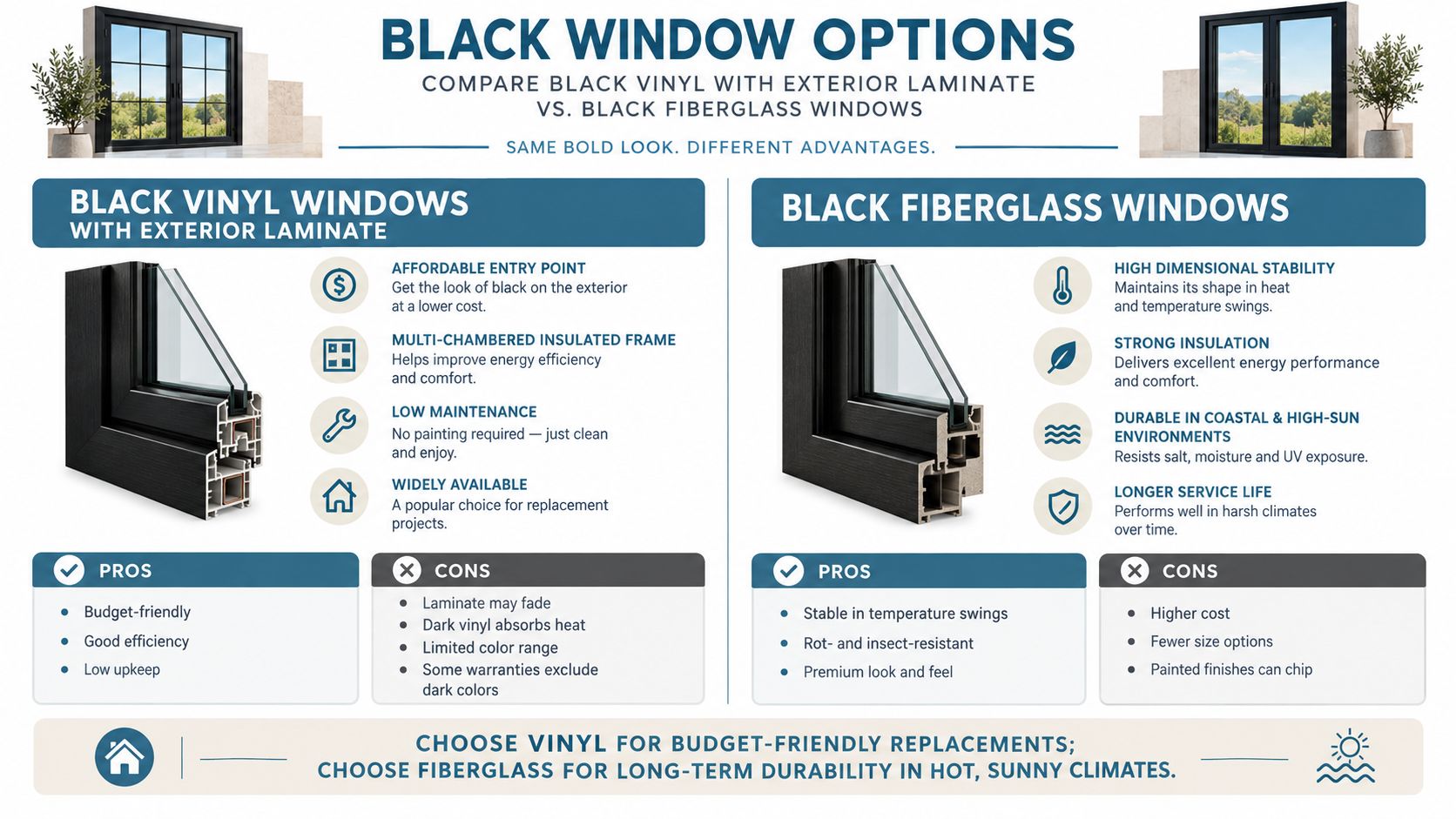
European and Scandinavian homes use tilt-turn units across entire facades, and U.S. high-performance projects specify them for air sealing, security, and flexible ventilation. In Texas, a quality double-pane low-E package is usually the practical starting point. Triple-pane glass can make sense for noise, comfort near the glass, or specific performance targets, but it adds weight and cost, so it shouldn't be automatic in a cooling-dominated climate.
This operating sequence shows why interior clearance needs to be planned before ordering, not discovered when the sash meets a faucet, blind, or bedside table.
Plan the Room Around the Swing
Measure furniture, curtain stacks, countertop depth, and interior shutters against the inward swing. Ask who services the hardware locally, whether replacement handles and hinges are stocked, and what the hardware warranty covers. Guidance on glazing options for temperature control reinforces the broader point that glass, shading, and orientation should be assessed together rather than treating frame color as the performance answer.
If the operation fits your rooms, review available tilt and turn windows by size, glass weight, and hardware capacity. Tilt mode is useful during mild Texas weather, but the best reason to buy this system is the complete seal and locking package.
6. Black Grid and Simulated Divided-Lite Windows
A black frame with no divisions can look like a dark hole on a traditional house. A well-scaled grid gives the glass rhythm and connects modern frames to Prairie, Craftsman, colonial, and farmhouse precedents. The mistake is applying the same six-over-six pattern everywhere because a brochure photo looked good.
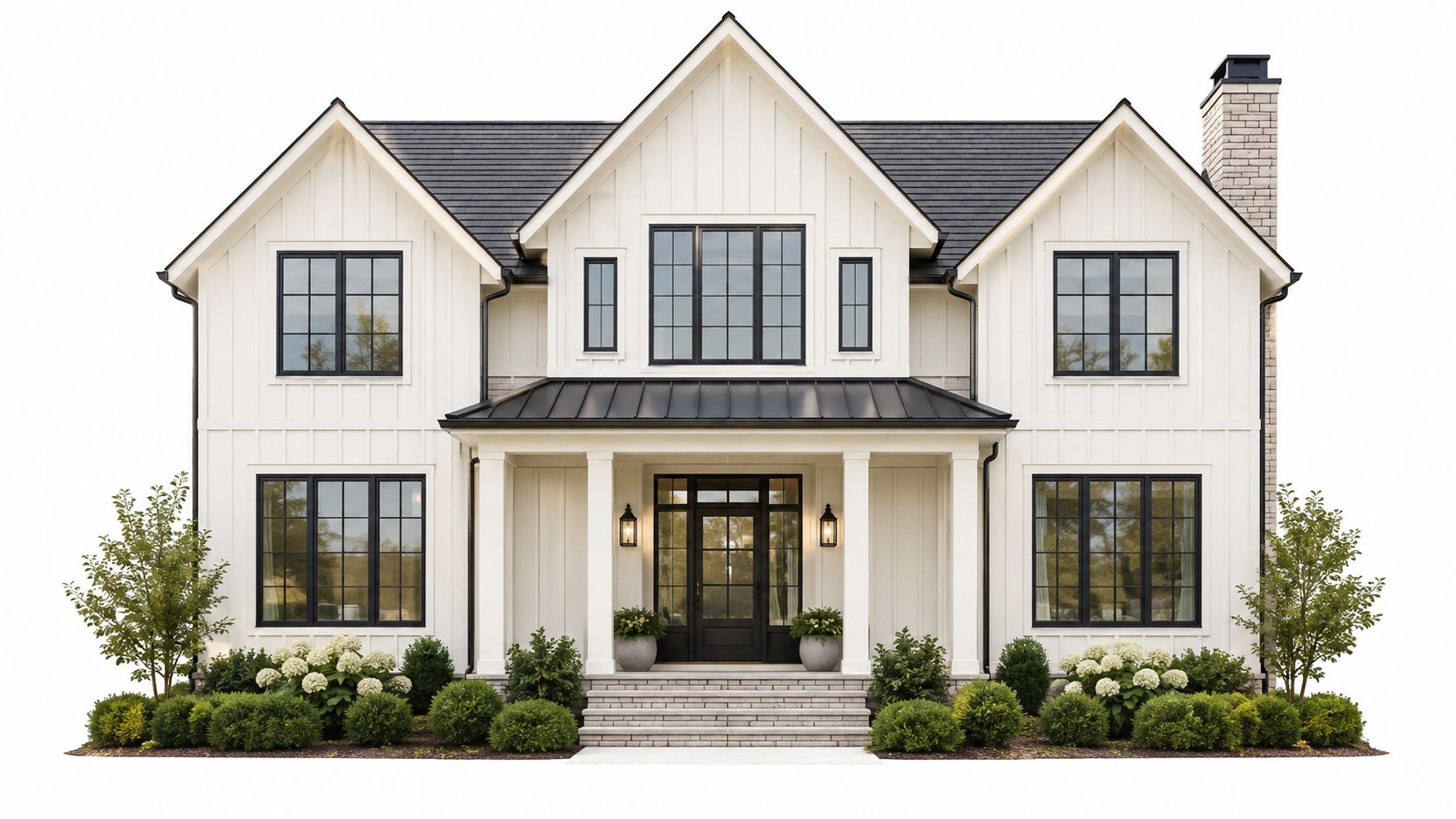
Modern farmhouse remodels often use black simulated divided-lite double-hungs across the front, while transitional homes pair black exterior grids with white interiors and matching door hardware. The farmhouse below works because the window proportions, board and batten spacing, and dark trim all repeat a clear vertical rhythm.
Choose the Grid Construction Honestly
Between-glass grids are easiest to clean and protect from damage, but they can look flat in raking light because there's no exterior shadow. Simulated divided lites place bars on the glass surfaces, often with an internal spacer, creating depth that reads more convincingly from the street. True divided lites use separate panes and are usually reserved for specialized historic work.
Scale is everything. Narrow windows need fewer divisions, tall casements can carry a horizontal rail, and large picture windows may look better with a simple perimeter pattern than a dense colonial grid. Match the pattern to the house, then repeat it consistently on the same elevation. If you're considering applied interior bars or replacement options, compare profiles used for wood grids for windows against the exterior simulated lite so both sides align.
Don't let the grid become decoration pasted onto the wrong window. If the opening proportions are wrong, black muntins will only make the problem easier to see.
Coordinate grids with the front door, garage hardware, light fixtures, and any black railing. A unified palette doesn't require every element to be pure black, but competing charcoal, bronze, and glossy black finishes can look accidental when they're only a few feet apart.
7. Black Floor-to-Ceiling and Large-Format Picture Windows
Large glass is where black frames earn their reputation and where weak specifications become expensive. Floor-to-ceiling fixed units, grouped picture windows, and storefront-style walls use the dark frame as a structural outline against stone, stucco, wood, or concrete. The view expands, interior walls feel less interrupted, and the facade gains a deliberate modern scale.
That uninterrupted glass also admits the most sun. Technical façade research summarized in a study showing light frames reduced solar heat gain by 27% in its tested comparison found that the highest-performing thermally broken frame reduced average heat gain by 61% compared with a dark unbroken frame. The lesson isn't to abandon black. It's to specify the thermal break, spacer, coating, shading, and orientation as one assembly.
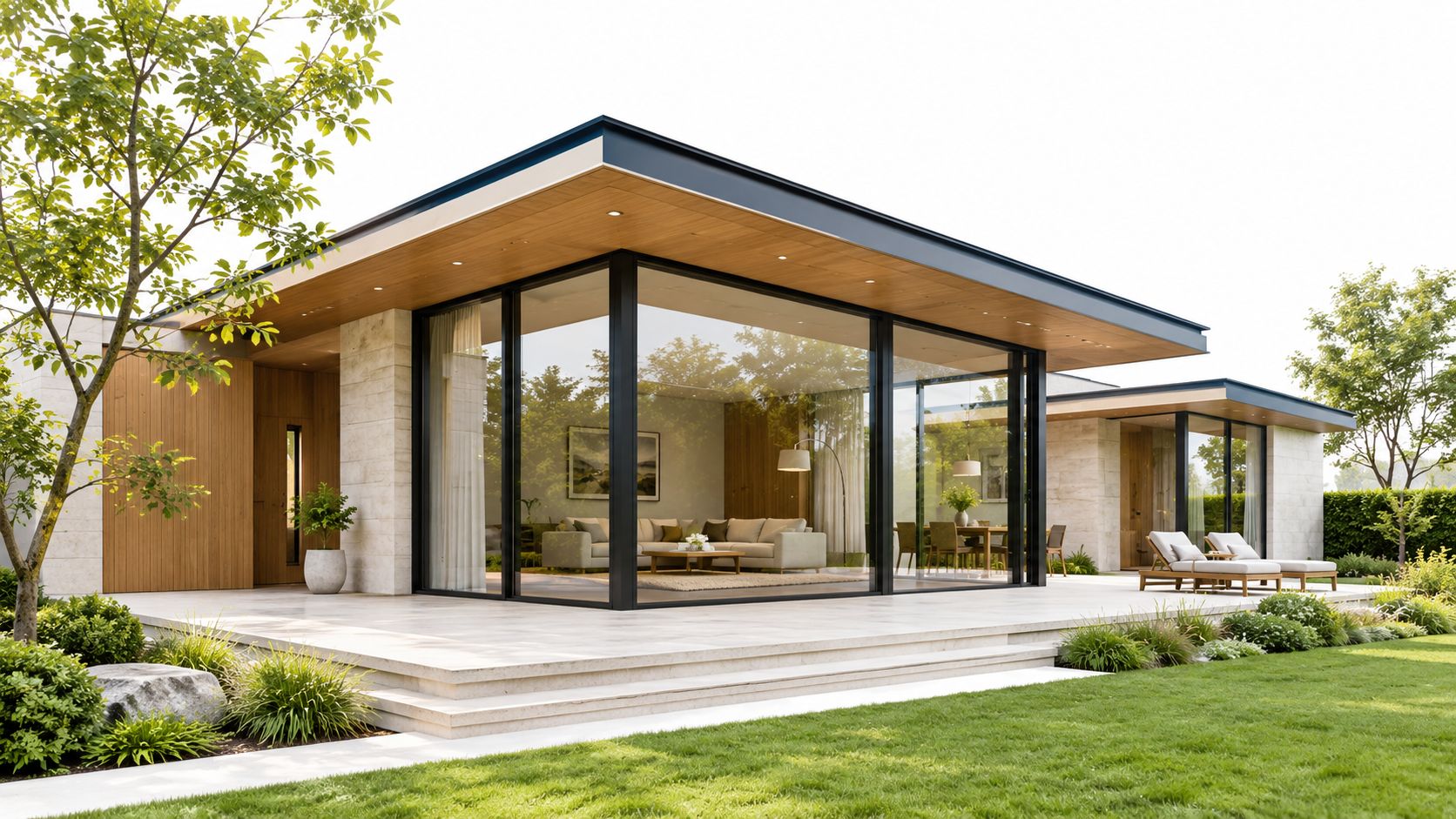
The patio elevation below uses deep cover and large black-framed openings together, which is the right instinct for Texas outdoor living spaces.
Design the Shade Before You Enlarge the Glass
Use low-SHGC low-E glazing on south and west orientations, then add roof overhangs, pergolas, exterior screens, recessed openings, or landscaping where the architecture allows. Interior shades help glare after heat has entered the glass assembly, so they aren't a substitute for exterior control.
Large spans need engineering for deflection and wind load, plus a realistic delivery plan. Confirm sill drainage, header movement, slab edge conditions, lifting equipment, crew size, and replacement access if a pane breaks years later. A dramatic wall that can't be serviced without removing finished trim is a design liability. Break very wide openings into fixed and operable units with aligned rails, and keep at least one practical ventilation path in the room rather than assuming the HVAC system should do everything.
8. Black Multi-Point Locking Casement and Security-Focused Windows
Security-focused black casements appeal to homeowners who want a minimal exterior without relying on a single latch and a thin sash. Multi-point locking hardware engages the sash at several locations, improving compression against the weather seal and making forced movement harder. Reinforced frames and laminated or tempered glass add another layer, although each component solves a different problem and shouldn't be marketed as interchangeable.
Commercial offices use these systems around perimeters where consistent locking and air sealing matter. Residential projects in storm-exposed areas or neighborhoods with security concerns may specify laminated glass, stronger keepers, and reinforced meeting points. The black finish keeps the hardware visually quiet, especially when handles and hinges use a matching dark finish.
Specify Security by Component
Ask exactly what's included. A multi-point lock doesn't make ordinary annealed glass impact resistant, and laminated glass doesn't correct a weak frame anchor. Review the complete load path from sash hardware into the frame and from the frame into the surrounding structure. Installation screws that miss solid backing can undermine an otherwise strong unit.
- Glass: Use laminated glass where impact resistance or retained fragments matter, and tempered glass where safety glazing is required.
- Hardware: Confirm lock points, handle construction, corrosion resistance, and availability of replacement parts.
- Anchoring: Require fasteners and shimming at lock and hinge locations according to the manufacturer's instructions.
- Maintenance: Inspect locks, keepers, hinges, and weather seals annually, then adjust before minor looseness becomes air leakage.
Combine secure windows with exterior lighting, visible entry points, and monitoring where appropriate. Security works as a layered system, not a single upgraded latch. For bedrooms, also verify emergency escape and rescue requirements before selecting fixed units, restrictive hardware, or interior security devices. A safer window still has to function as a code-compliant window.
8 Modern Black Window Exterior Styles Compared
| Window Type | 🔄 Implementation Complexity | ⚡ Cost & Resource Profile | 📊 Expected Outcomes | ⭐ Key Advantages | 💡 Ideal Use / Considerations |
|---|---|---|---|---|---|
| Black Steel-Look Casement and Awning | Moderate; specify suitable hardware and glazing | Moderate to high; custom grids add cost | Slim sightlines and strong daylight; insulation depends on frame design | Clean, high-contrast modern appearance; awnings ventilate in light rain | Contemporary or industrial homes; use thermally broken frames and low-SHGC glass in Texas |
| Black Aluminum-Clad Wood | Moderate; protect cladding during installation | High; wood interiors may need periodic care | Durable exterior with a warm wood interior | Low exterior maintenance and broad style compatibility | Premium custom homes; seal carefully against humidity and storms |
| Black Fiberglass | Moderate; custom colors may extend lead times | Higher than vinyl; low ongoing maintenance | Stable performance across temperature swings | Good insulation and resistance to rot, corrosion, and insects | Sunny, humid, or coastal locations, including Texas |
| Black Vinyl with Exterior Laminate | Low to moderate; verify reinforcement and warranty terms | Low to moderate; widely available | Affordable, energy-efficient replacement option | Low maintenance and broad availability | Budget-focused projects; choose UV-stable laminate for hot, sunny exposures |
| European Tilt-Turn Black Windows | High; requires clearance planning and experienced installers | High; custom or imported units may take longer | Secure ventilation, strong sealing, and high thermal and acoustic performance | Two opening modes and multi-point locking | High-performance homes; plan for inward swing and confirm local service support |
| Black Grid and Simulated Divided-Lite Windows | Low to moderate; pattern and grid type affect installation and upkeep | Varies by grid style; true divided lites cost more | Adds visual structure while reducing unobstructed views | Supports farmhouse, traditional, and transitional designs | Match grid patterns to the home; between-glass grids are easier to clean in dusty areas |
| Black Floor-to-Ceiling and Large-Format Picture Windows | High; requires structural planning and professional installation | High; large glass may require lifting equipment | Maximizes daylight and views but can increase solar heat gain | Dramatic facade and strong indoor-outdoor connection | Large openings and view-focused designs; specify solar control and exterior shading |
| Black Multi-Point Locking Casement and Security-Focused Windows | Moderate to high; hardware may need professional adjustment | Moderate to high; laminated glass adds weight and cost | Improved resistance to forced entry and stronger air sealing | Enhanced security with a contemporary appearance | Security- or storm-conscious projects; combine with lighting and other security measures |
Choose the Window Before Choosing the Black Finish
Start with how the opening needs to work. Casements and tilt-turn units compress their seals and provide strong ventilation control. Sliders suit wide openings where an outward or inward swing would conflict with patios and furniture. Fixed picture windows maximize view but contribute no airflow. Double-hungs may suit a traditional elevation, although their meeting rails and grid proportions need care in black. Operating style affects comfort every day, long after the novelty of the color wears off.
Next, choose the frame for the exposure and budget. Fiberglass and thermally broken aluminum are strong candidates for large or sun-exposed openings. Aluminum-clad wood serves projects where interior wood justifies added cost and care. Factory-laminated vinyl can be practical for replacements and moderate sizes, provided the manufacturer engineers it for dark colors and the installer respects expansion clearances. Steel-look sightlines are achievable in several materials, so don't pay for a profile description without checking the assembly behind it.
Then match glass to each facade instead of ordering one package for the entire house by habit. Review certified U-factor, SHGC, visible transmittance, and air leakage for the actual product configuration. South and west glass usually needs stronger solar control, while shaded north openings may prioritize daylight differently. Large picture windows and sliding doors deserve separate attention because their glass area, frame length, and repeated movement amplify both heat gain and installation errors.
Verify the Details That Determine Service Life
Get finish, glass, hardware, warp, and fade warranties in writing, with dark-color exclusions identified before deposit. Ask whether screens, grids, spacer bars, handles, and exterior trim will match or intentionally contrast. Review shop drawings for rail alignment, grid spacing, egress, tempered locations, and sill conditions. Research on durable window frame finish techniques can help you distinguish a manufacturer-approved finish system from an improvised field coating, which is an important distinction on dark frames in full sun.
Measure existing openings after trim removal where the project allows, check whether walls are square, and document flashing responsibility. Replacement inserts preserve existing frames but reduce glass area and can hide old water damage. Full-frame replacement costs more and disturbs trim, yet it lets the crew correct flashing, insulation, and structural problems. Neither method is universally better. The condition of the wall should decide.
Compare complete systems, not corner samples under showroom lighting. Put frame sections against your siding, stone, roof, and front door in morning and afternoon sun. Request written performance specifications, installation instructions, and a scope that names disposal, trim, sealing, and warranty registration. Breaking Glass Co. is one option for Texas projects that need product selection, measurement, and installation coordinated under one scope. Whoever supplies the windows, hold them to the same standard, the right window first, the black finish second, and no vague promises where written ratings should be.
Breaking Glass Co. supplies and installs residential and commercial windows and doors across Texas, including factory-direct products selected for heat, sun exposure, and modern black exterior designs. Request measurement, written performance specifications, and a quote for your replacement or new-construction project from Breaking Glass Co.